
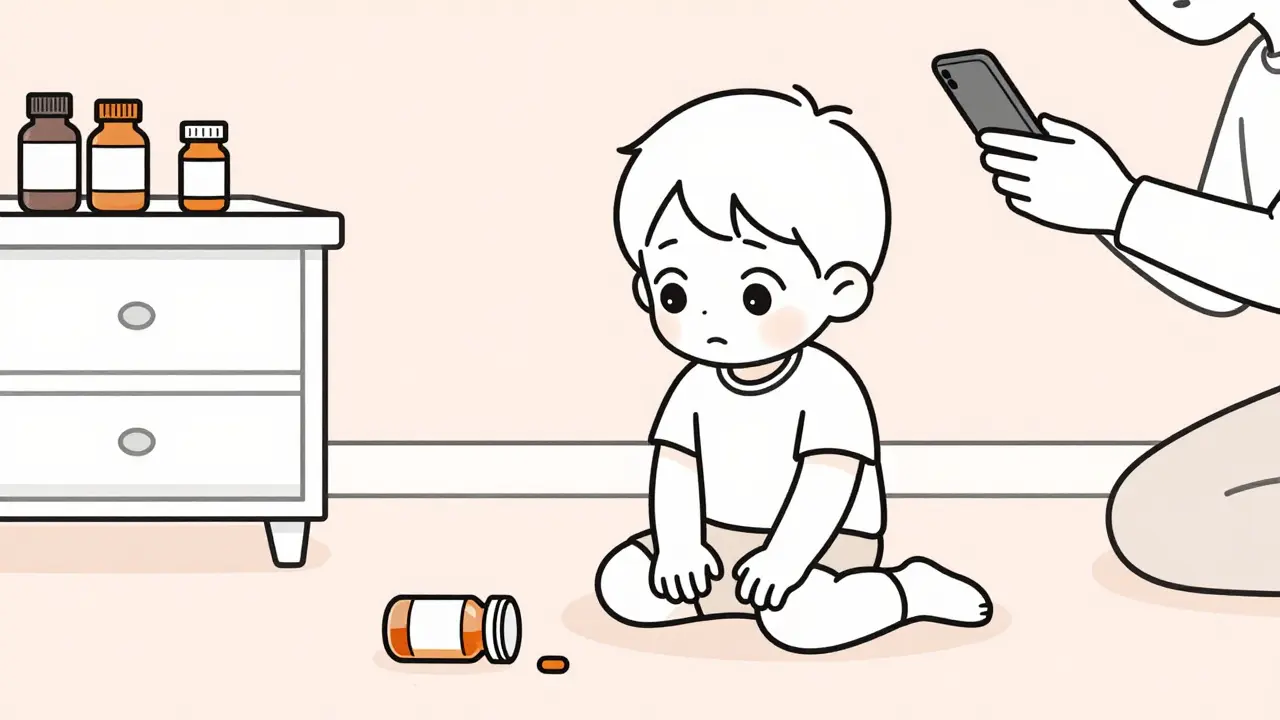
When a child accidentally swallows too much medicine, it’s not just a scare-it’s a medical emergency. Kids don’t process drugs like adults. Their bodies are smaller, their organs are still developing, and even a small extra dose can cause serious harm-or death. You might think you’re being careful, but pediatric medication overdose happens more often than most parents realize. In fact, children under six account for nearly half of all drug exposures reported to poison centers in the U.S. Every year, over a million cases are logged. Many of these happen right at home, from medicines left within reach, mistaken for candy, or double-dosed because caregivers didn’t realize two different products contained the same active ingredient.
What to Look For: Common Signs of Overdose
The symptoms of a drug overdose in a child vary wildly depending on what was taken. That’s why you can’t wait for a clear sign before acting. Some overdoses show up fast. Others creep in silently. Here’s what to watch for, broken down by type of medication.Opioids (like oxycodone, hydrocodone, or fentanyl) can shut down breathing. Look for:
- Pupils that look like pinpoints
- A body that goes limp, like a ragdoll
- Unresponsiveness-even if the child’s eyes are open
- Slow, shallow, or stopped breathing
- Gurgling or choking sounds
- Cold, clammy skin
- Lips or fingernails turning blue, purple, or gray
If you see even one of these, call 911 immediately. Don’t wait. Fentanyl is especially dangerous-even a tiny amount can be fatal. If you have naloxone on hand, give it now. Give another dose after 2-3 minutes if there’s no improvement.
Acetaminophen (Tylenol, Panadol, or any cold medicine with it) is the most common cause of pediatric poisoning. The scary part? It doesn’t show symptoms for up to 24 hours. A child might seem fine after swallowing too much, but liver damage is already starting. Later signs include:
- Nausea or vomiting
- Abdominal pain
- Loss of appetite
- Yellowing of the skin or eyes (jaundice)
- Extreme tiredness or confusion
Even if your child looks fine, if you suspect they took too much acetaminophen, call Poison Control right away. Treatment with N-acetylcysteine (NAC) is nearly 100% effective if given within 8 hours-but drops to 40% after 16 hours. That’s a narrow window.
Stimulants (like ADHD meds: Adderall, Ritalin, or Vyvanse) can push the body into overdrive. Watch for:
- Rapid heartbeat or chest pain
- High blood pressure
- Fast, shallow breathing
- Severe agitation or hallucinations
- Seizures
- High body temperature
- Loss of coordination
These kids might seem hyper, not sleepy. But their body is in crisis. A seizure or heart rhythm problem can happen suddenly. Don’t assume they’re just “acting out.”
Cough and cold medicines often contain antihistamines, decongestants, or dextromethorphan. Too much can cause:
- Blurred vision
- Severe drowsiness
- Stomach pain and vomiting
- Fast or irregular heartbeat
- Hallucinations
- Difficulty urinating
Many parents don’t realize that multiple cold medicines can contain the same ingredients. Giving both a nighttime cold syrup and a pain reliever? That’s how you accidentally double-dose.
When to Call Poison Control vs. 911
This is where timing saves lives.Call Poison Control (1-800-222-1222) immediately if:
- You suspect your child took too much of any medication-even if they seem fine
- You’re unsure how much was taken
- You found an empty bottle or pill container
- You’re worried about herbal supplements, vitamins, or liquid medications
Poison Control isn’t just for emergencies. Their experts can guide you through whether your child needs to go to the ER, if you can monitor at home, or if you should give activated charcoal. They’re available 24/7. You don’t need to be certain-just suspicious.
Call 911 right away if your child shows any of these:
- Cannot be woken up
- Is not breathing or breathing very slowly
- Has seizures or uncontrollable shaking
- Has blue or gray lips, skin, or nails
- Has swelling of the face, lips, or tongue
- Is having trouble swallowing or drooling excessively
These are signs your child’s body is shutting down. Every second counts. Do not wait to see if they get better. Do not drive them yourself. Emergency responders have the tools and training to stabilize them on the way to the hospital.
Why Kids Are at Higher Risk
Children under five are especially vulnerable. Their livers and kidneys aren’t fully developed, so they can’t break down drugs as efficiently. A dose that’s safe for a 10-year-old might be toxic for a 2-year-old.Most overdoses happen at home. The CDC found that 60% of childhood poisonings occur in the child’s own bedroom or bathroom. Why? Because medicine bottles are left on counters, nightstands, or in purses. Even child-resistant caps aren’t foolproof-20% of poisonings still happen despite them.
Another big cause? Accidental double-dosing. The Cleveland Clinic says 70% of acetaminophen overdoses in kids happen because caregivers gave two products that both contain it. For example: giving Tylenol for fever and a nighttime cold syrup that also has acetaminophen. Parents think they’re helping, but they’re stacking the dose.
And it’s getting worse. Between 2018 and 2022, over 1,500 children died from medication poisoning in the U.S. That’s a 24% increase from the prior five years. Fentanyl is now showing up in fake pills sold as oxycodone or Adderall-and kids don’t know what they’re taking.
What You Can Do to Prevent It
Prevention isn’t about being perfect. It’s about being smarter.- Lock it up. Store all medications-prescription, OTC, vitamins, and supplements-in a locked cabinet, out of sight and reach. Even if you think your child can’t open it, they might learn how.
- Use the right tool. Never use a kitchen spoon to measure liquid medicine. Use the dropper, cup, or syringe that came with the bottle. Dosing errors are the #1 cause of accidental overdose.
- Read the label. Always check the active ingredients. If two products say “acetaminophen” or “ibuprofen” on the front, don’t give them together.
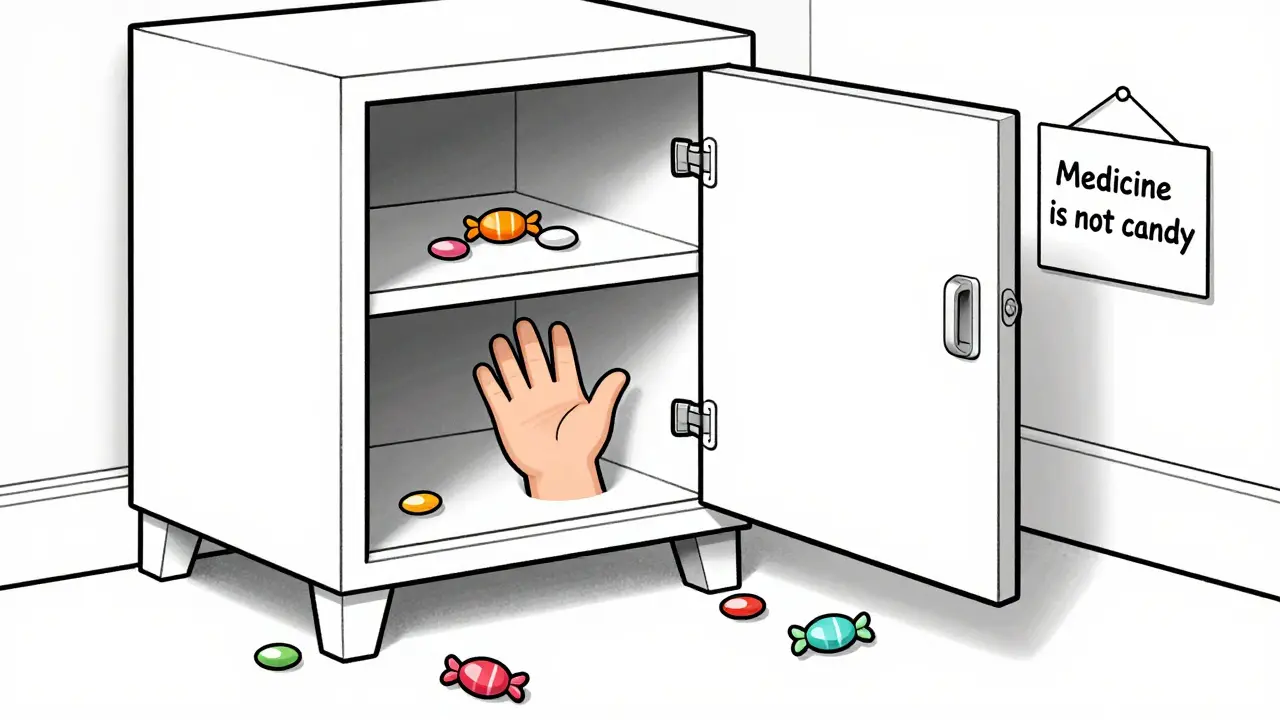
- Never call medicine candy. Even jokingly saying “this is like candy” teaches kids to associate pills with treats. Say: “This is medicine. Only grown-ups give it to you.”
- Dispose of old meds. Don’t keep expired or unused drugs in the medicine cabinet. Take them to a pharmacy drop-off or use a drug take-back program.
Since the FDA required unit-dose packaging for liquid acetaminophen in 2020, unintentional overdoses in kids have dropped by 19%. That’s proof that small changes work.
What Happens After You Call for Help
If you call Poison Control, they’ll ask:- What was taken?
- How much?
- When?
- How old is the child?
- What symptoms are showing?
They’ll use a database of over 100,000 substances to give you exact advice. Many times, they’ll say: “Keep watching at home.” Other times, they’ll say: “Go to the ER now.” Either way, you’re getting expert guidance-no guesswork.
If you call 911, paramedics will:
- Check breathing and heart rate
- Give oxygen if needed
- Administer naloxone for opioid overdoses
- Start IV fluids or antidotes
- Transport to the nearest pediatric ER
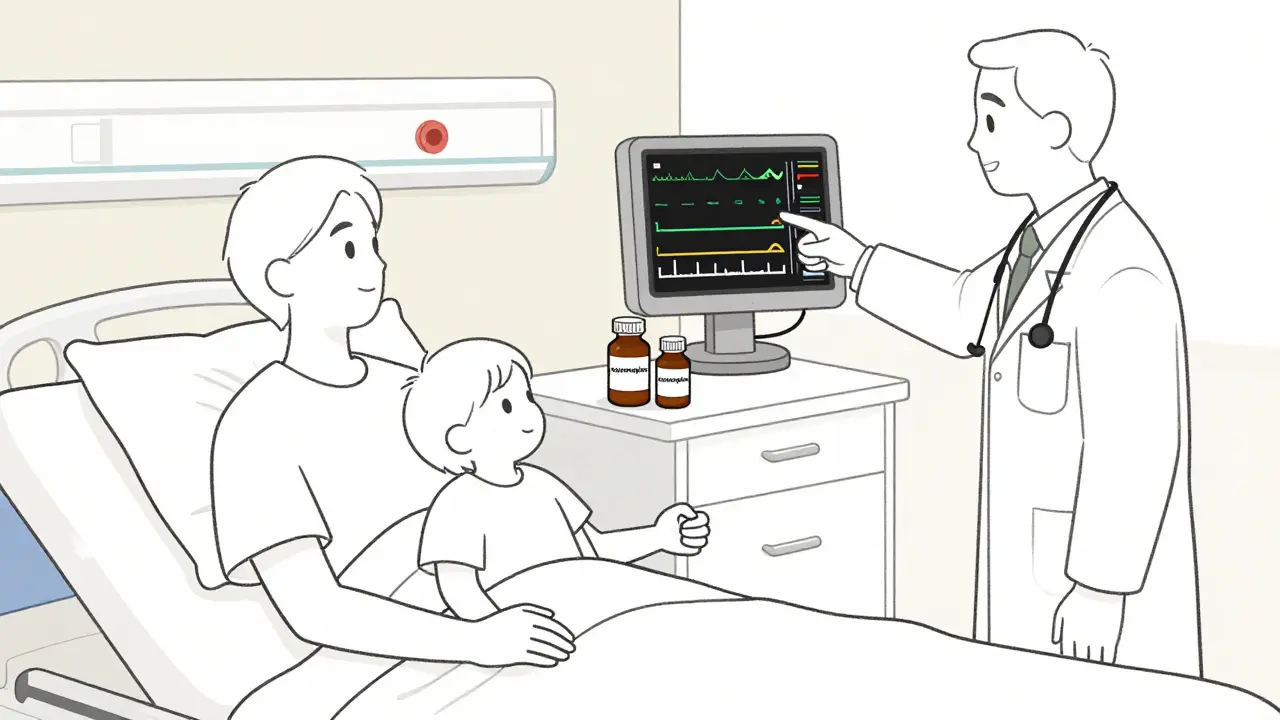
In the hospital, doctors will run blood tests to check liver function, kidney levels, and drug concentration. For acetaminophen, they’ll give NAC intravenously. For stimulants, they’ll manage blood pressure and seizures. For opioids, they’ll monitor breathing for hours after naloxone wears off.
What You Should Never Do
- Don’t wait to see if symptoms appear. Especially with acetaminophen or opioids, damage starts before signs show.
- Don’t give syrup of ipecac. It’s outdated and can make things worse.
- Don’t try to make them vomit. You could choke them or cause more harm.
- Don’t assume it’s “just a little extra.” A child’s body can’t handle small differences like an adult’s can.
- Don’t feel guilty. Accidents happen. What matters now is acting fast.
What should I do if I find my child with an empty medicine bottle but no symptoms?
Call Poison Control immediately-1-800-222-1222. Even if your child seems fine, the medication could be causing silent damage. For acetaminophen, liver injury can start within hours and show no symptoms for up to 24 hours. Don’t wait. Have the bottle ready when you call so you can tell them the name, strength, and how many pills or milliliters are missing.
Can I use the webPOISONCONTROL tool instead of calling?
Yes, webPOISONCONTROL.org is a reliable online tool that gives real-time guidance for non-emergency cases. It’s great for checking if a small overdose might be harmless or if you need to go to the ER. But if your child is showing any symptoms-drowsiness, vomiting, trouble breathing, or unresponsiveness-call 911 or Poison Control directly. The website doesn’t replace human experts in urgent situations.
Is it safe to give naloxone if I’m not sure it’s an opioid overdose?
Yes. Naloxone is safe to give even if you’re unsure. It only works on opioids and has no effect on other drugs like acetaminophen or stimulants. If your child has signs like pinpoint pupils, slow breathing, or unresponsiveness, give naloxone immediately. One dose, then wait 2-3 minutes. If there’s no improvement, give a second dose. It won’t harm them if they didn’t take opioids-but it could save their life if they did.
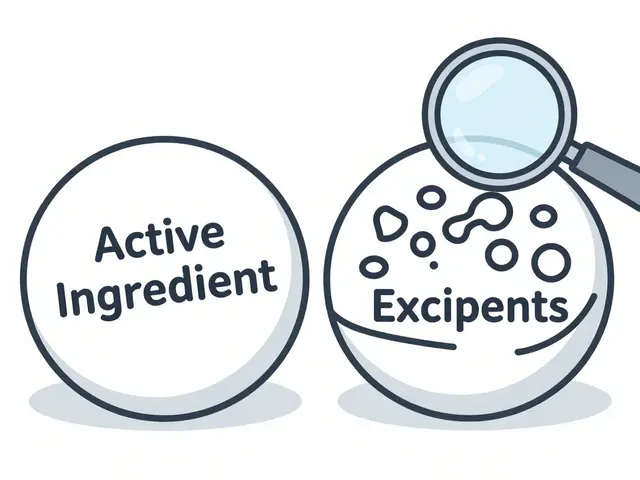
Why do some medicines have the same active ingredient?
Many over-the-counter products combine multiple drugs to treat different symptoms. For example, a nighttime cold medicine might include acetaminophen (for pain), an antihistamine (for runny nose), and a cough suppressant. If you give your child Tylenol for fever and then give them this cold medicine, you’re doubling the acetaminophen. Always check the “Active Ingredients” section on the Drug Facts label. If two products list the same drug, don’t give them together.
How can I tell if a medicine is child-resistant?
Child-resistant packaging must meet federal standards: at least 80% of children under 5 shouldn’t be able to open it within 5 minutes. Look for a cap that requires pressing down while turning. But don’t rely on it. Many kids figure it out, especially if they watch adults. Always store medicines in a locked cabinet-even child-resistant caps can be opened by curious hands.
Aisling Maguire
I can't believe how many parents don't realize that kids can open child-resistant caps. My niece got into her grandma's painkillers last year-thought they were gummies. She's fine now, but we all learned the hard way. Locked cabinet. No exceptions. Even the ibuprofen.
Gigi Valdez
The data presented here is statistically significant and aligns with CDC surveillance reports from 2020-2023. The 19% reduction in pediatric acetaminophen overdoses following unit-dose packaging mandates is a compelling case for regulatory intervention in over-the-counter pharmaceutical design.
Sumit Mohan Saxena
As a clinical pharmacist with over 18 years in pediatric care, I must emphasize that the most dangerous scenario is not the overt overdose, but the delayed presentation of acetaminophen toxicity. Parents often assume "no symptoms = no problem." This is a lethal misconception. The metabolic cascade begins within 2-4 hours. By the time nausea appears, hepatic necrosis is already underway. NAC must be administered before the 8-hour window. Period.
Vikas Meshram
Why do we even have to spell this out? If you can't read a medicine label you shouldn't be allowed near a child. I've seen moms give Tylenol AND cold syrup and then act shocked when their kid ends up in ICU. It's not a tragedy-it's negligence. Lock it up? That's the bare minimum. You should be using a biometric safe. My 4-year-old nephew could open a regular lock. He's not special-he's a kid.
Ben Estella
This is why America needs to stop being soft. We let people keep drugs on counters like they're cereal. If you're too lazy to lock up your meds, don't blame the system. Lock it. Or lose custody. Simple. No more hand-holding. We're not babysitting adults who can't read.
Jimmy Quilty
You know what's really going on here? Big Pharma wants you to think this is about "accidents." It's not. They design these multi-drug combos on purpose. Why? Because if you overdose on one, you're more likely to need another. It's a cycle. And don't get me started on naloxone-why is it only available for opioids? What about stimulant overdoses? Why isn't there a universal antidote? The government's hiding something.
Sneha Mahapatra
I just want to say how deeply moved I am by how much care goes into this guide. 💛 So many parents are terrified they'll mess up-and they shouldn't be. You're not a bad parent for making a mistake. You're human. The fact that you're reading this means you care. And that matters more than perfect storage or perfect dosing. What we need is compassion, not shame. I've been there. My daughter took half a melatonin tablet. We called Poison Control. They were calm. They helped. We didn't panic. And we're okay. You can be too.
Byron Duvall
I'm not buying any of this. Why are we treating every kid like they're going to overdose? I grew up with medicine on the counter. I took aspirin when I had a headache. My mom didn't even lock the cabinet. Kids are resilient. This is just fearmongering to sell more locks and apps. Also, who even calls Poison Control anymore? It's 2025. Google it.
Angel Wolfe
They say call 911 if they're blue but what if you're in rural Alabama and the nearest hospital is 45 minutes away? Who's gonna save them? They're gonna die waiting. And why is naloxone only for opioids? What about the kids who overdose on cough syrup? Why isn't there a universal emergency kit? This whole system is broken. They don't want you to save your kid-they want you to pay for the ER. I've seen it. I know.
Eimear Gilroy
I'm curious-what about herbal supplements? My cousin gave her toddler elderberry syrup thinking it was "natural" and safe. Turned out it had a high concentration of zinc. Kid ended up with acute GI toxicity. Should we be treating these the same way as pharmaceuticals? I feel like this guide focuses too much on OTC meds and not enough on the "wellness" products people think are harmless.
Ajay Krishna
I work with families in rural India where medicine bottles are often unlabeled or repurposed into juice containers. This guide is essential, but we need to adapt it. A locked cabinet? Many families don't have one. What we need is community education-village health workers, pictograms on bottles, radio announcements in local dialects. Prevention isn't just about storage-it's about literacy, access, and trust.
Charity Hanson
Y'all this is so important!! I just started as a pediatric nurse and every week I see a kid brought in for a "little too much". It breaks my heart. But here's the good news-you CAN prevent this. Just one habit change-like always using the syringe-cuts your risk by 70%. You got this. You're not alone. I believe in you. 💪❤️
Noah Cline
The pharmacokinetic profile of acetaminophen in pediatric populations is non-linear due to immature glucuronidation pathways. The therapeutic index narrows exponentially below 15kg body mass. Consequently, weight-based dosing protocols are non-negotiable. Deviations from standard mg/kg calculations constitute iatrogenic risk. The 8-hour NAC window is predicated on hepatic glutathione depletion kinetics. Delay beyond 16 hours correlates with 60% mortality. This is not opinion. It is biochemistry.
Lisa Fremder
I'm tired of being told what to do. My kid's fine. I've never locked anything up. I don't need a lecture. You think I'm careless? I'm a single mom working two jobs. I don't have time for your perfect systems. Stop judging. Just help.
Justin Ransburg
Thank you for creating such a comprehensive, evidence-based resource. This is the kind of clear, calm, and authoritative guidance that saves lives. I've shared this with every new parent I know. Knowledge is power-and in this case, it's the difference between a child going home and a funeral. Please keep doing this work.