
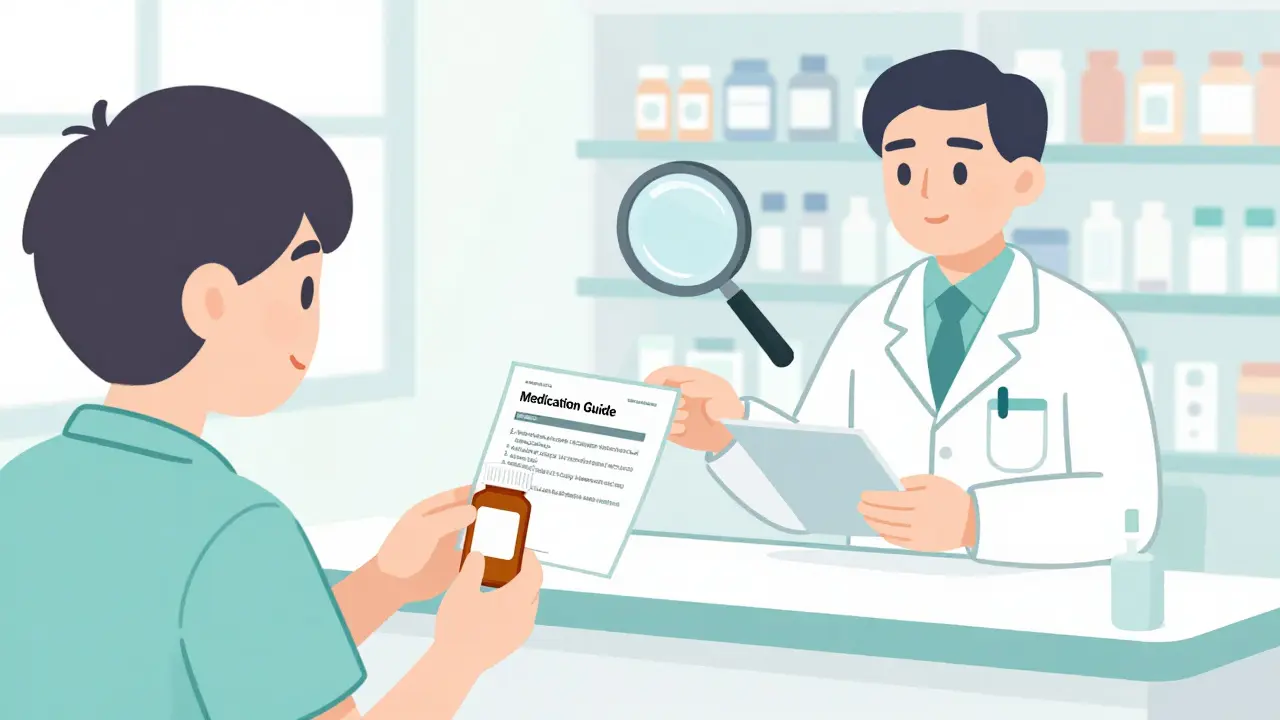
Every time you pick up a prescription for certain high-risk medications, a small paper sheet should be handed to you along with your pills. This isn’t just a receipt or a reminder - it’s a Medication Guide, a legally required document from the U.S. Food and Drug Administration (FDA) designed to help you understand serious risks tied to your drug. These guides aren’t optional. They’re mandatory for over 300 prescription drugs that carry life-threatening side effects, require strict adherence to work, or could cause harm if used incorrectly. But if you’ve never seen one, or aren’t sure how to get one, you’re not alone. Many patients don’t know they have the right to ask for it - even if the pharmacist doesn’t hand it out automatically.
What Exactly Is a Medication Guide?
A Medication Guide (or MG) is a printed handout approved by the FDA that must be given to patients when they receive certain prescription drugs. It’s not the same as the manufacturer’s package insert that doctors read. This is written for you - in plain language, no jargon. The FDA only requires these guides for drugs where the risks are serious enough that patients need to fully understand them before taking the medication. Examples include drugs for epilepsy, cancer, severe mental illness, or those with high chances of causing heart damage, liver failure, or birth defects.
By law, these guides must include:
- The exact name of the drug
- What the drug is used for
- Important safety warnings - like what side effects to watch for
- When to call your doctor immediately
- How to take it correctly - including what to avoid (like alcohol or other drugs)
The FDA doesn’t make these guides themselves. Drug manufacturers write them, submit them for approval, and then must supply them to pharmacies. The FDA reviews each one to make sure it’s clear, accurate, and not buried in tiny print. Still, studies from 2012 found that many of these guides are hard to read - longer than a page, full of medical terms, and poorly organized. That’s why the FDA is working on replacing them with something simpler: the Patient Medication Information (PMI) system.
When Are You Supposed to Get a Medication Guide?
You should get a Medication Guide every time you refill a prescription - not just the first time. The rule applies to outpatient settings: pharmacies, mail-order services, clinics, dialysis centers, and infusion centers. If you’re getting your drug at a hospital and a nurse is giving it to you directly, they don’t have to hand you the guide - unless you ask for it.
There are three main reasons the FDA requires a Medication Guide for a drug:
- The drug has serious side effects that patients need to recognize and act on quickly
- Patient adherence is critical - missing doses or taking it wrong could make it dangerous
- Clear instructions could prevent serious harm - like avoiding pregnancy while on certain drugs
Some drugs also require guides because they’re part of a Risk Evaluation and Mitigation Strategy (REMS). These are stricter programs for the riskiest medications. In REMS cases, you might even need to sign a form or attend a counseling session before getting the drug. Your doctor or pharmacist should explain this if it applies.
How to Get a Medication Guide - Step by Step
You have more options than you think. Here’s how to make sure you get yours:
- Ask at the pharmacy - When you pick up your prescription, don’t assume the guide is included. Ask: “Is there a Medication Guide for this drug?” Pharmacists are required to provide it if the drug requires one. If they say no, ask why - and remind them it’s FDA-mandated.
- Request it for refills - Even if you got one last time, you should get one every refill. Some pharmacies forget. Don’t let them skip it.
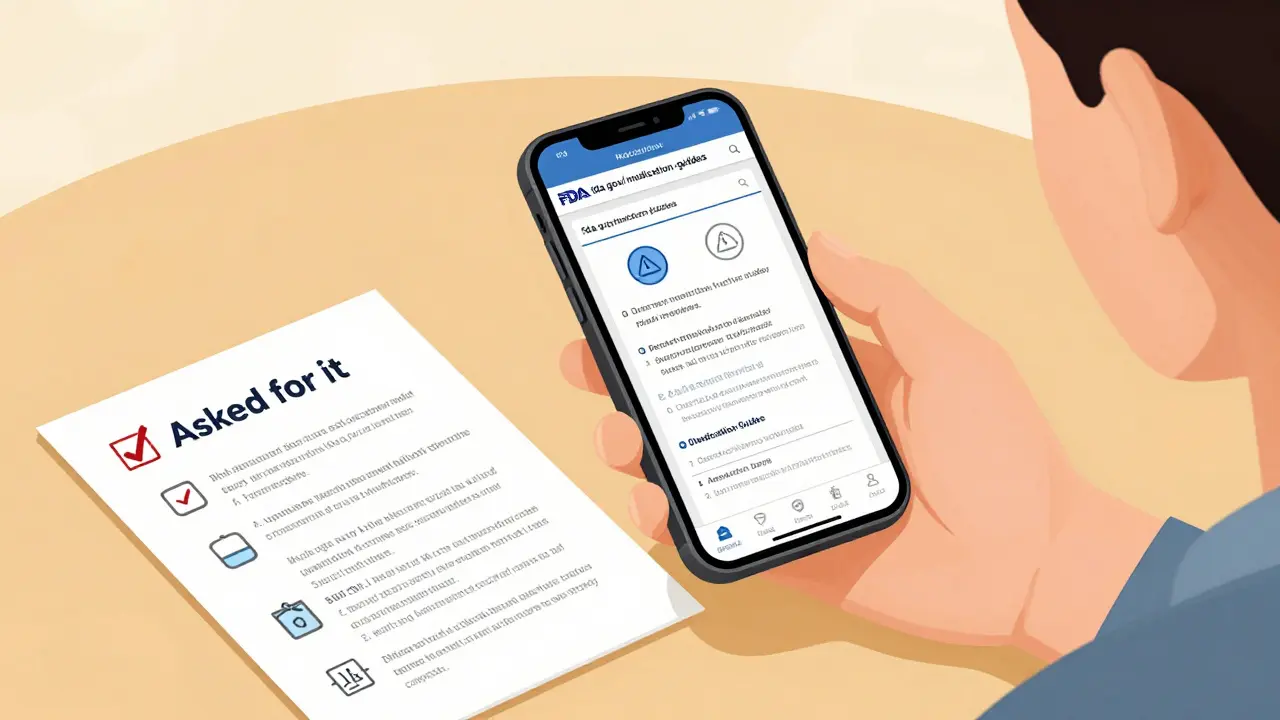
- Choose electronic delivery - You have the right to get the guide as a PDF or link instead of paper. Ask your pharmacist: “Can I receive this electronically?” They must comply. Many pharmacies now offer this through patient portals or email.
- Download it yourself - The FDA maintains a public, searchable database of all approved Medication Guides. Go to fda.gov/medication-guides and type in your drug’s name. You can view, print, or save the guide anytime.
- Ask your doctor - If your doctor prescribed the drug, they should know if a guide is required. Ask them for a copy or direct you to where to find it.
Important: Even if your doctor says you don’t need the guide, you still have the right to request one. The FDA makes it clear: patients can always ask, regardless of provider opinion.
The New System Coming: Patient Medication Information (PMI)
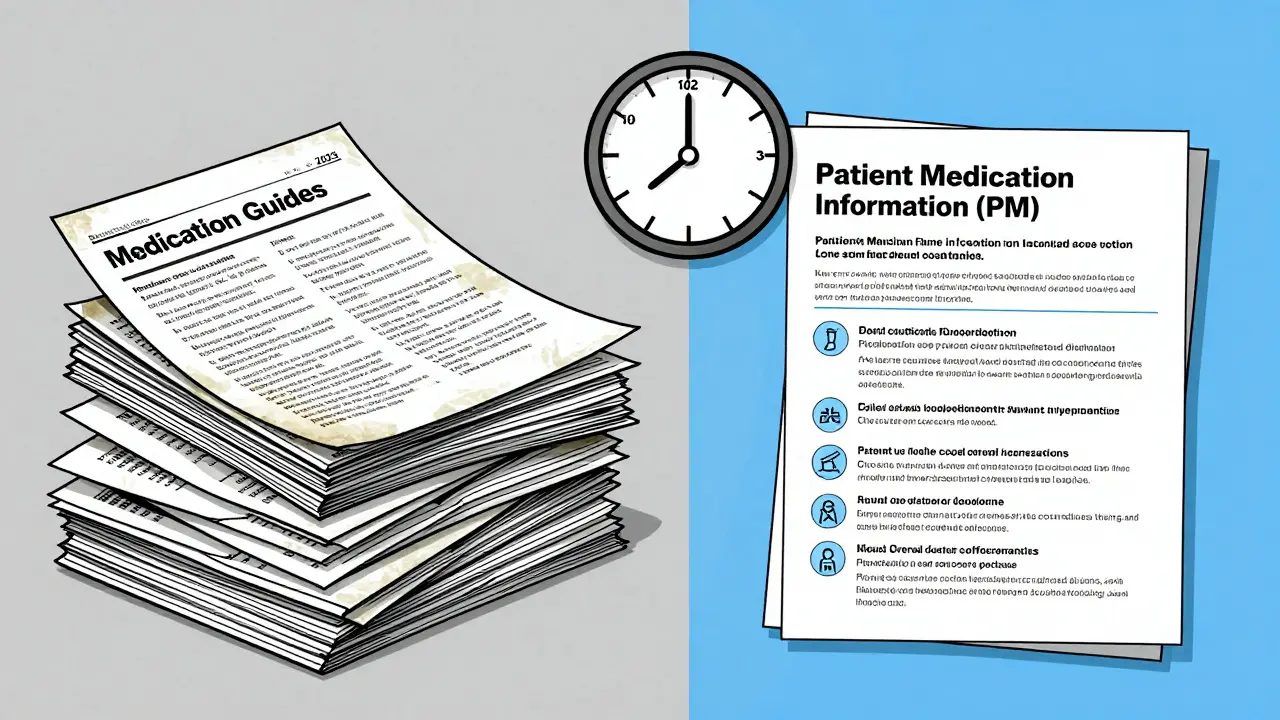
The current Medication Guide system is outdated. Many guides are too long, too confusing, and inconsistently formatted. A 2012 study found that despite the number of guides jumping from 40 to over 300 in just five years, readability didn’t improve. That’s why the FDA proposed a major overhaul: the Patient Medication Information (PMI) system.
Starting in 2026, new drugs approved will need to use PMI. For older drugs, manufacturers have until 2027-2031 to switch, depending on when the drug was first approved. Here’s what’s changing:
- One-page format - no more 3-5 page booklets
- Standardized headings - always the same structure: “What this drug is,” “Warnings,” “How to take it,” “Side effects,” “Storage,” etc.
- Central online repository - all PMIs will be stored in a free, searchable FDA database
- Language must meet federal readability standards
This means in a few years, you won’t have to ask for a guide - you’ll be able to look it up instantly on your phone. Pharmacists will still provide it, but the digital version will be the default. The goal? No more confusion. No more missing risks. Just clear, consistent, easy-to-read info.
What If You Can’t Find Your Guide?
If you’ve been taking a drug for months and never received a Medication Guide, here’s what to do:
- Check the FDA’s online database - search by drug name. If it’s listed, you’re entitled to the guide.
- Contact the pharmacy - they may have overlooked it. Ask for a printed copy or digital link.
- Call the drug manufacturer - their customer service line should be on the packaging. They can mail or email you a copy.
- Ask your doctor - they can request a copy on your behalf.
Don’t wait. If your drug is one that requires a guide, you’re at risk if you don’t understand the warnings. Some side effects - like sudden liver damage or dangerous blood clots - can develop fast. The guide tells you exactly what to watch for and when to act.
Why This Matters
Medication Guides aren’t paperwork. They’re safety tools. For drugs like clozapine (used for severe schizophrenia), warfarin (a blood thinner), or isotretinoin (for acne), a single misunderstanding can lead to hospitalization or death. These guides are the last line of defense between you and a serious mistake.
Even with flaws, the current system saves lives. But it’s broken. Too many people never see the guide. Too many are too long to read. Too many are outdated. The new PMI system is the first real step toward fixing this. Until then, your power is simple: ask. If you don’t get it, ask again. And if you still don’t get it, go online - the FDA has it waiting for you.
Do I have to get a Medication Guide every time I refill my prescription?
Yes. The FDA requires that a Medication Guide be provided every time a drug is dispensed in an outpatient setting - including refills. This applies even if you’ve received it before. Pharmacists sometimes forget, so always ask.
Can I get a Medication Guide for an over-the-counter drug?
No. Medication Guides are only required for certain prescription drugs with serious risks. Over-the-counter medications don’t require them. However, OTC drug labels must still include clear directions and warnings - just not in the same detailed format.
What if my pharmacist says they don’t have the guide?
If the drug requires a Medication Guide by FDA rules, the manufacturer must supply it to the pharmacy. Ask the pharmacist to call the manufacturer or their wholesaler. If they still can’t provide it, contact the FDA’s Drug Information line or visit fda.gov/medication-guides to download it yourself.
Can I get the guide in Spanish or another language?
Currently, FDA requires Medication Guides to be in English. Some manufacturers provide translations, but they are not required. If you need help understanding the guide, ask your pharmacist or doctor for assistance. The upcoming PMI system may allow for multilingual versions in the future.
Are Medication Guides the same as REMS?
No. A Medication Guide is one part of a REMS (Risk Evaluation and Mitigation Strategy). REMS are broader programs that may include additional requirements like doctor training, patient enrollment, or restricted distribution. Some drugs have both a Medication Guide and a REMS - but not all Medication Guides are part of a REMS.


Shruti Chaturvedi
I've been taking my meds for years and never knew I could ask for the guide. My pharmacist always just handed me the bottle. Now I check the FDA site every time I refill. It's wild how much you miss when no one tells you your rights. Seriously, if you're on anything serious, just ask. No shame in it.
Also, the PDF option is a game changer. I keep all my guides in a folder on my phone now. No more losing paper.
Katherine Rodriguez
This whole thing is a joke. The FDA thinks we’re dumb enough to need a pamphlet for drugs that kill people? I’ve been on warfarin for 12 years and I’ve never read one. My doctor told me what I needed to know. Why do we need another layer of bureaucracy?
Devin Ersoy
Oh honey, the Medication Guide? That’s just the FDA’s way of making drug companies write a 4-page novel in 10-point font so they can say 'we warned them.'
Meanwhile, the real danger is the $800 copay and the 3-week wait for the refill. No one reads the guide. They read the insurance denial letter. And guess what? That one’s written in legalese so dense, it could be used as a doorstop.
But hey, at least the new PMI system will have bullet points. Progress, baby.
Scott Smith
I appreciate the effort, but let’s be real. The guides are still too long. I’ve read some that took 10 minutes just to get to the part about 'do not take with grapefruit.' Why not just put a big red sticker on the bottle that says 'DO NOT EAT GRAPEFRUIT'?
Also, I’ve never seen a pharmacist actually hand one out. They just say 'you got it' and move on. The system is broken. Asking is the only way.
Sally Lloyd
Did you know that the FDA database isn’t updated in real time? I looked up my drug last week and it said 'no guide available.' I called the manufacturer-they said they submitted it in January. The FDA hasn’t approved it yet. Meanwhile, my prescription is still active.
I think this whole system is being used to track us. Why else would they make it so hard to access? I’ve started printing the PDFs and keeping them in a locked box. Just in case.
Emma Deasy
I cannot believe how casually this information is being treated. The FDA’s Medication Guide is not merely a suggestion-it is a legally mandated, federally enforced, life-preserving document that every patient has an absolute right to receive, in writing, at the point of dispensation, without having to beg, plead, or file a complaint. And yet, here we are, in 2026, with patients still being told, 'Oh, we don’t have it,' or 'You don’t need it,' or worse-'We’ll email it next time.'
Next time? There is no next time. There is only now. And if you are not demanding your guide, you are not protecting yourself. You are not advocating. You are not empowered. You are at risk. And that is unacceptable.
tamilan Nadar
In India, we don’t even get printed leaflets for prescriptions. But we have WhatsApp groups where people share PDFs of FDA guides. My cousin in Mumbai sent me the one for lamotrigine last month. We don’t wait for the system to work. We make our own.
Adam M
If you don’t ask for the guide, you’re not paying attention. Period.
Rosemary Chude-Sokei
I’ve been a pharmacist for 18 years. I can tell you this: most patients never ask. We’re not hiding the guides. We’re not ignoring them. But if you don’t say something, we assume you don’t need it. The system works only if you participate. So yes, ask. Always.
And if you’re on a REMS drug? Ask twice. We’re trained to do it right. But we’re also human.
Noluthando Devour Mamabolo
The PMI system is a game-changer for patient empowerment. Leveraging centralized, standardized, FDA-compliant, linguistically validated digital repositories ensures that medication risk literacy is democratized across socioeconomic strata. The integration of multilingual interfaces and API-accessible metadata will enable interoperability with EHRs and patient-facing mobile applications-ultimately closing the gap between regulatory intent and real-world adherence.
Also, 📱✨