
Hyponatremia Treatment Calculator
Which Hyponatremia Treatment Is Right for You?
This tool helps you compare treatment options based on your specific condition. Answer a few questions to get a personalized recommendation.
Your Situation
Treatment Options
Recommended Treatment
Why this works for you
Key considerations
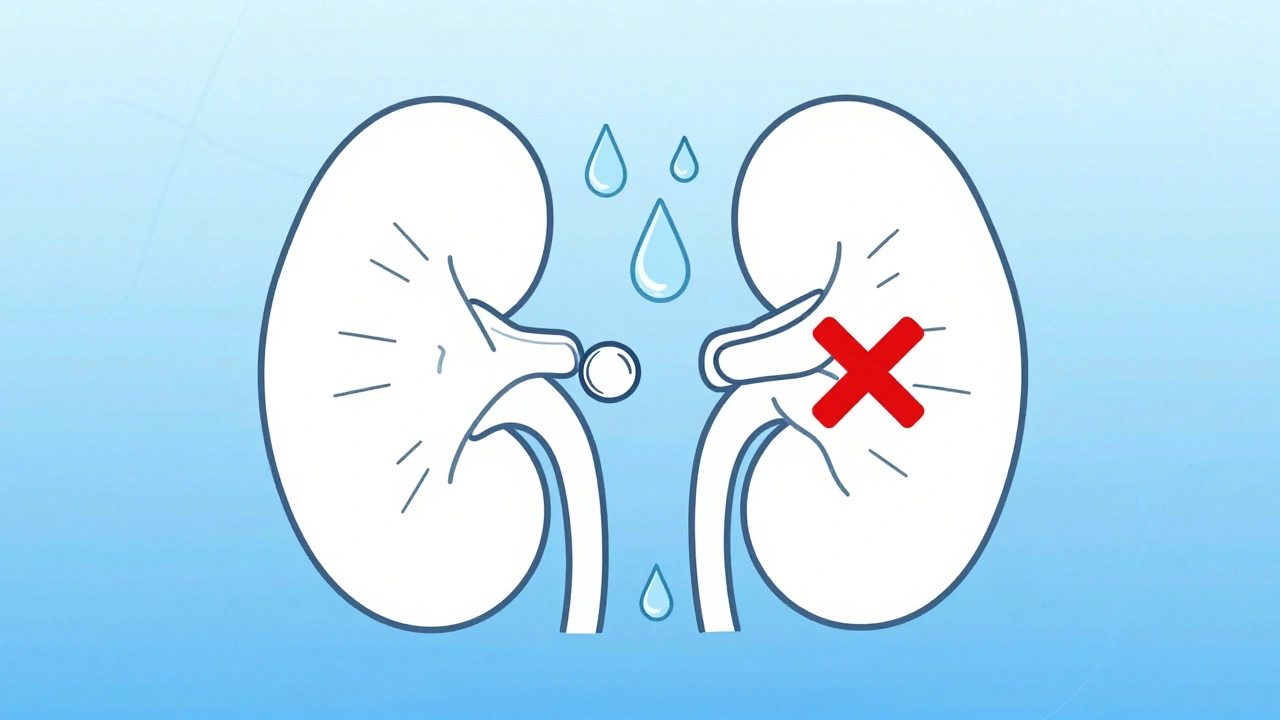
When your body holds onto too much water and your sodium levels drop dangerously low, doctors reach for drugs that force your kidneys to flush out the excess. Samsca (tolvaptan) is one of the few pills approved specifically for this - a vasopressin receptor blocker that tells your kidneys to pee out water without losing sodium. But it’s not the only option. For many patients, especially those with chronic kidney issues, heart failure, or liver disease, alternatives exist. Some are cheaper. Some are safer. Some work better for certain types of hyponatremia. So what’s the real difference between Samsca and the rest?
What Samsca Actually Does
Samsca contains tolvaptan, a selective V2 receptor antagonist. That’s a fancy way of saying it blocks the hormone vasopressin (also called antidiuretic hormone, or ADH) from telling your kidneys to hold onto water. When ADH is overactive - like in SIADH (syndrome of inappropriate antidiuretic hormone secretion), heart failure, or cirrhosis - your body keeps water instead of flushing it. Sodium gets diluted. You feel tired, confused, nauseous. Samsca fixes that by making you urinate more water, raising your sodium levels slowly and safely.
It’s not a quick fix. Doctors don’t use it for sudden, life-threatening drops in sodium. For that, they use hypertonic saline. Samsca is for chronic, mild-to-moderate cases where you need a steady, controlled correction over days or weeks. The typical starting dose is 15 mg once daily, with a max of 60 mg. Most patients see sodium levels rise by 0.5 to 1 mmol/L per day - the safe zone. Too fast, and you risk central pontine myelinolysis, a rare but devastating brain injury.
Why People Look for Alternatives
Despite its effectiveness, Samsca has big downsides. First, it’s expensive. In Australia, a 30-day supply can cost over $400 without subsidy. Second, it carries a black box warning from the FDA for potential liver damage. The risk is low - under 1% - but it’s serious enough that liver function tests are required monthly for the first 18 months. Third, it causes intense thirst and frequent urination. Many patients quit because they can’t handle the constant need to drink and go to the bathroom.
For those reasons, doctors often consider other options - especially if the patient has mild symptoms, can’t afford Samsca, or has liver issues. Some alternatives are older, cheaper, and well-studied. Others are newer, less proven, or used off-label. Here’s what’s actually out there.
Demeclocycline: The Old-School Choice
Demeclocycline is a tetracycline antibiotic that’s been used since the 1970s to treat SIADH. It doesn’t block vasopressin directly. Instead, it makes the kidneys resistant to ADH’s effects - a side effect discovered accidentally when patients on long-term demeclocycline for acne developed dry mouths and increased urination.
It’s cheap. A month’s supply costs under $50 in most places. It’s also been used for decades, so doctors know how to manage it. But it’s not perfect. It can cause sun sensitivity, yeast infections, and, rarely, kidney damage. It also takes days to weeks to work, so it’s not useful for acute cases. And because it’s an antibiotic, long-term use risks gut flora disruption and antibiotic resistance.
Still, for older patients with stable SIADH from lung cancer or brain injuries, demeclocycline remains a common first alternative. It’s not ideal, but it’s reliable.
Fluid Restriction: The Simplest Tool
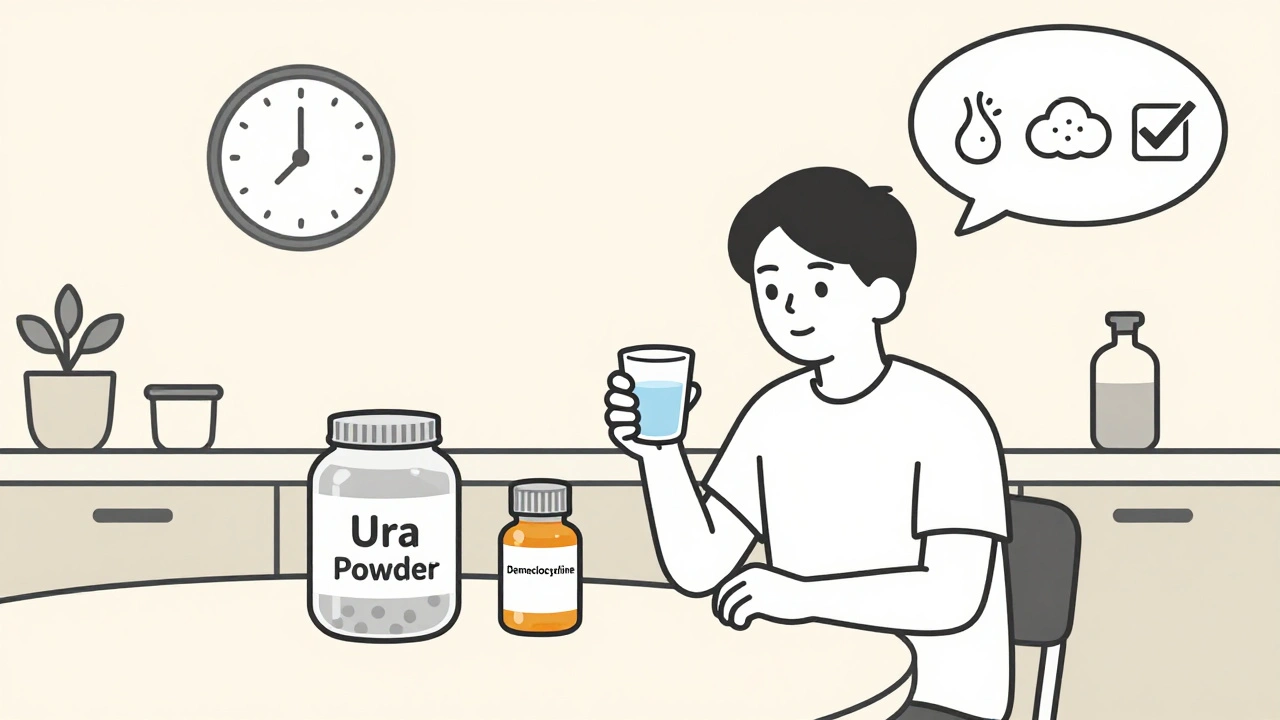
Before you reach for pills, sometimes the best treatment is doing nothing - at least in terms of medication. Fluid restriction, limiting daily intake to 800-1200 mL, is the first-line approach for mild SIADH. It’s free, has no side effects, and works surprisingly well if the patient can stick to it.
But here’s the catch: most people can’t. Thirst is powerful. People forget. They drink a glass of water at night. They eat soup. They don’t realize how much water is in fruit or yogurt. Studies show that over 60% of patients on fluid restriction fail to maintain it long-term. It works best for those with strong support systems - caregivers, nurses, or patients with very structured routines.
Fluid restriction is rarely used alone. More often, it’s combined with demeclocycline or, in rare cases, with low-dose Samsca to make compliance easier.
Urea: The Forgotten Option
Urea has been used for hyponatremia since the 1950s. It’s not a drug you buy at the pharmacy - it’s a supplement. Medical-grade urea comes in powder form, mixed into water or juice. It works by increasing the osmotic pressure in your kidneys, tricking them into excreting water without affecting sodium.
It’s cheap. A month’s supply costs under $30. It’s safe. No liver toxicity. No kidney damage. No antibiotic risks. And it doesn’t cause thirst like Samsca.
But it tastes awful. Like bitter chalk. And it causes bloating and gas. Most patients stop after a week. Still, in Europe, especially Germany and Italy, urea is commonly prescribed for chronic SIADH. In Australia, it’s available through compounding pharmacies - but most doctors don’t know about it. It’s gaining traction in geriatric care for elderly patients who can’t tolerate Samsca or demeclocycline.
One 2023 study in the Journal of Clinical Endocrinology & Metabolism tracked 120 patients with SIADH over six months. Half got urea, half got tolvaptan. Both groups raised sodium levels equally. But 78% of the urea group stayed on treatment after three months. Only 42% of the Samsca group did.
Other Drugs: Off-Label and Experimental
Some doctors try drugs not approved for hyponatremia but known to affect water balance.
- Li carbonate - used for bipolar disorder, it can reduce ADH sensitivity. Risky due to narrow therapeutic window. Can cause tremors, kidney damage, and thyroid issues. Rarely used now.
- Conivaptan - an IV-only V2 receptor blocker, similar to tolvaptan. Used only in hospitals for acute cases. Not practical for home use.
- Vaptans (like lixivaptan) - newer versions of tolvaptan in trials. No major advantage over Samsca yet, and none are approved in Australia.
None of these are first-line. They’re last-resort options when everything else fails - and even then, only under specialist supervision.
Which Alternative Is Right for You?
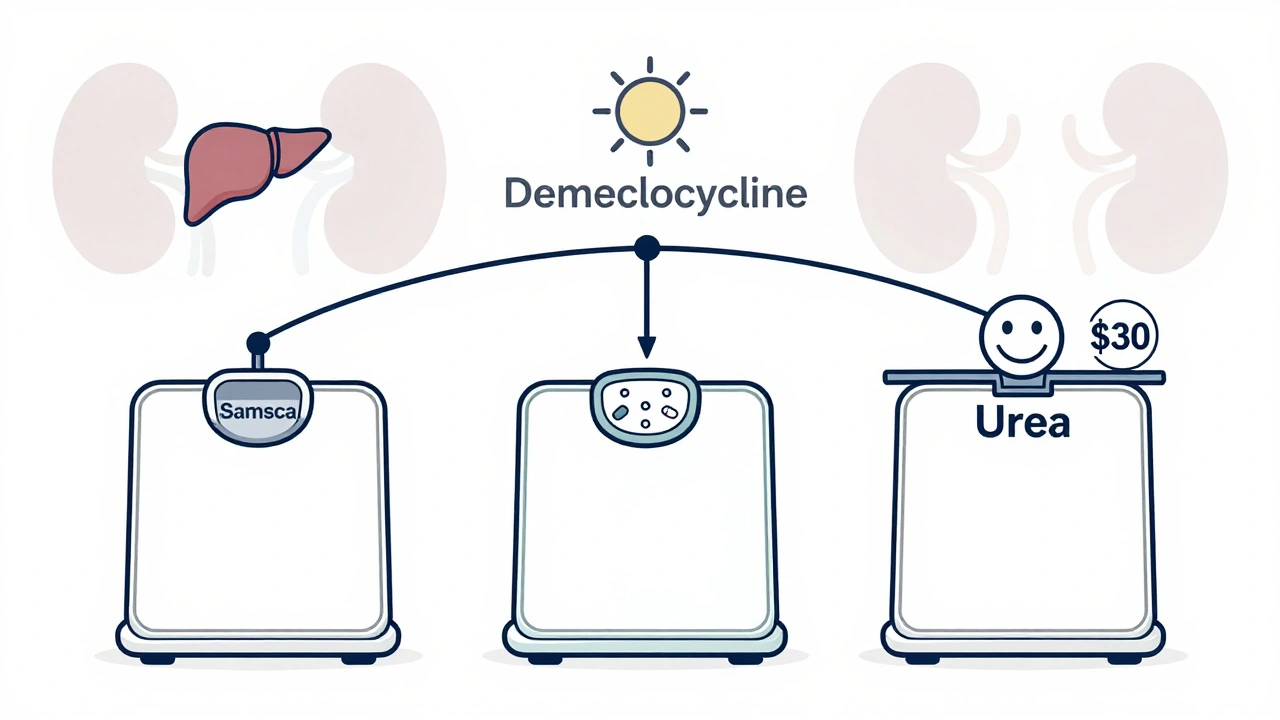
There’s no one-size-fits-all. Your choice depends on your condition, cost tolerance, and ability to stick with treatment.
| Treatment | How It Works | Cost (Monthly) | Speed of Effect | Main Risks | Best For |
|---|---|---|---|---|---|
| Samsca (Tolvaptan) | Blocks ADH receptors in kidneys | $350-$450 | 2-5 days | Liver damage, thirst, frequent urination | Patients needing fast, controlled correction; no liver disease |
| Demeclocycline | Makes kidneys resistant to ADH | $40-$60 | 1-3 weeks | Sun sensitivity, kidney stress, antibiotic side effects | Chronic SIADH; low-budget patients |
| Fluid Restriction | Limits water intake | $0 | 1-4 weeks | Failure due to non-compliance | Mild cases; patients with strong support |
| Medical Urea | Increases kidney osmotic pressure | $25-$35 | 3-7 days | Bitter taste, bloating, gas | Elderly patients; long-term management; liver concerns |
| Conivaptan | IV V2 blocker | $1,000+ per day | Hours | Low blood pressure, infusion reactions | Acute, in-hospital cases only |
If you’re young, have good liver function, and can handle the side effects, Samsca is still the gold standard. But if you’re older, have liver problems, or can’t afford it, urea or demeclocycline may be better long-term bets. Fluid restriction should always be tried first - even if it’s just to reduce the dose of pills you need.
What Doctors Wish Patients Knew
Most patients think the goal is to raise sodium as fast as possible. That’s wrong. The goal is to raise it safely - no more than 8-10 mmol/L in 24 hours. Rushing it can cause permanent brain damage.
Also, many don’t realize that hyponatremia often comes from something else - like heart failure, thyroid problems, or adrenal insufficiency. Treating the sodium without fixing the root cause is like putting a bandage on a broken leg.
And finally: if you’re on Samsca, don’t skip liver tests. The damage is silent until it’s too late. One patient I saw in Perth developed liver failure after three months because she thought she felt fine, so she stopped the blood work. She needed a transplant.
Final Thoughts
Samsca is powerful, but it’s not the only answer. For many, cheaper, safer, or more tolerable options exist. Urea, despite its taste, is quietly becoming the go-to for elderly patients. Demeclocycline still has a place in chronic cases. And fluid restriction? It’s the foundation - even if it’s not glamorous.
The best choice isn’t the newest drug. It’s the one you can stick with. The one your body tolerates. The one you can afford. Talk to your doctor. Ask about urea. Ask about demeclocycline. Ask if fluid restriction could be enough. Don’t assume Samsca is the only option - because it’s not.
Is Samsca better than demeclocycline for SIADH?
Samsca works faster and is more predictable, but demeclocycline is cheaper and doesn’t carry the same liver risk. For long-term management, especially in older patients or those with mild symptoms, demeclocycline is often preferred. Samsca is better when you need a quicker correction, like after surgery or in hospital settings.
Can I take urea instead of Samsca?
Yes. Medical-grade urea is an effective alternative for chronic hyponatremia, especially if you have liver concerns or can’t afford Samsca. It’s not widely known in Australia, but it’s available through compounding pharmacies. Most patients tolerate it well after the first week, once they get used to the taste.
Does fluid restriction really work for hyponatremia?
It works for mild cases - especially if your sodium is only slightly low and your symptoms are minimal. But most people can’t stick to it long-term. It’s most effective when combined with another treatment, like a low dose of Samsca or urea, to reduce how strict the restriction needs to be.
Why is Samsca so expensive in Australia?
Samsca is a brand-name drug with no generic version approved in Australia. Tolvaptan is still under patent protection here. In the U.S., generics are available, bringing the cost down to under $100 a month. Until a generic is approved locally, Samsca will remain costly.
What happens if I stop taking Samsca suddenly?
Your sodium levels can drop again quickly - sometimes within 24 to 48 hours. That’s why you shouldn’t stop without talking to your doctor. If you’re switching to another treatment, your doctor will overlap the medications for a few days to prevent a rebound drop.
Are there natural ways to raise sodium levels?
No. Sodium levels are tightly controlled by your kidneys and hormones. You can’t fix low sodium by eating more salt - your body won’t absorb it if your kidneys are holding onto water. In fact, adding salt without treating the underlying cause can make things worse. Medication or fluid restriction are the only proven methods.


zac grant
Samsca is great if you've got the cash and a clean liver, but honestly? Most chronic SIADH patients are geriatric and on 12 other meds. Urea's the quiet hero here - osmotic diuresis without the hepatotoxicity or the constant thirst. The 2023 JCEM study nailed it: 78% adherence vs 42%. That’s not just efficacy, that’s quality of life.
Rachel Bonaparte
Let’s be real - Big Pharma doesn’t want you to know about urea because it’s cheap, natural, and doesn’t require monthly liver panels. They push Samsca because it’s a $400/month cash cow. And don’t get me started on demeclocycline - it’s an antibiotic repurposed by accident, and now we’re told it’s ‘standard care’? That’s not medicine, that’s institutional inertia. The FDA’s black box warning? A cover-up for profit-driven toxicity. Urea’s been used since the 50s. Why is it still ‘alternative’? Because the system hates simple solutions.
And fluid restriction? Of course it works - your body isn’t broken, it’s being overmedicated. But nobody wants to tell you to drink less water because they can’t sell you a pill for it. The real conspiracy? We’ve been trained to think every problem needs a drug. Urea doesn’t need a patent. That’s why you won’t hear about it from your doctor.
Scott van Haastrecht
Urea? Seriously? That’s what you’re recommending? The same stuff cows eat? This isn’t a biochemistry seminar, it’s a medical decision. If you’re telling people to swallow chalk powder instead of a drug with 30 years of clinical data, you’re not helping - you’re endangering people. Samsca’s side effects are known, monitored, and manageable. Urea’s ‘taste’ is a joke - if you can’t tolerate a bad flavor, you shouldn’t be managing chronic disease. This is amateur hour.
Chase Brittingham
I appreciate how thorough this post is. Honestly, I’ve seen patients bounce between Samsca and demeclocycline and just… give up. The thirst, the bathroom trips, the liver anxiety - it’s exhausting. Urea isn’t glamorous, but I’ve had older patients tell me it’s the first thing that didn’t make them feel like a lab rat. Yeah, it tastes like regret, but after a week, they stop noticing. And the fact that they can actually sleep through the night? Priceless.
Fluid restriction is underrated. I had a guy with SIADH from lung cancer who just started tracking his intake in a notebook with his daughter. Three months later, his sodium was stable. No pills. Just accountability. Sometimes the simplest tools are the most powerful - if you’ve got the support.
Bill Wolfe
Let me just say this with the gravitas it deserves: urea as a treatment? That’s not medicine, that’s a cry for help from a broken healthcare system. You’re telling patients to swallow industrial-grade fertilizer because the pharmaceutical industry is too greedy to make generics? That’s not innovation - that’s surrender. Samsca has a black box warning? So does lithium. We don’t abandon lithium because it’s risky - we monitor it. We don’t throw out proven therapies because they’re expensive - we fix the system. And yet here we are, glorifying chalk powder as if it’s some ancient wisdom. It’s not wisdom. It’s desperation dressed up as pragmatism.
And don’t get me started on the ‘taste’ argument. If you can’t tolerate a mildly unpleasant flavor to save your own life, you’re not a patient - you’re a consumer. Medicine isn’t about comfort. It’s about survival. If you’re choosing taste over efficacy, you’re not making a medical decision - you’re making a lifestyle choice. And that’s not your doctor’s job to enable.
Benjamin Sedler
Wait - so we’re comparing a drug that makes you pee like a racehorse to a powder that tastes like wet chalk and gives you gas? And somehow urea wins because people ‘stick with it’? That’s not efficacy, that’s low expectations. If the bar for success is ‘they didn’t quit after a week,’ we’ve already lost. Samsca’s side effects are annoying. Urea’s are disgusting. Demeclocycline’s a walking antibiotic apocalypse. So we pick the least terrible option? That’s not medicine. That’s survival. And honestly? That’s the real tragedy here.
Jordan Wall
Urea? In the UK we’ve had it available via compounding for years - but most GPs have never heard of it. It’s not in NICE guidelines. It’s not in the BNF. It’s not even on the formulary. So when a patient asks about it, you either look confused or pretend you’ve never heard of it. The fact that it’s cheaper than a cup of coffee in a hospital café doesn’t matter if the system doesn’t know it exists. It’s not that it doesn’t work - it’s that we’ve forgotten how to look beyond the branded pill.
Also, ‘medical-grade urea’? That’s just urea. It’s not a special kind. It’s the same molecule. We just stopped calling it ‘urea’ and started calling it ‘a treatment’ so we could charge for it. The system is broken.
Gareth Storer
So the solution to a $400 drug is to tell people to drink chalk water? Brilliant. Next you’ll tell me to treat diabetes with lemon juice and hope. At least Samsca comes with a warning label. Urea comes with a Yelp review. ‘Tastes like regret and regret’s cousin.’ That’s not a clinical trial, that’s a TikTok trend.
Chase Brittingham
Hey Scott - I get where you’re coming from. But you’re framing this like it’s a battle between science and snake oil. It’s not. Urea isn’t ‘chalk water.’ It’s a well-studied osmotic agent with zero liver toxicity. The ‘taste’ is a barrier, not a flaw. We don’t reject insulin because it needs to be injected. We help patients manage the discomfort. Same here. The real issue isn’t urea - it’s that we don’t train doctors to talk about tolerability. We optimize for efficacy, not adherence. And that’s why people stop.