
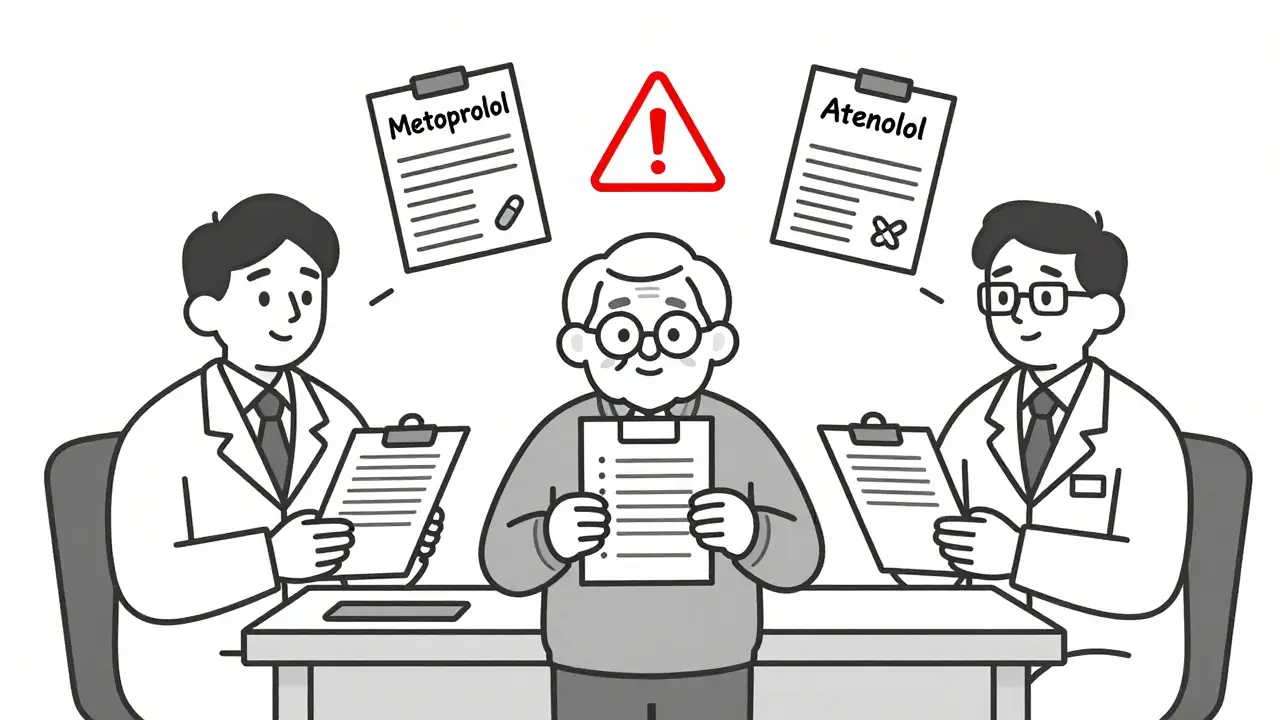
Every year, thousands of older adults end up in emergency rooms because they took two pills that did the same thing. Not because they were careless - but because two different doctors, unaware of each other’s prescriptions, gave them medications from the same class. One doctor prescribed a blood pressure pill. Another, months later, prescribed another one. The patient didn’t know they were duplicates. Neither did the pharmacist. And that’s how a simple mistake turns into a dangerous drop in blood pressure, dizziness, falls, or worse.
Why This Happens to Seniors
As we age, it’s common to see multiple specialists - a cardiologist for the heart, a rheumatologist for arthritis, a neurologist for memory issues. Each one treats a specific condition. But few of them see the full picture. They don’t know what your primary care doctor prescribed last month. They don’t know about the over-the-counter painkiller you’ve been taking for years. And they rarely have time to check.The numbers don’t lie. A 2015 study of 53 community pharmacies found that clinical decision systems flagged 20.4 duplicate medication alerts for every 100 prescriptions filled. That’s not a glitch - that’s a systemic flaw. And it’s worse for seniors. People over 65 who take five or more medications are three times more likely to have a duplicate therapy error than younger patients, according to the American Pharmacists Association.
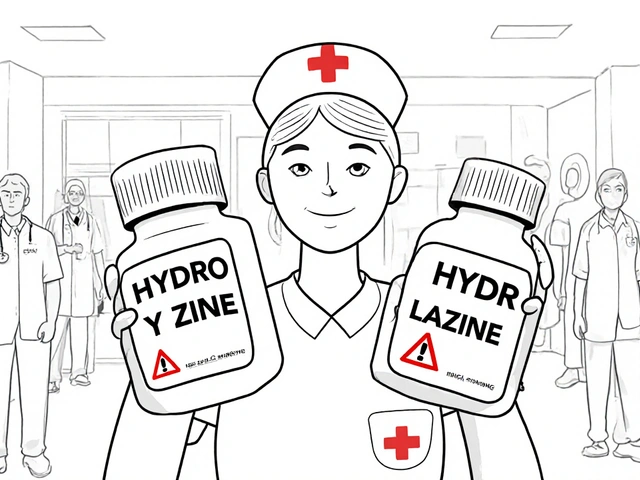
One common example? Two different doctors prescribing two different beta-blockers - say, metoprolol and atenolol - for high blood pressure. Both do the same thing. Together, they can cause dangerously low heart rate or blood pressure. Another? Taking both ibuprofen and naproxen for joint pain. Both are NSAIDs. Together, they raise the risk of stomach bleeding and kidney damage. These aren’t rare mistakes. They’re routine.
What You Can Do: The Medication List That Saves Lives
The single most powerful tool you have isn’t a high-tech app or an electronic health record. It’s a simple, updated list - written in your own handwriting, kept in your wallet, and brought to every appointment.Here’s how to build it:
- Write down every pill, capsule, patch, or liquid you take - every one. Prescription, over-the-counter, herbal, vitamin, or supplement.
- Include the dose (e.g., “10 mg”) and how often (e.g., “once daily” or “as needed”).
- Write the reason you take it (e.g., “for high blood pressure,” “for heartburn,” “for sleep”).
- Bring your actual pill bottles to your appointment. Photos of labels on your phone help, but having the bottles lets the doctor or pharmacist check the exact name, strength, and manufacturer.
- Update it every time you start, stop, or change a medication. Don’t wait for your next visit.
This isn’t just advice - it’s a proven strategy. The Kaiser Permanente health system cut duplicate prescriptions by 37% by making it mandatory for doctors to list the reason for every medication. When a pharmacist sees “for arthritis” on two different pills, they know to ask: “Are these both really needed?”
Use One Pharmacy - Always
This sounds simple, but it’s one of the most effective safeguards. If you use multiple pharmacies - one for your heart meds, another for your diabetes drugs - no one has your full history. Pharmacists can’t spot duplicates if they only see half your list.Choose one pharmacy you trust. Let them know you’re on multiple medications. Ask them to flag any new prescriptions that might conflict with what you’re already taking. Most pharmacies have systems that alert them to potential duplicates. But those systems only work if they have your full record.
According to a 2022 survey by the American Society of Health-System Pharmacists, 42% of pharmacists said lack of communication between providers was the top cause of duplicate prescriptions. But when a patient uses one pharmacy consistently, that number drops by over 60%.
Ask These Three Questions at Every Specialist Visit
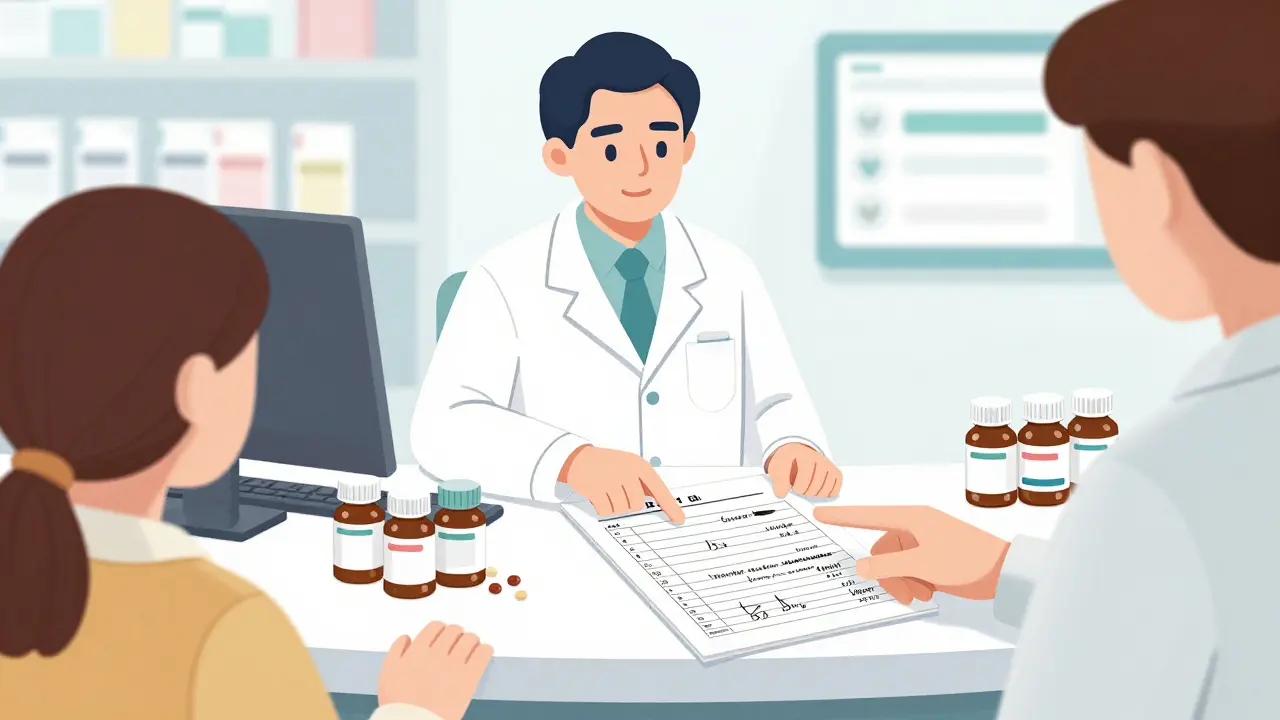
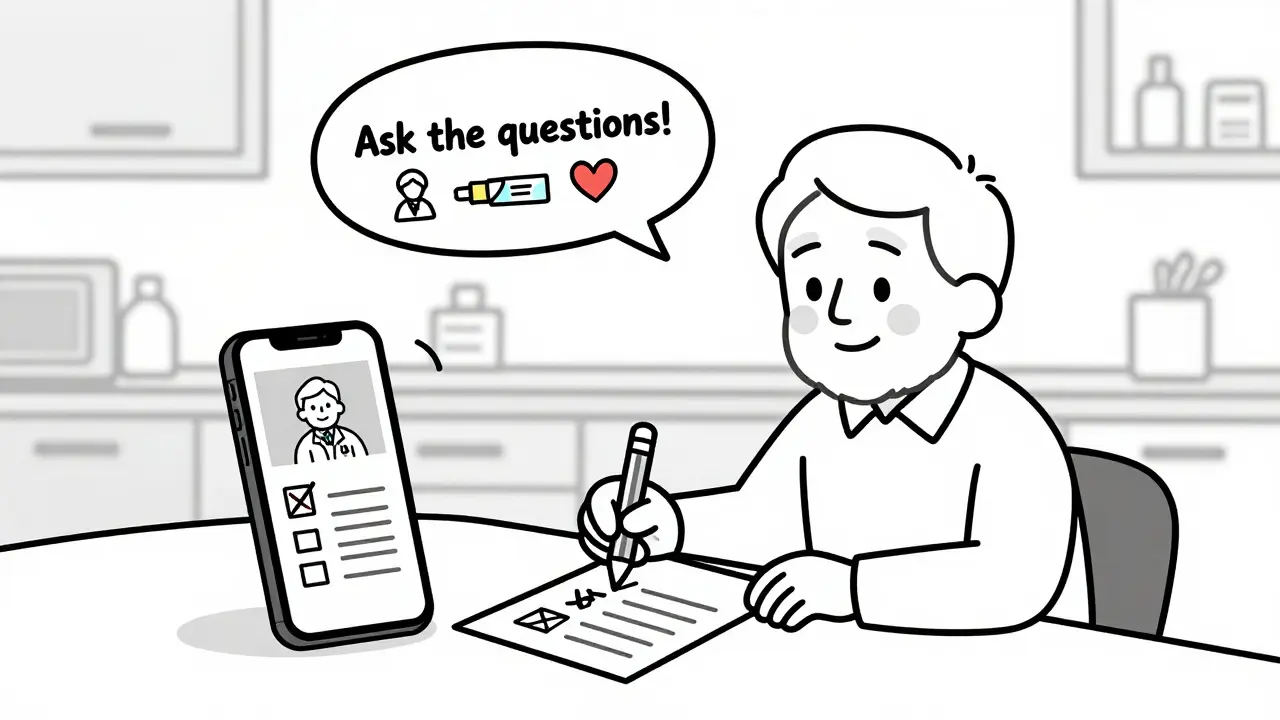
When a specialist writes you a new prescription, don’t just say “thank you” and leave. Ask:- “Why am I taking this?” - Make sure you understand the reason. If it’s the same reason as another pill you’re already on, that’s a red flag.
- “Is this replacing something I’m already taking, or adding to it?” - Many doctors assume you’ve stopped an old med. You might not have.
- “Can we review all my meds together?” - Say you’d like to schedule a follow-up with your primary care doctor or pharmacist to check for overlaps. Most providers will agree.
One patient in Perth told her cardiologist she was on metoprolol for blood pressure. He prescribed another beta-blocker. She didn’t know they were in the same class. She asked the questions. The doctor paused. “You’re right,” he said. “Let’s stop the new one.” That’s how simple it can be.
Let Your Pharmacist Be Your Safety Net
Pharmacists are the last line of defense - and they’re trained to catch duplicates. But they can’t do it if you don’t tell them everything.Don’t assume your pharmacist knows your full list just because you fill prescriptions there. Walk up to the counter and say: “I’ve been seeing a few specialists lately. Can you check if any of my new meds might overlap with what I’m already taking?”
Pharmacists can do more than just fill scripts. They can call your doctor to suggest alternatives. They can flag interactions. They can even help you simplify your regimen. A 2023 study found that patients who got a face-to-face medication review from a pharmacist after leaving the hospital had 40% fewer emergency room visits in the next three months.
What About Electronic Systems?
Yes, doctors use electronic prescribing. Yes, systems alert them to duplicates. But alerts aren’t foolproof. In the same 2015 study, only 17% of duplicate alerts led to action. Why? Because providers get hundreds of alerts a day. Many are false alarms. Some are ignored. Others are overridden without review.Even more troubling? The alerts work best for new prescriptions - not refills. So if you’ve been taking a medication for years, and a new doctor prescribes a duplicate, the system often won’t catch it. That’s why your personal list matters more than any computer.
Emerging AI tools are helping. Mayo Clinic piloted a system that boosted duplicate detection from 2.4% to 5.83% - a 143% improvement. But these are still in testing. They’re not the norm. You can’t wait for technology to fix this. You have to act now.
What to Do If You Already Have Duplicates
If you suspect you’re taking two drugs that do the same thing - don’t stop either one on your own. That can be dangerous.Instead:
- Write down both medications and their purposes.
- Call your primary care doctor or pharmacist. Say: “I think I might be taking two pills that do the same thing. Can we review them?”
- Ask if one can be stopped, switched, or lowered in dose.
- If your doctor agrees to stop one, get clear instructions on how to do it safely.
Never assume a duplicate is harmless. Even if you feel fine, combining two similar drugs can silently raise your risk of kidney damage, internal bleeding, confusion, or falls. It’s not worth the risk.
What should I do if I see the same medication prescribed by two different doctors?
Don’t take both. Contact your primary care doctor or pharmacist immediately. Bring your medication list and both prescriptions. Ask them to determine if one is unnecessary or if there’s a mistake. Never stop a medication without professional advice - but don’t assume two of the same type are safe to take together.
Do over-the-counter meds count as duplicates?
Yes, absolutely. Many OTC pain relievers, sleep aids, and heartburn medications have the same active ingredients as prescription drugs. For example, taking prescription aspirin and daily OTC aspirin together increases bleeding risk. Same with ibuprofen and naproxen. Always include OTCs and supplements on your list.
How often should I update my medication list?
Update it every time you start, stop, or change a medication - even if it’s just a new bottle from the pharmacy. Don’t wait for your next doctor’s visit. A list that’s outdated by a week can be dangerous. Keep a copy in your wallet, on your phone, and give one to your main caregiver.
Can I rely on my doctor’s electronic records to catch duplicates?
No. Even with electronic systems, duplicate alerts are often missed, overridden, or ignored. Doctors see dozens of alerts a day and may not have time to review them. Your personal, written list is your best protection. Technology helps - but it’s not a replacement for your own vigilance.
Why is using one pharmacy so important?
Pharmacists can only spot duplicates if they see your full history. If you use different pharmacies, each one only sees part of your meds. That means they can’t warn you if a new prescription conflicts with something you’re already taking elsewhere. Using one pharmacy ensures your complete record is in one place - and your pharmacist becomes your safety net.
Final Thought: You’re the Most Important Person in Your Care
No doctor, pharmacist, or computer system will care about your medications as much as you do. You’re the one who takes them every day. You’re the one who notices when you feel dizzy, tired, or confused. You’re the one who holds the list.Take five minutes today to write down every medication you’re on - including the ones you only take once in a while. Bring it to your next appointment. Ask the questions. Let your pharmacist help. And remember: fewer pills don’t mean less care. Sometimes, fewer pills mean better health.

Timothy Olcott
This is why we need to stop letting old people take so many pills 😅 I mean, come on. One beta-blocker, one ibuprofen, done. But nooo, they gotta have 12 meds and a pill organizer that looks like a NASA control panel. 🚀💊
Desiree LaPointe
Ah yes, the classic ‘I’m a cardiologist, I don’t need to know what the neurologist prescribed’ mentality. How quaint. It’s like having five chefs in a kitchen, each adding salt to the same pot while yelling, ‘I’m the expert!’ 🤦♀️ The real tragedy? Patients are the ones who get salted to death.
Jackie Tucker
The irony is delicious. We live in the age of AI, blockchain, and quantum computing, yet the healthcare system still runs on paper lists and hand-written notes. The future is here. It’s just not evenly distributed. Also, pharmacists are the real MVPs. They’re the only ones who don’t have a 30-minute lunch break while you’re on your 8th medication.
Thomas Jensen
You think this is bad? Wait till you find out the government’s been inserting tracking chips in pill bottles since 2018. They’re monitoring your meds. Why? To control your ‘health behavior’. I’ve got proof. Ask me. I’ll send you the whistleblower documents. 🕵️♂️💊
Chris Dwyer
This is one of those posts that actually makes you feel like you can do something. Seriously. Five minutes. A piece of paper. A pen. You don’t need an app. You don’t need a degree. Just write it. Bring it. Ask. It’s not complicated. It’s not glamorous. But it saves lives. I gave my list to my mom last week. She cried. Said she finally felt seen. That’s the power of a simple list.
matthew runcie
I’ve been doing this for years. List in wallet. One pharmacy. Ask the three questions. It’s not rocket science. I’m 71. Still drive. Still hike. Still cook. Probably because I don’t take 17 pills. Just the ones that matter. Keep it simple. Your body will thank you.
shannon kozee
One pharmacy. Always. This is non-negotiable. I used to go to three. Now? One. My pharmacist knows my meds better than my sister. She called me last month: ‘You’re on two blood thinners. You sure?’ Saved me. Seriously. Just pick one. It’s that easy.
Shaun Wakashige
I tried the list thing. Then I lost it. Then I forgot to update it. Then I took two blood pressure pills. Felt weird. Didn’t go to the hospital. Just stopped one. Now I just don’t take anything unless I’m dying. 🤷♂️
Allison Priole
I’ve been on 11 meds for 8 years. Last year, my pharmacist sat with me for 90 minutes. We cut it down to 4. I feel like a new person. No more brain fog. No more dizziness. Just… me. It’s not about taking less. It’s about taking what actually helps. I didn’t know I was taking two things for the same thing. Turns out, I didn’t need either. My body just needed rest. And a better list.
Casey Tenney
If you’re taking more than five meds, you’re not being treated. You’re being experimented on. This isn’t healthcare. It’s pharmaceutical roulette. And you’re the wheel. Stop. Just stop. Ask for a second opinion. Or better yet - don’t take anything until you’ve got proof it’s necessary.
Sandy Wells
The suggestion to update the list every time a medication changes is impractical. Most elderly patients are cognitively impaired or physically unable to maintain such records. The burden is misplaced. The system should adapt to the patient, not the other way around.
Paul Cuccurullo
I’ve been saying this for years. Pharmacists are underappreciated geniuses. They’re the unsung heroes who catch the errors the doctors sleep through. I once had a pharmacist call my cardiologist and say, ‘Your patient is on two beta-blockers. One should be stopped.’ He did. Saved my life. Never underestimate the power of a pharmacist with a clipboard and a conscience.
Solomon Kindie
The real issue isn’t duplicate meds. It’s the fragmentation of care. We’ve turned medicine into a series of silos. Each specialist owns a piece. No one owns the whole. That’s not a mistake. That’s a design flaw. We treat organs, not people. Until we fix that, no list, no pharmacy, no algorithm will help. We need holistic care. Or we need to stop pretending we’re healing anyone.