
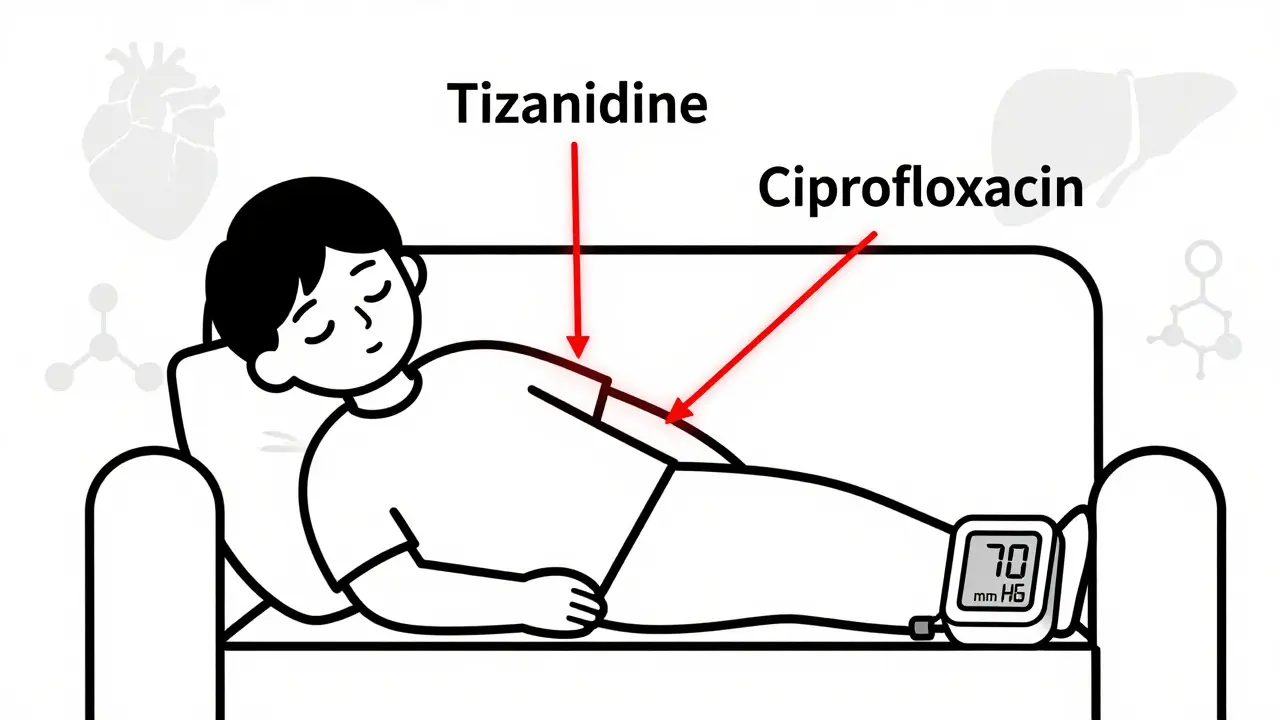
When you’re dealing with a bad back spasm and a urinary tract infection at the same time, it’s easy to assume your doctor is just covering all bases. But combining tizanidine and ciprofloxacin isn’t just a harmless overlap-it’s a ticking time bomb. This isn’t theoretical. Real patients have ended up in emergency rooms with blood pressure so low they passed out, or so sedated they couldn’t stay awake for hours. And it’s happening more often than you think.
What Happens When These Two Drugs Meet?
Tizanidine is a muscle relaxant. It works by calming overactive nerves in your spinal cord, helping ease painful muscle spasms. Ciprofloxacin is an antibiotic-commonly used for bladder infections, sinus infections, or even some types of pneumonia. On paper, they seem unrelated. But inside your body, they collide in a way that can be deadly. The problem starts with an enzyme called CYP1A2. This enzyme is your liver’s main tool for breaking down tizanidine. Without it, tizanidine sticks around too long, building up to dangerous levels. Ciprofloxacin doesn’t just slow down CYP1A2-it shuts it down hard. Studies show that when you take ciprofloxacin with tizanidine, the amount of tizanidine in your blood can spike by 10 to 33 times. That’s not a small increase. That’s like taking five doses instead of one.What Does That Look Like in Real Life?
You don’t just feel a little drowsy. You might feel like you’re sinking into the couch and can’t get up. Your vision blurs. Your head spins. Then your blood pressure drops-fast. In clinical studies, systolic pressure falling below 70 mm Hg is considered severe. That’s low enough to cause fainting, falls, or even heart rhythm problems. One patient in a 2019 Vanderbilt study passed out after taking both drugs and hit his head on the floor, requiring hospitalization. Another was admitted to the ICU because his heart couldn’t pump enough blood to his organs. Sedation isn’t just “feeling tired.” It’s being unable to respond to your name, slurring speech, or losing consciousness. In elderly patients or those already on blood pressure meds, this can turn fatal. Emergency room records show these reactions usually start within 2 to 4 hours after taking the antibiotic-right when people think they’re just feeling the side effects of being sick.Why Is This So Much Worse Than Other Muscle Relaxants?
Not all muscle relaxants are the same. Cyclobenzaprine, for example, is often used as an alternative. But here’s the key difference: cyclobenzaprine gets broken down by multiple liver enzymes. If one pathway gets blocked, others can pick up the slack. Tizanidine? It relies almost entirely on CYP1A2. No backup. No safety net. That’s why researchers compared the two in a large health record analysis. When patients took ciprofloxacin with cyclobenzaprine, there was no spike in low blood pressure. But with tizanidine? The risk jumped by 43%. That’s not a coincidence. It’s a direct result of how the body processes each drug.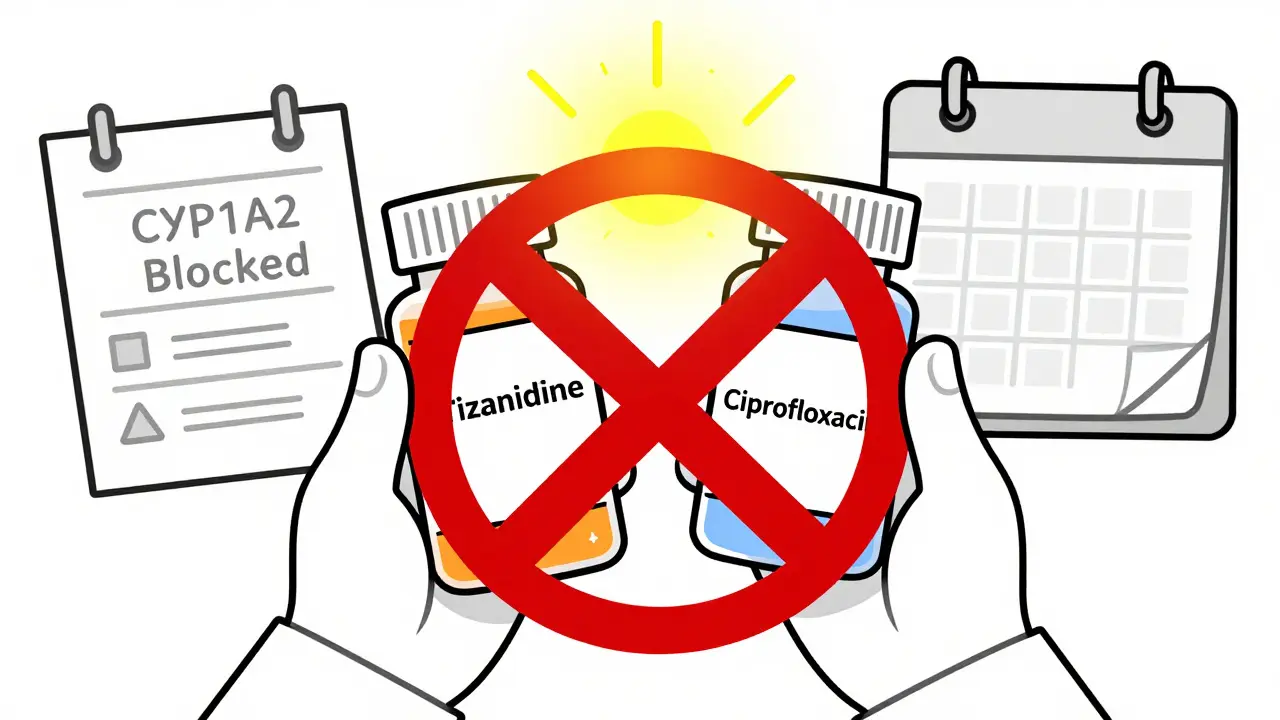
Who’s Most at Risk?
This isn’t just a problem for one kind of patient. It hits several groups harder:- Elderly patients-their livers process drugs slower, so tizanidine lingers even longer.
- People on other blood pressure meds-if you’re already taking lisinopril, amlodipine, or hydrochlorothiazide, adding tizanidine and ciprofloxacin can crash your pressure into dangerous territory.
- Patients with multiple chronic conditions-those with diabetes, kidney disease, or heart problems have less room for error.
- People taking other CYP1A2 inhibitors-fluvoxamine (an antidepressant), oral contraceptives, or even some herbal teas like peppermint can add to the risk.
What Do the Experts Say?
The U.S. Food and Drug Administration (FDA) and the European Medicines Agency (EMA) both list this combination as absolutely contraindicated. That means it’s not just discouraged-it’s banned in prescribing guidelines. The package insert for Zanaflex® (tizanidine) explicitly warns against it. But here’s the scary part: doctors still prescribe them together. A study analyzing over 100,000 patient records found this combo was prescribed in real-world clinics despite the warnings. Why? Because it’s easy. A patient has back pain and gets a UTI. The doctor writes the script for ciprofloxacin without thinking about the muscle relaxant already on file. Or the pharmacist doesn’t catch it because the warning isn’t loud enough in the system.What Should You Do Instead?
If you’re on tizanidine and need an antibiotic, here’s what actually works:- Switch the antibiotic: Amoxicillin, nitrofurantoin, or doxycycline are safe alternatives for most infections. They don’t touch CYP1A2.
- Hold off on tizanidine: If you must take ciprofloxacin, stop tizanidine for the full duration of the antibiotic course-and for 5 to 7 days after. Tizanidine’s effects can linger even after you stop taking it, especially when metabolism is blocked.
- Ask about non-drug options: Physical therapy, heat packs, or stretching can help with muscle spasms without the risk.
What If You’ve Already Taken Both?
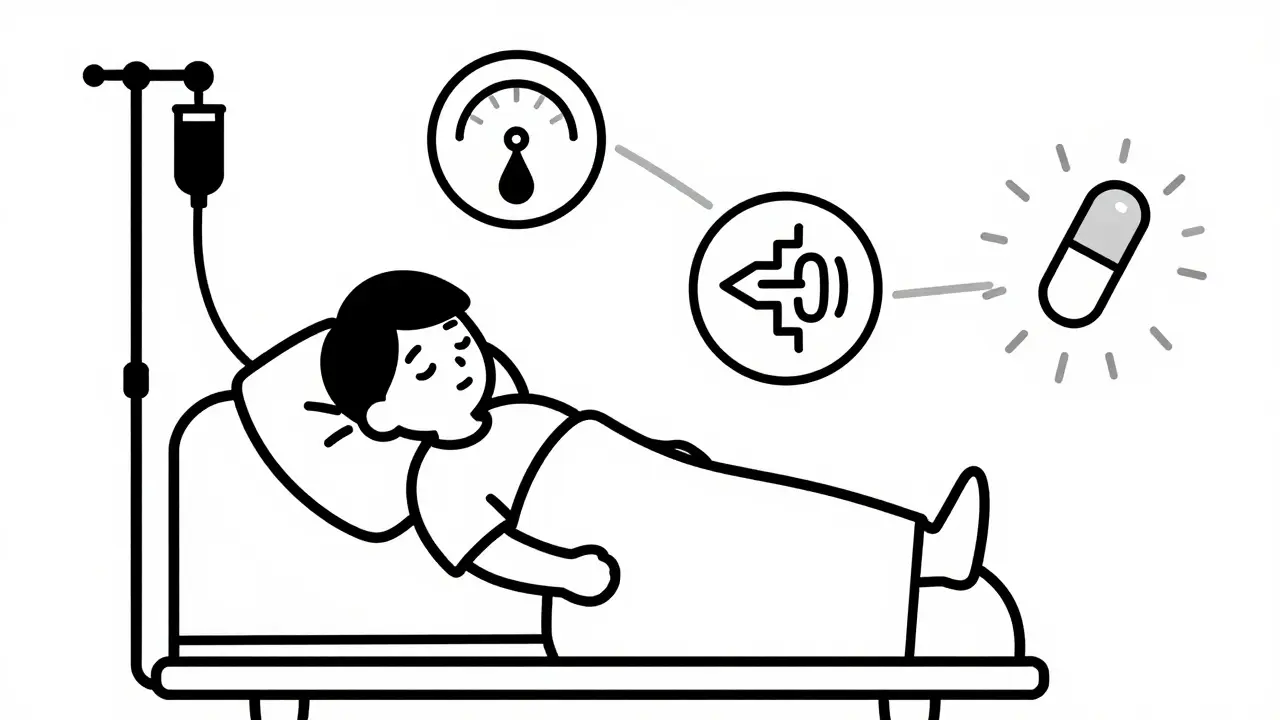
If you’ve accidentally taken tizanidine and ciprofloxacin together:- Don’t wait. Call your doctor or go to the ER if you feel dizzy, faint, unusually sleepy, or your heart is racing.
- Do not drive or operate machinery. Even if you feel okay, your reaction time could be dangerously slowed.
- Keep someone with you. Sedation can sneak up on you. You might not realize how bad it is until it’s too late.
How Can This Be Prevented?
Hospitals and pharmacies are starting to use electronic alerts to flag this combo before it’s prescribed. But not all systems are set up that way. That’s why you have to be your own advocate.- Always tell every doctor and pharmacist you see that you’re on tizanidine.
- When a new prescription comes in, ask: “Does this interact with tizanidine?”
- Use a medication app that checks interactions. Apps like Medscape or Epocrates can warn you before you fill the script.
Bottom Line: This Isn’t a Risk You Can Afford to Take
Tizanidine and ciprofloxacin aren’t just two common meds. Together, they create a perfect storm. The science is clear. The warnings are loud. And the consequences are real. No amount of convenience justifies the chance of collapsing on the floor, hitting your head, or needing emergency care because you didn’t ask the right question. If you’re prescribed both, say no. Ask for an alternative. Push back. Your body isn’t a lab experiment-it’s your life. And some drug combos aren’t worth the gamble.Can I take tizanidine and ciprofloxacin if I space them out by a few hours?
No. It doesn’t matter when you take them-whether 2 hours apart or 12 hours apart. Ciprofloxacin inhibits the CYP1A2 enzyme for days after you take it. Even if you take tizanidine the next day, the enzyme is still blocked, and tizanidine will build up to dangerous levels. The only safe option is to avoid the combination entirely.
Is there a safer muscle relaxant than tizanidine to use with ciprofloxacin?
Yes. Cyclobenzaprine is a better choice because it’s broken down by multiple liver enzymes, not just CYP1A2. Methocarbamol and baclofen are also safer options since they don’t rely on CYP1A2 metabolism. But always check with your doctor or pharmacist before switching-no drug is completely risk-free.
What antibiotics can I take instead of ciprofloxacin if I’m on tizanidine?
For most common infections like UTIs, amoxicillin, nitrofurantoin, or fosfomycin are safe alternatives. For sinus or respiratory infections, doxycycline or azithromycin won’t interfere with tizanidine. Your doctor can choose an antibiotic based on your infection type without risking this dangerous interaction.
How long should I wait after stopping ciprofloxacin before restarting tizanidine?
Wait at least 5 to 7 days after your last dose of ciprofloxacin. Even though ciprofloxacin’s half-life is only about 4 hours, its effect on the CYP1A2 enzyme lasts much longer. Restarting tizanidine too soon can still cause a dangerous spike in blood levels. When in doubt, wait longer.
Why do some doctors still prescribe this combo if it’s so dangerous?
Many doctors aren’t aware of the full risk, or they assume the patient is already taking tizanidine and don’t check the interaction. Electronic health records often don’t highlight this warning strongly enough. In busy clinics, it’s easy to miss. That’s why patients need to speak up-don’t assume your doctor knows.



Solomon Ahonsi
This is why people die from dumb prescriptions. Doctor writes cipro because it's the 'go-to' and never checks the med list. My uncle almost died from this exact combo. No one told him. No one asked. Just another stat in the ER.
George Firican
It's fascinating how pharmacology operates like a Rube Goldberg machine where one tiny obstruction-like a single enzyme being inhibited-can cascade into systemic collapse. Tizanidine's reliance on CYP1A2 isn't just a metabolic quirk; it's a vulnerability engineered into the drug's design, and ciprofloxacin doesn't merely interfere-it exploits it. The body doesn't have redundancy here, no backup pathways, no fail-safes. It's like driving a car with only one brake, and someone comes along and sandpapers the pad. This isn't an interaction-it's a betrayal of biological trust. We treat drugs like interchangeable tools, but the body isn't a toolbox. It's a symphony, and some notes, once silenced, can't be recovered.
Matt W
God, this needs to be shouted from rooftops. My mom got prescribed this combo last year and passed out in the kitchen. We thought she had a stroke. Turned out it was just two pills doing a death dance in her liver. I'm so glad someone finally wrote this clearly. Please share this with anyone on muscle relaxants.
Anthony Massirman
Don't mix these. Period.
Bridget Molokomme
So let me get this straight-doctors are still writing this combo like it’s 2005 and we don’t have computers? Maybe we should just start printing warning labels on their foreheads.
Vatsal Srivastava
Actually the FDA warnings are overblown. Most people tolerate it fine. This is just fearmongering wrapped in clinical language. People need to stop being so fragile
Brittany Marioni
PLEASE, PLEASE, PLEASE-every single person reading this: if you're on tizanidine, tell EVERY doctor, EVERY pharmacist, EVERY nurse-even the one who’s just taking your blood pressure!-and if they prescribe anything new, ask: 'Will this interact with tizanidine?'-and if they say 'probably not,' ask again. And again. And again. Your life isn't worth the risk of a 30-second oversight.
Dan Pearson
Look, I get it, Canada and the UK are all about 'caution'-but in America, we don't let fear stop progress. This combo works for millions. If you're weak enough to pass out from a little drowsiness, maybe you shouldn't be taking muscle relaxants at all. This is why America leads in medical innovation-we don't coddle patients. Also, cipro is the BEST antibiotic. Period.
Bob Hynes
Bro, this is wild. I had this exact thing happen to my cousin in Vancouver-she was just trying to chill after a long day, took her tizanidine, then popped cipro because her UTI was flaring… next thing she knows, she’s on the floor like a sack of potatoes. Took 3 days to get her back to normal. Now she only takes cyclobenzaprine. Like, why is this even a question? Just… don’t.
Eli Kiseop
So if I take cipro in the morning and tizanidine at night is it okay
Ellie Norris
Just a quick note-my husband was on this combo last year and we didn't know. He was so drowsy he forgot his own birthday. I only found out because I checked his meds on Medscape. Please, please, please use an app. It saved us. Also, typo: 'ciprofloxacin' has two f's, not one. 😅
Marc Durocher
Man, this is the kind of stuff that makes me want to throw my pharmacy degree out the window. We train for years to understand these pathways, but the system? It’s designed to move patients through like widgets. Someone’s got a backache and a UTI? Write two scripts. No time to check interactions. And then we wonder why people end up in ICU. It’s not the drugs-it’s the workflow. We need better alerts. We need better training. We need to stop pretending this is just a patient’s problem.
larry keenan
The pharmacokinetic interaction between ciprofloxacin and tizanidine is mediated through competitive inhibition of cytochrome P450 1A2, resulting in a significant reduction in hepatic clearance, thereby elevating the plasma concentration of tizanidine beyond therapeutic thresholds. This is well-documented in multiple clinical pharmacology studies, including those published in the Journal of Clinical Pharmacology and the British Journal of Clinical Pharmacology. The clinical implications are unequivocal: concomitant administration is contraindicated due to the high risk of hypotension and CNS depression. Alternative agents such as cyclobenzaprine, which undergoes multi-enzyme metabolism, are recommended for patients requiring concurrent antimicrobial therapy.