
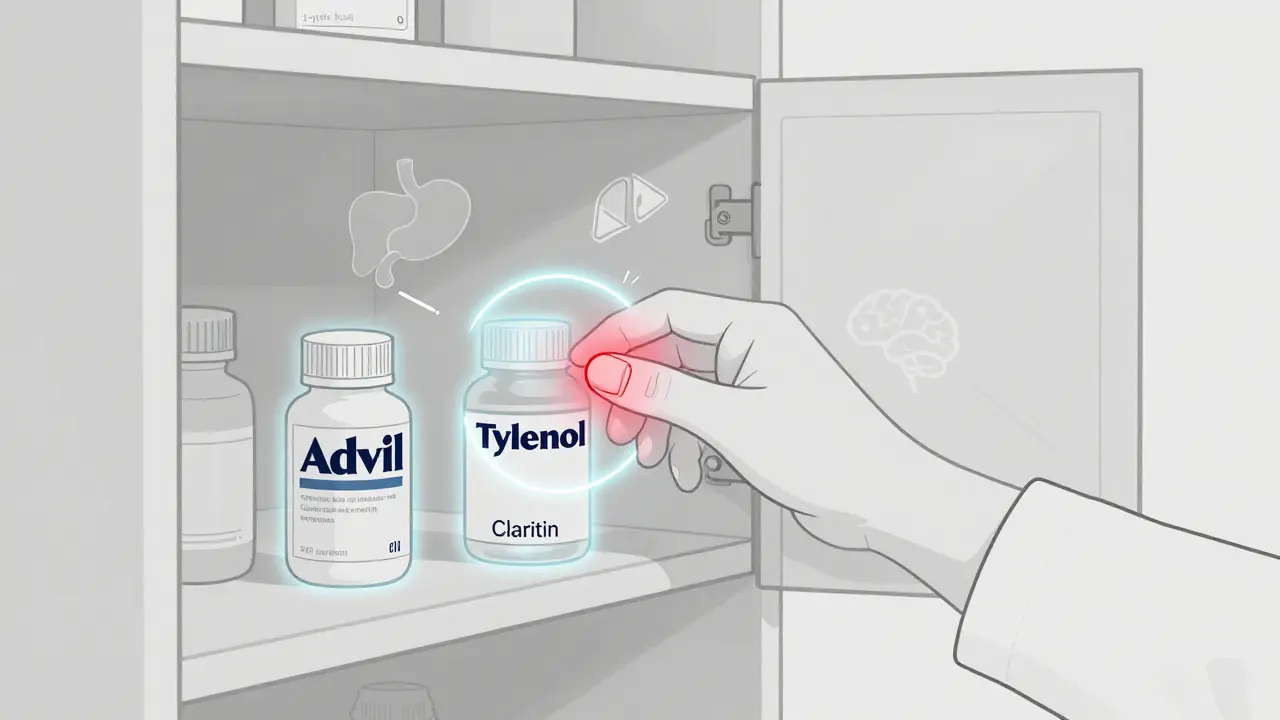
Every year, millions of people reach for an OTC pill without thinking twice. It’s a headache. A stuffy nose. A sore knee. You grab what’s in the cabinet-Advil, Tylenol, Claritin-and hope for the best. But here’s the truth: OTC doesn’t mean harmless. These medications are powerful, and using them wrong can land you in the emergency room. Let’s cut through the noise and break down exactly how NSAIDs, acetaminophen, and antihistamines really work, what they’re good for, and where most people go wrong.
NSAIDs: The Inflammation Fighters
NSAIDs-nonsteroidal anti-inflammatory drugs-are the go-to for pain that comes with swelling. Think sprained ankles, arthritis flare-ups, or menstrual cramps. Common OTC names: ibuprofen (Advil, Motrin IB), naproxen (Aleve), and aspirin. They work by blocking enzymes called COX-1 and COX-2 that trigger inflammation and pain signals. But here’s the catch: they don’t just turn off pain. They also mess with your stomach lining and blood clotting.
OTC ibuprofen comes in 200mg tablets. You can take up to 6 tablets a day-that’s 1,200mg total. Naproxen is stronger per pill (220mg), so you only take two a day. But if you’re using them every day for weeks, you’re doubling your risk of stomach bleeding. A 2021 study in the Journal of Pain Research found ibuprofen was 50% more effective than acetaminophen for inflammatory pain. That’s why athletes and people with joint pain swear by it. But if you’ve got a history of ulcers, kidney issues, or high blood pressure? Talk to a pharmacist first.
And don’t forget: aspirin isn’t just for pain. It’s a blood thinner. That’s why doctors give it to heart attack survivors. But if you’re not supposed to be on blood thinners? Taking aspirin OTC could turn a minor bleed into a life-threatening one.
Acetaminophen: The Safe Choice? Not Always
Acetaminophen (Tylenol) is the most popular pain reliever in the U.S. Why? Because it doesn’t irritate your stomach like NSAIDs do. It’s also safe for people with bleeding disorders or asthma-conditions where NSAIDs are off-limits. But here’s the dark side: acetaminophen is the number one cause of accidental liver failure in the U.S.
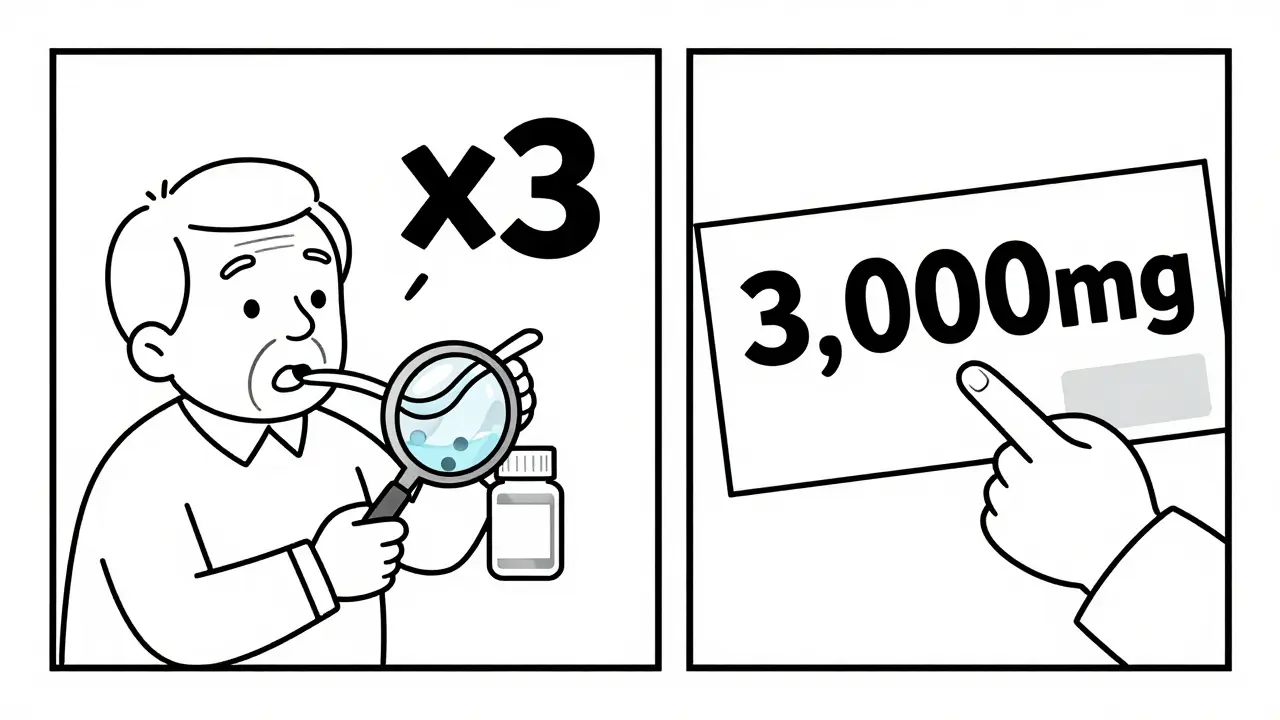
The FDA says the max daily dose is 4,000mg. But most manufacturers now recommend 3,000mg as a safer limit. Why? Because it’s terrifyingly easy to overdose. You take a Tylenol for your headache. Then you grab a cold medicine. Then you take a sleep aid. All of them contain acetaminophen. You don’t even realize you’re stacking doses. In 2023, over 56,000 emergency room visits in the U.S. were due to acetaminophen overdose. Half of those were accidental.
Each tablet is usually 325mg or 500mg. A liquid dose for kids is 160mg per 5mL. But here’s a real-world problem: people use kitchen spoons. The FDA found that 20% of pediatric overdoses happen because parents confuse teaspoons (tsp) with tablespoons (tbsp). A tablespoon is three times bigger. One wrong spoonful can be deadly for a child.
And it’s not just kids. Seniors often take multiple meds daily. If you’re on a statin, a blood pressure pill, or an antibiotic? Acetaminophen can interact. Your liver is already working overtime. Adding extra acetaminophen? It’s like pouring gasoline on a fire.
Antihistamines: Allergy Relief with a Catch
Allergies? Antihistamines are your friend. But not all are created equal. There are two generations: the old-school sedating ones and the modern non-drowsy ones.
First-generation: diphenhydramine (Benadryl), chlorpheniramine. They work fast-within 15 to 30 minutes. Perfect for sudden hives or bug bites. But they cross into your brain. That’s why 50% of users report drowsiness. In older adults, this increases fall risk by 50%. A 2021 JAMA Internal Medicine study linked these meds to higher rates of confusion and memory loss in seniors. Still, they’re cheap and effective for short-term use.
Second-generation: loratadine (Claritin), cetirizine (Zyrtec), fexofenadine (Allegra). These don’t make you sleepy. They’re designed to stay out of the brain. But they take longer to kick in-1 to 3 hours. And they’re not always better. One Reddit user in r/AskDocs shared that 20% of patients respond better to one antihistamine over another. Why? Genetics. Your body’s histamine receptors vary. If Claritin doesn’t work, try Zyrtec. If that fails, try Allegra. It’s trial and error.
And don’t forget: OTC antihistamines come in pills, liquids, dissolvable tabs, and even nasal sprays. But the pills are the most reliable. Sprays and liquids? They’re harder to dose accurately. One study found only 60% of liquid allergy meds came with a proper measuring cup. If you’re giving it to a child? Always use the tool that came with it.
What You’re Probably Doing Wrong
Most people think OTC means ‘safe to use however you want.’ It doesn’t. Here are the top three mistakes:
- Combining meds without checking: Cold medicine + Tylenol = double dose. Pain reliever + sleep aid = double dose. Always read the ‘Active Ingredients’ section on the label. If it says ‘acetaminophen’ or ‘ibuprofen’ twice-you’re doubling up.
- Ignoring the clock: Ibuprofen lasts 4-6 hours. Acetaminophen lasts 4-8. But if you take them every 4 hours for 3 days straight? You’re asking for trouble. Stick to the label. Don’t ‘just take one more’ because you’re still in pain.
- Using them for too long: If you’ve been taking OTC pain relievers for more than 10 days straight for the same issue? You’ve got an underlying problem. See a doctor. Chronic pain isn’t solved by popping pills. It’s solved by diagnosis.
Also: check inactive ingredients. Some people are allergic to dyes, gluten, or lactose. It’s rare, but it happens. A 2023 Merck Manual study found 5% of OTC users had reactions to fillers or coatings-not the active drug.
Who Should Be Extra Careful?
- Seniors: Liver and kidney function slow down with age. They process meds slower. Stick to the lowest effective dose. Avoid first-gen antihistamines. Acetaminophen is usually safer than NSAIDs for seniors, but still cap it at 3,000mg/day.
- People with liver disease: Acetaminophen is a no-go. Even small doses can cause damage.
- Asthma sufferers: NSAIDs can trigger severe breathing attacks. Up to 20% of people with asthma react badly. Stick to acetaminophen.
- Pregnant women: NSAIDs are risky after 20 weeks. Acetaminophen is the only OTC painkiller generally considered safe. Always check with your OB.
What’s Changing in 2026?
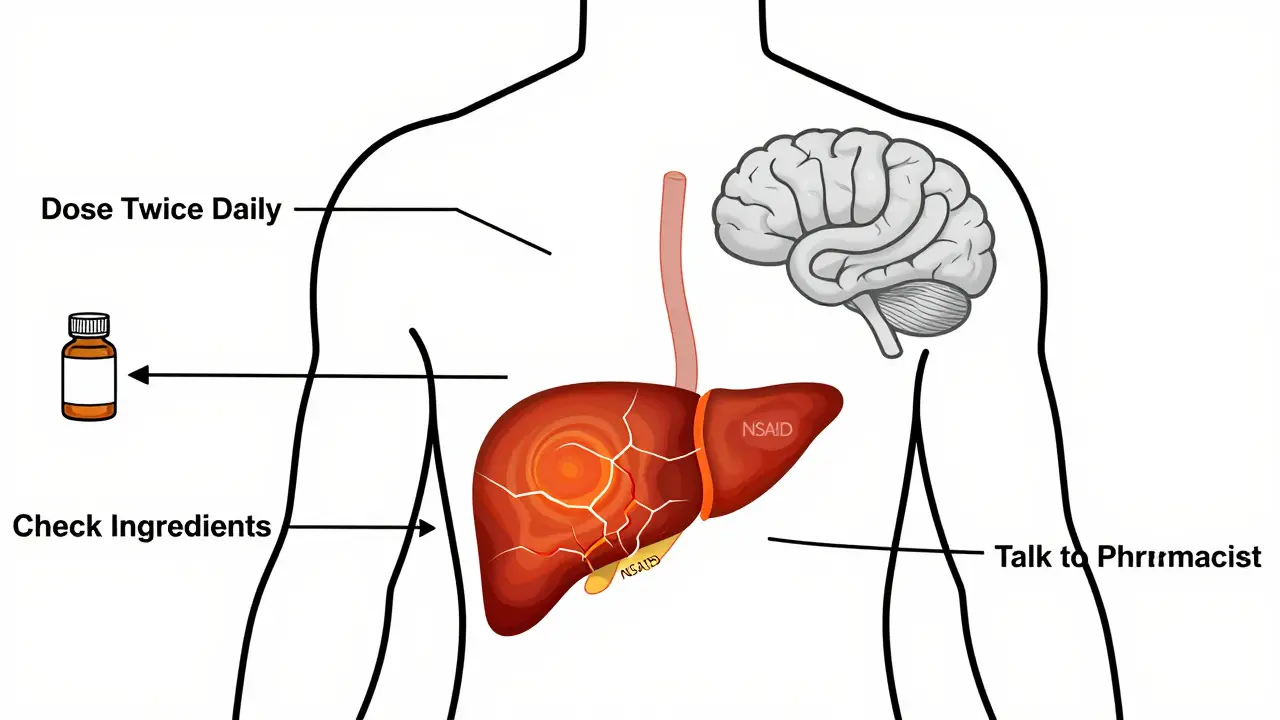
The FDA is pushing hard to make OTC meds safer. In 2023, they proposed lowering the max daily acetaminophen dose from 4,000mg to 3,250mg. That’s not a suggestion-it’s coming. Manufacturers are already starting to update labels.
Also, higher-strength topical NSAIDs are now available without a prescription. Voltaren Arthritis Pain 1% gel was the first. Now, a 3% diclofenac gel is OTC. It’s great for localized joint pain-no stomach risk. Just apply it to the sore spot. Wash your hands after.
And look out for the next big OTC shift: low-dose statins. Atorvastatin (Lipitor) might soon be available over the counter for cholesterol. It’s already happened with omeprazole (Prilosec). Once it was prescription-only. Now it’s on every shelf. That’s the future-more power in your hands, but more responsibility too.
Final Rule: Know Your Dose
OTC meds are tools. Not candy. The best advice? Read the label. Twice. Write down what you took and when. Use the measuring cup that came with the bottle. And if you’re ever unsure? Walk into a pharmacy. Pharmacists aren’t just cashiers. They’re trained experts who see hundreds of these mistakes every week. Ask them: ‘Is this safe with my other meds?’ They’ll tell you.
Because the real danger isn’t the medicine. It’s the assumption that it’s harmless.


Nandini Wagh
So let me get this straight - we’re giving people access to chemical weapons and calling it ‘OTC’? 🤡
My grandma took three Advil with a glass of wine and thought she was ‘just being proactive.’
She ended up in the ER with a gastric bleed. And the pharmacist? Just shrugged and said, ‘It’s on the shelf, honey.’
Someone needs to put a warning label on the bottle that says: ‘This is not candy. You are not a superhero.’
Holley T
Actually, I think the real problem isn’t the medications - it’s the cultural obsession with self-diagnosis and the myth that ‘if it’s OTC, it’s automatically safe’ - which is a dangerous oversimplification, because even water can kill you if you drink enough of it too fast, and acetaminophen is no different, especially when you’re combining it with other substances that are metabolized by the same hepatic pathways, like alcohol or certain antibiotics, which most people don’t even think to check because they assume that if it’s in the same aisle as the gum and the batteries, it must be harmless - but it’s not, and we need to stop treating pharmacology like a game of Russian roulette with a 12-pack of Tylenol and a cold medicine labeled ‘Nighttime Relief’ that contains the exact same active ingredient, which is why I’m not surprised that 56,000 ER visits last year were due to accidental overdose - because nobody reads labels anymore, and we’ve normalized ignorance as a lifestyle choice.
Dominic Punch
Listen. I’ve been a pharmacist for 18 years. I’ve seen it all.
You think you’re being smart by taking two Advil because ‘one didn’t work’? You’re not smart - you’re one liver enzyme away from a coma.
And don’t even get me started on people using kitchen spoons for kids’ liquid meds.
Here’s what you do: buy a 5mL syringe. $2 at any pharmacy. Use it. Every time.
Stop guessing. Stop trusting your gut. Read the label. Twice.
If you’re still unsure? Ask. Don’t Google. Don’t ask Reddit. Ask a pharmacist. We’re not here to sell you stuff - we’re here to stop you from killing yourself.
Valerie Letourneau
It is, indeed, a matter of considerable public health significance that over-the-counter pharmaceuticals are treated with such casual disregard, particularly in jurisdictions where regulatory oversight remains comparatively permissive.
One cannot help but observe that the normalization of polypharmacy - particularly in the context of concurrent use of analgesics and antihistamines - represents a systemic failure in public education, rather than an individual lapse in judgment.
It is my sincere hope that future labeling protocols will incorporate standardized, multilingual visual warnings, as has been successfully implemented in several European Union member states, where pictograms indicating contraindications have reduced unintentional overdose incidents by over 37% in the last decade.
Perhaps, then, we might begin to treat pharmacology with the gravity it deserves.
Khaya Street
Yeah, but let’s be real - most people don’t care. I’ve seen dudes take Tylenol and Benadryl together just to ‘chill out.’
They think it’s a party trick.
And don’t get me started on seniors who take four different OTC meds and call it ‘wellness.’
It’s not your fault if you’re dumb - but it’s everyone else’s problem when you end up in ICU.
So yeah, the info’s here. But most won’t read it.
And that’s just how it is.
Christina VanOsdol
OMG YES. 😱 I took NyQuil + Advil + a sleep gummy (yes, the one with melatonin) last week because I had a migraine + sinus pressure + insomnia. I thought I was being responsible. Then I woke up at 3am with my liver screaming. 💥
Turns out? 3,000mg of acetaminophen in 12 hours. Not even close to the ‘max.’
But it was enough. I Googled ‘is this overdose’ and cried for 20 minutes.
Also - WHY DO THEY USE THE SAME COLOR CAPS FOR DIFFERENT DRUGS??
It’s a trap. A sneaky, glittery, ‘feel-good’ trap.
Also also - I’m never trusting a pharmacy again. 😭
Brooke Exley
You know what’s wild? The fact that we’ve normalized self-medication so much that people don’t even think to ask if it’s safe - like, at all.
But here’s the good news: you can change this. Start small.
Next time you grab a bottle? Read the label like it’s a love letter.
Write down what you took. Set a phone reminder. Ask the pharmacist. No shame.
You’re not weak for asking - you’re brave for caring.
And if you’re helping someone else? Don’t just hand them the pill. Talk to them. Show them the measuring cup.
Small actions save lives. You’ve got this. 💪❤️
Alfred Noble
yeah i read this whole thing and honestly? i think the real issue is that people dont know how to read a label at all.
like i saw someone at walmart yesterday using a coffee spoon to measure kids' tylenol.
how??
also why do all the cold meds have the same name? 'daytime' 'nighttime' 'maximum strength' - it's like a game of musical chairs with chemicals.
also i always thought aspirin was just for heart stuff, but now i'm scared to even look at my medicine cabinet.
lol
Matthew Brooker
I’ve been using ibuprofen for years for my back pain and never had an issue. But now I’m wondering if I should switch to acetaminophen. I’ve got high blood pressure though. Anyone else in this boat? I’m just trying to stay active without wrecking my insides. I don’t want to be one of those stats.
Emily Wolff
This article is painfully basic. If you need this level of explanation, you shouldn’t be near a pharmacy. The real danger is not the drugs - it’s the people.
Lou Suito
You say acetaminophen causes liver failure? I’ve taken 10,000mg a day for months and I’m fine. Science is a social construct. Also, why is aspirin even in this list? It’s not even used for pain anymore. And why are you talking about 2026? The future is now. And it’s a lie.