
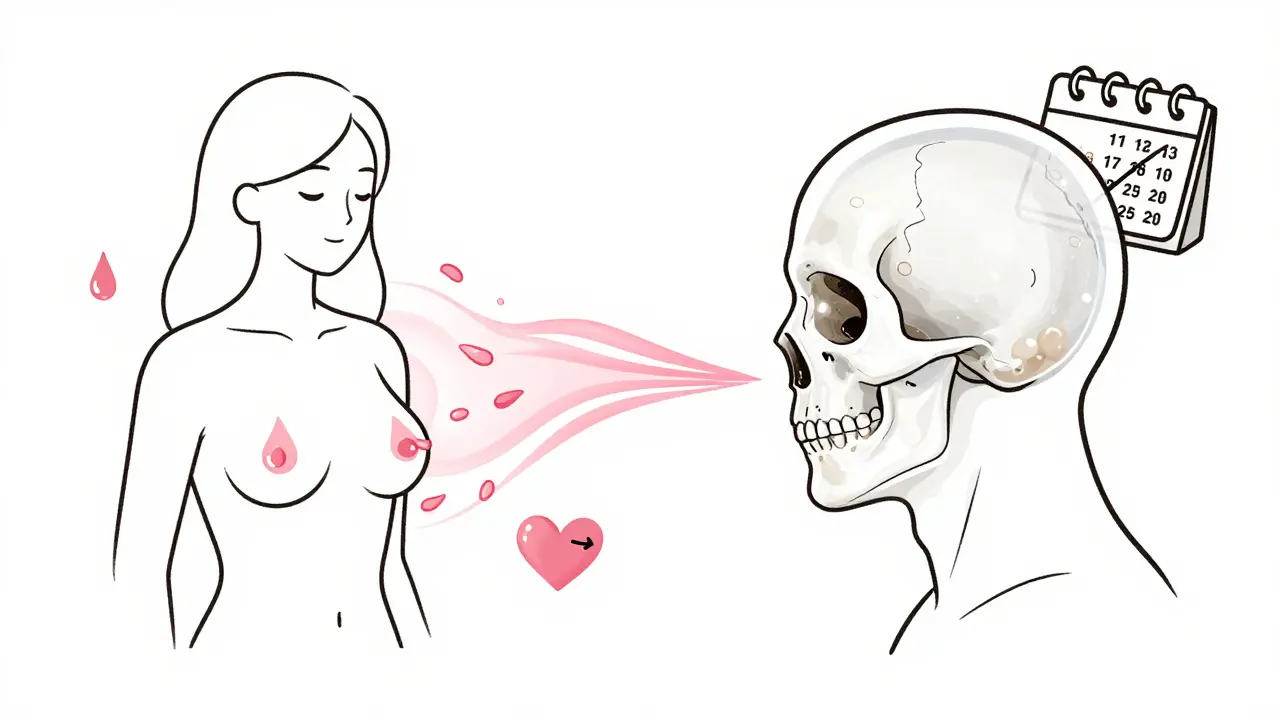
When your body’s main hormone control center starts growing a tumor, things don’t just get weird-they get serious. Pituitary adenomas are benign growths in the pituitary gland, a pea-sized organ at the base of your brain that runs your hormones like a conductor leads an orchestra. Most people never know they have one. About 1 in 10 adults has a tiny, silent pituitary tumor that never causes symptoms. But when that tumor starts pumping out too much prolactin, it turns your life upside down. That’s a prolactinoma-and it’s the most common type of hormone-producing pituitary tumor.
What Happens When Prolactin Goes Too High
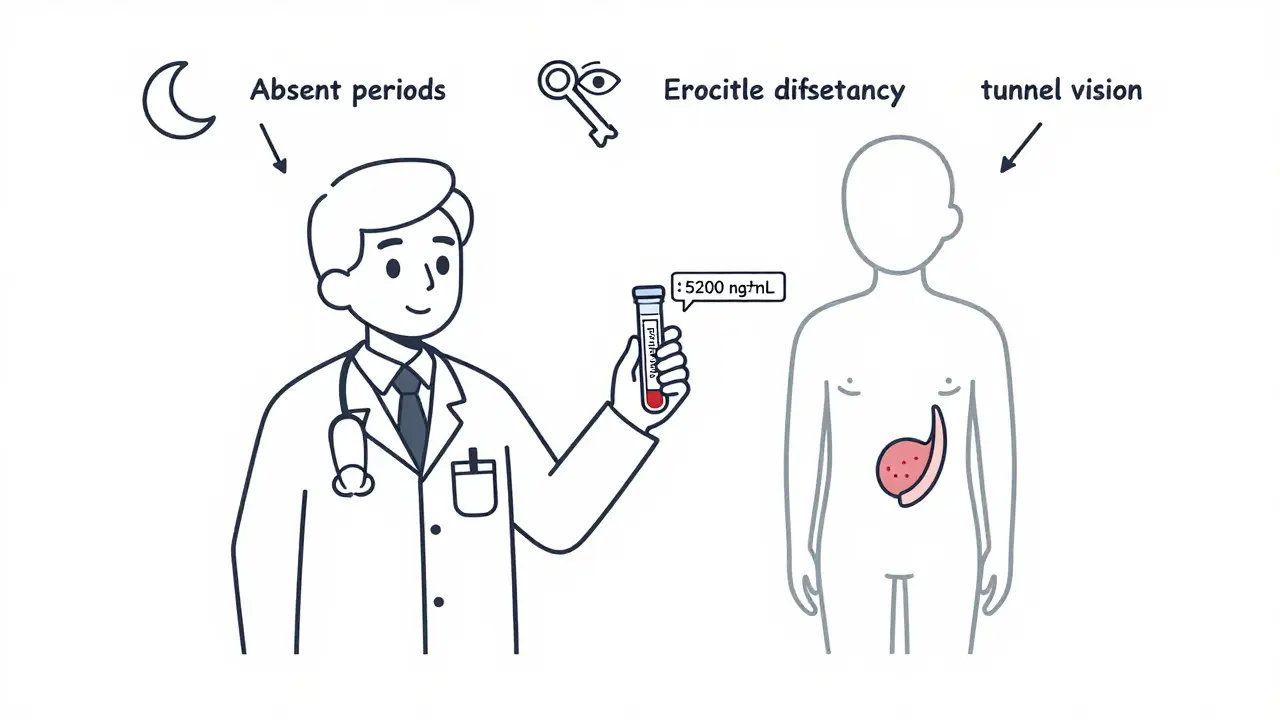
Prolactin isn’t just for breastfeeding. It’s a hormone that affects your sex drive, your period, your sperm production, and even your bone strength. When a prolactinoma grows, it dumps out way more prolactin than your body needs. Levels above 200 ng/mL usually mean a tumor larger than 1 cm. At 5,200 ng/mL, like in one documented case, your body is screaming for help.
In women, high prolactin means no periods, milk coming from the breasts even if they’ve never had a baby, and trouble getting pregnant. About 95% of women with prolactinomas experience one or more of these. In men, it’s more subtle-low libido, erectile dysfunction, fatigue, and sometimes breast tenderness. Around 80% of men with this condition notice sexual problems first. Many don’t connect the dots until they’re told their prolactin levels are through the roof.
It’s not just about reproduction. Too much prolactin can cause low estrogen or testosterone, leading to thinning bones over time. Left untreated, this can increase fracture risk later in life. And if the tumor grows large enough to press on your optic nerves, you start losing peripheral vision-like looking through tunnel vision. That’s a medical red flag.
Diagnosis: It Starts With a Blood Test
Before imaging or surgery, it’s a simple blood test that changes everything. A single serum prolactin level above 150 ng/mL has a 95% chance of being a prolactinoma. But not every high level means a tumor. Stress, pregnancy, certain medications like antidepressants or antipsychotics, and even nipple stimulation can temporarily spike prolactin. Doctors rule those out first.
If the number stays high, the next step is an MRI of the pituitary gland with 3mm slices. That’s the gold standard. A microadenoma is under 1 cm. A macroadenoma is bigger-and more likely to cause vision problems or crush other parts of the pituitary. A visual field test checks if your side vision is fading. If it is, you need fast action.
Doctors don’t just look at the size. They check if the tumor is invading nearby structures like the cavernous sinus, where major nerves and arteries live. That affects treatment choices. Invasive tumors are harder to remove surgically and more likely to come back.
First-Line Treatment: Pills, Not Scalpels
For almost every prolactinoma, the first move isn’t surgery. It’s dopamine agonists-medicines that trick your brain into thinking there’s enough prolactin. The two main ones are cabergoline and bromocriptine. But here’s the thing: cabergoline wins by a landslide.
Cabergoline is taken just twice a week. Most people start at 0.25 mg per dose. Within weeks, prolactin levels drop. By three months, 80-90% of microadenomas and 70% of macroadenomas have normal hormone levels. Tumors shrink in 85% of cases. One patient saw a 2.4 cm tumor shrink by 70% in a year. That’s not magic-it’s science.
Bromocriptine works too, but it’s taken daily. And side effects? Rough. Up to 45% of people get severe nausea. Dizziness hits 38%. One in three people quit it because they can’t stand it. With cabergoline, only 18% stop due to side effects. That’s why guidelines from the Endocrine Society, Harvard, and the University of Sydney all say: start with cabergoline. Save surgery for the exceptions.
When Surgery Becomes Necessary
Surgery isn’t the first choice-but it’s the right one in some cases. If your vision is fading, or if you can’t tolerate the pills, or if the tumor is crushing your pituitary and causing multiple hormone failures, then it’s time to go under the knife.
The procedure is called transsphenoidal surgery. Surgeons go through your nose, not your skull. Endoscopic tools give them a clear view. For small tumors under 1 cm, success rates hit 85-90%. For big ones over 1 cm? That drops to 50-60%. Why? Because large tumors often wrap around blood vessels and nerves. You can’t always remove it all without risking damage.
Recovery is quick-most people leave the hospital in 3-5 days. But complications happen. About 5% get a cerebrospinal fluid leak. A few develop diabetes insipidus, where the body can’t hold onto water. That means drinking gallons a day and taking desmopressin. It’s manageable, but it’s a shock if you weren’t warned.
And here’s the hard truth: even after successful surgery, 25-30% of macroadenomas come back within five years. Microadenomas? Only 5%. That’s why follow-up blood tests are non-negotiable.
Radiation: The Slow Option
Radiation isn’t used much anymore unless the tumor comes back after surgery and meds fail. It’s slow. It takes 2 to 5 years to fully control prolactin. You’re stuck with symptoms for years while waiting.
There are three types: conventional radiation, Gamma Knife, and proton beam. Gamma Knife is the favorite now. It delivers one high-dose blast in a single day, with precision that spares your optic nerves. Only 1-2% of patients have vision damage with Gamma Knife. With older radiation? Up to 10%. That’s a huge difference.
But radiation has its own cost. Half of patients end up with hypopituitarism-where the pituitary stops making other hormones like cortisol or thyroid hormone. That means lifelong replacement pills. And the risk keeps growing over time. For that reason, radiation is rarely the first or second choice. It’s a last resort.

Long-Term Risks and Monitoring
Cabergoline is safe for most people-but not forever without checks. If you’re taking more than 2 mg per week for over three years, your heart valves need monitoring. About 2-7% of long-term users develop mild valve regurgitation. It’s usually not dangerous, but it needs an echocardiogram every two years.
And you can’t just stop the pill. Miss one dose? Prolactin can bounce back in 72 hours. That’s why adherence is everything. Many patients do great for years, then stop because they feel fine-and then their period disappears again, or their libido vanishes. It’s a trap.
Even if your prolactin is normal and the tumor is gone, you still need annual blood tests. Hormones can drift. Tumors can regrow silently. And if you’ve had radiation or surgery, you might need hormone replacement for life-cortisol, thyroid, testosterone, estrogen. Your pituitary might never fully recover.
What’s Next? The Future of Treatment
Science is moving fast. In 2023, the FDA approved paltusotine for acromegaly, and early trials are testing it for prolactinomas. It’s a new kind of pill that could replace cabergoline for some. Researchers are also exploring CRISPR to fix genetic mutations linked to tumor growth, like MEN1. AI is being used to plan surgeries with 3D models of your exact anatomy.
But here’s the reality: despite all the progress, 30% of large prolactinomas still don’t respond well to current treatments. That’s why research continues. For now, though, the best tool we have is still a simple pill, taken twice a week, that can turn a life-altering condition into a manageable one.
What You Need to Do Now
If you’ve been told you have a prolactinoma, here’s your action plan:
- Get your prolactin level confirmed with a repeat blood test.
- Request a high-resolution pituitary MRI with 3mm slices.
- See an endocrinologist-not just a general doctor. This is their specialty.
- Start cabergoline at 0.25 mg twice a week. Don’t panic if you feel dizzy at first-side effects usually fade in a week.
- Get your vision tested if the tumor is over 1 cm.
- Don’t stop the medication without talking to your doctor-even if you feel fine.
- Get an echocardiogram if you’re on more than 2 mg per week for over a year.
Pituitary adenomas aren’t cancer. But they’re not harmless either. They steal your hormones, your energy, your fertility, your confidence. The good news? Most of the time, they’re fixable. With the right treatment, you don’t just survive-you get your life back.
Can a prolactinoma go away on its own?
Rarely. Most prolactinomas don’t shrink without treatment. Small ones might stabilize, but they won’t disappear. Left untreated, they can grow larger and cause permanent damage to vision or hormone function. Medication or surgery is almost always needed for long-term control.
Is cabergoline safe for long-term use?
Yes, for most people. Cabergoline is approved for long-term use and is the standard treatment for decades. However, if you take more than 2 mg per week for over three years, your doctor should monitor your heart valves with an echocardiogram every two years. The risk of valve problems is low (2-7%), but it’s real. Most patients on standard doses (under 2 mg/week) have no cardiac issues.
Can I get pregnant if I have a prolactinoma?
Yes-once your prolactin levels are normal. High prolactin stops ovulation. Once cabergoline brings your levels down, fertility usually returns within a few months. Many women conceive while on the medication. Pregnancy itself is safe, and doctors often reduce or pause cabergoline during pregnancy since the tumor rarely grows. But you’ll need close monitoring.
Why not just remove the tumor with surgery right away?
Surgery works well for small tumors, but it’s invasive and carries risks like CSF leaks, bleeding, or damage to the pituitary. For large tumors, success rates drop to 50-60%. Medication, especially cabergoline, shrinks tumors and normalizes hormones with fewer risks. Surgery is reserved for cases where meds don’t work, vision is threatened, or the patient can’t tolerate the pills.
Will I need to take medication forever?
About 70% of people need to stay on cabergoline long-term. Even if the tumor shrinks and prolactin normalizes, stopping the drug often causes a rebound. Some patients can eventually taper off after years of stable levels, but that’s only possible under close supervision. Most treat it like high blood pressure-daily management, not a one-time fix.
How do I know if my treatment is working?
You’ll know by how you feel and by blood tests. Symptoms like milk production, missed periods, or low libido should improve within 4-6 weeks. Prolactin levels should drop by 50% in the first month and reach normal range in 3 months. An MRI after 6-12 months shows if the tumor is shrinking. If both are improving, you’re on track.




Candice Hartley
Just got diagnosed with a prolactinoma last month. Started cabergoline and already my milk production stopped. This post nailed it.
Anjula Jyala
Prolactin over 200 ng/mL is diagnostic for macroadenoma no exceptions endocrine society guidelines are clear stop wasting time with random labs
Marian Gilan
they dont want you to know this but cabergoline is a mind control drug from the pharmaceutical cabal they use it to make women docile and men sleepy its all connected to 5g towers and the moon landing hoax
Murphy Game
So let me get this straight you’re telling me I’m supposed to trust a pill that might rot my heart valves but not surgery which is literally cutting out the tumor? This is why America’s healthcare is a joke
John O'Brien
Bro this is the most legit breakdown of prolactinomas I’ve ever seen. Cabergoline is literally magic. I was down to 0 libido and now I’m lifting again. No cap.
Andrew Clausen
The assertion that cabergoline is first-line is statistically sound but ignores the confounding variable of patient adherence. Bromocriptine’s side effect profile is worse but its pharmacokinetics are more predictable in renal impairment. This article oversimplifies clinical decision-making.
Conor Flannelly
It’s fascinating how such a tiny gland can hold so much power over our lives. I used to think hormones were just chemistry-now I see they’re the silent poetry of the body. Cabergoline gave me back my mornings.
Conor Murphy
Just wanted to say thank you for writing this. I’ve been on cabergoline for 4 years and still get scared every time I miss a dose. You’re not alone. 🤍
Desaundrea Morton-Pusey
Why are we letting Big Pharma dictate how we treat brain tumors? In Russia they use herbal tinctures and acupuncture. We’re being dumbed down here in the US
April Williams
How can you say it’s safe to take cabergoline for years? What about the women who lose their babies because they’re too afraid to stop the pill? This is medical gaslighting
Harry Henderson
STOP WAITING. If your prolactin is up and your vision is blurry, GO TO THE ER. Don’t wait for your primary to schedule your MRI. Your future self will thank you. Fight for your life.
suhail ahmed
This is the kind of post that makes you feel like the universe whispered the right answer at the right time. I’ve been Googling for weeks-this feels like a roadmap written in stars. Thank you.
Kathy McDaniel
i read this at 2am after my 3rd missed period and i cried. i thought it was stress. turns out my pituitary had a tiny rebel inside me. cabergoline is my new best friend. 🥺
Patrick Merrell
They say radiation is a last resort but they never mention the 30% who end up with permanent adrenal failure. You think you’re cured until you collapse on the subway because your cortisol dropped to zero. This isn’t treatment-it’s a gamble with your life.
John O'Brien
^ This is why you need an endocrinologist who actually listens. My last doc said ‘just take the pill and stop being dramatic.’ I switched and now I’m alive. Don’t settle for dismissive care.