

When you’re managing bipolar disorder with lithium carbonate, it’s not just about taking a pill. It’s about serum lithium levels-the invisible line between stability and danger. Generic versions of lithium are everywhere now, cheaper than the brand names, and doctors prescribe them without a second thought. But here’s the problem: not all generics are the same. Switch from one to another, and your blood levels can jump or drop-without you feeling a thing until it’s too late.
Why Lithium Isn’t Like Other Medications
Most drugs have a wide safety window. Take a little more? Maybe you get a little drowsy. Take a little less? Maybe it doesn’t work as well. Lithium isn’t like that. Its therapeutic range is razor-thin: 0.6 to 1.2 mmol/L. Go above 1.5 mmol/L, and you risk toxicity-tremors, confusion, kidney stress, even heart rhythm problems. Go below 0.6, and your mood might crash back into depression or mania. This isn’t guesswork. It’s science. And it’s why every patient on lithium needs regular blood tests.Lithium was first used for mood stabilization in Australia in the 1940s. John Cade’s experiments with lithium salts in guinea pigs led to the first human trials. Today, it’s still one of the most effective drugs for preventing suicide in bipolar disorder. But its power comes with precision. You can’t just pick any generic and expect the same result.
Generic vs. Brand: The Hidden Differences
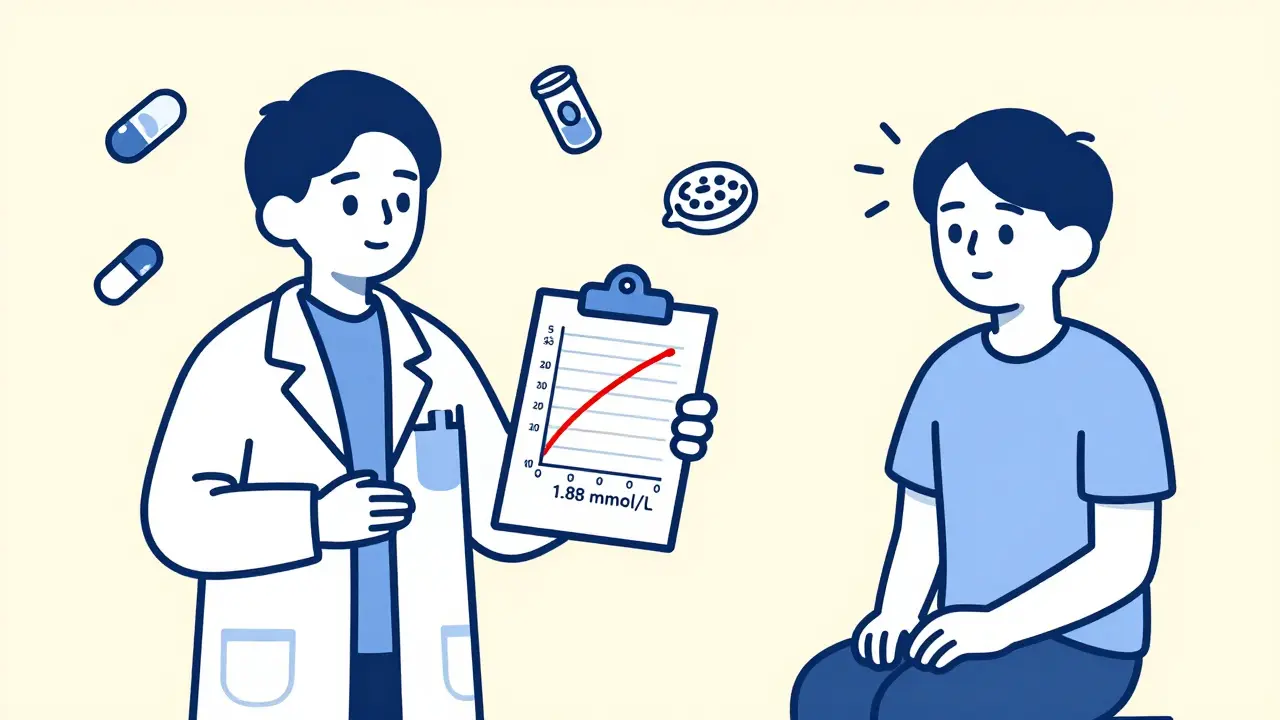
All generic lithium carbonate must prove bioequivalence to the brand name-meaning their absorption in the body falls within 80-125% of the original. Sounds fair, right? But here’s the catch: that range is huge. Two generics can be 125% different in how fast they release lithium into your blood-and still both be considered "equivalent." For example, Priadel and Camcolit are both sustained-release formulations. But a 2024 study found patients on Camcolit had, on average, 11% higher serum levels than those on Priadel-even when given the same milligram dose. That’s not a small difference. That’s enough to push someone from 0.9 mmol/L into the risky 1.0-1.2 zone, or worse, above 1.3.Even more troubling: immediate-release lithium (like Essential Pharma’s version) hits peak blood levels in 1-3 hours. Sustained-release versions take 4-5 hours. If you switch from one to the other without adjusting your dose or timing, your levels can spike or dip unpredictably. One patient in the same study saw their lithium level jump to 1.88 mmol/L after a generic switch-no symptoms at first, but dangerously close to toxicity.
When and How to Check Your Levels
Timing matters. If you’re on a standard-release lithium pill taken three times a day, your blood test should be done 12 hours after your last dose. That’s when levels stabilize. If you’re on a once-daily sustained-release tablet, you wait 24 hours-because that’s when the drug fully clears from your system.Most doctors check levels every 3-6 months once you’re stable. But if you’ve switched generics, changed your dose, started a new medication, or even had the flu, you need a test within two weeks. Why? Because lithium is cleared by your kidneys. Any change in hydration, salt intake, or kidney function alters how much stays in your blood.
And here’s something many patients don’t know: your lithium level doesn’t just depend on your dose. It’s also tied to your age, weight, sex, and kidney health. A 75-year-old woman on 600 mg/day might have the same blood level as a 30-year-old man on 1,200 mg. That’s why dosing isn’t one-size-fits-all.
Target Levels: What’s Right for You?
There’s no single "correct" level. It depends on your situation.- Acute mania: 0.8-1.0 mmol/L
- Maintenance (stable): 0.6-0.8 mmol/L
- Sustained-release formulations: Aim for the higher end-0.8-1.0 mmol/L
- Over 60: Many experts recommend 0.4-0.7 mmol/L due to reduced kidney function
Back in the 1980s, doctors thought higher levels meant better results. A 1984 study showed patients with levels of 0.8-1.0 had less than half the relapse rate of those on 0.4-0.6. But today, we know that higher levels mean more side effects: tremors, weight gain, thyroid problems, kidney strain. The trend now is to use the lowest effective dose. That’s why most guidelines now favor 0.6-0.8 mmol/L for long-term use.
Still, some psychiatrists-especially when treating severe bipolar I-stick with 0.8-1.0. It’s not about being old-fashioned. It’s about balancing risk. If you’ve had multiple hospitalizations, you might need the higher end. If you’re stable and feel great on 0.6, don’t push it up.
What Else Affects Your Levels?
Lithium doesn’t live in a vacuum. Other things change how your body handles it:- NSAIDs (like ibuprofen or naproxen): Can raise lithium levels by 20-40%. Avoid them unless approved by your doctor.
- Diuretics (water pills): Increase lithium retention. Dangerous combo.
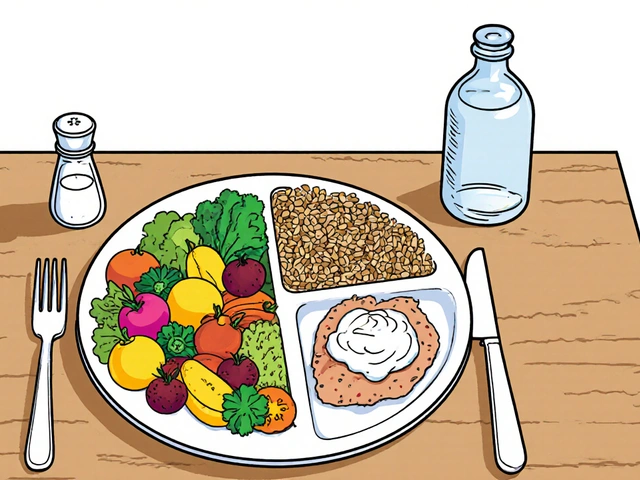
- Salt intake: Low-salt diets (like keto or paleo) can spike lithium levels. Keep your salt intake steady.
- Dehydration: Even mild dehydration from exercise, heat, or illness can cause lithium to build up. Drink water, but don’t overdo it.
- Thyroid function: Lithium causes hypothyroidism in 5-15% of users. Get your TSH checked every 6-12 months.
- Kidney function: Check your eGFR and creatinine regularly. Some experts now recommend cystatin C instead-it’s more accurate for older adults.
One patient I worked with switched from a brand to a generic, cut back on salt because she was trying to lose weight, and started taking ibuprofen for her arthritis. Within three weeks, her lithium level jumped from 0.7 to 1.3. She didn’t feel sick-just a little "off." But her kidneys were stressed, and her tremor had gotten worse. All from changes she thought were harmless.
What to Do If You’re Switching Generics
If your pharmacy switches your lithium to a different brand-whether because of cost, supply, or insurance-you need to act.- Don’t panic. Many switches are fine.
- Call your prescriber. Tell them the brand changed.
- Request a blood test within 10-14 days. Don’t wait for your next routine check.
- Watch for symptoms: Increased tremor, nausea, confusion, frequent urination, or muscle weakness.
- Keep a log. Note your dose, the brand name, and how you feel. This helps your doctor spot patterns.
Some pharmacies will warn you if they’re switching brands. But many won’t. You have to ask. Your lithium level is too important to leave to chance.
The Future: Personalized Lithium Dosing
We’re starting to move beyond trial-and-error. The International Consortium on Lithium Genetics (ConLiGen) has identified 30 genetic variants linked to how people process lithium. Some people naturally clear it faster. Others hold onto it longer. Soon, a simple DNA test might tell your doctor your ideal starting dose.Some clinics are already using AI tools that pull data from your electronic health record-your age, weight, kidney numbers, meds, even your weather app (yes, humidity affects hydration)-and suggest a dose. It’s not perfect yet, but it’s getting closer.
For now, though, the best tool is still the blood test. And the best advice? Never assume your generic is the same as the last one. Even if the label says "lithium carbonate 600 mg," the release profile could be different. And that’s enough to change your life.
Final Thought: Lithium Still Matters
There are newer drugs for bipolar disorder-anticonvulsants, atypical antipsychotics. But none have the same track record for preventing suicide. Lithium remains the gold standard for long-term stability. And while generics make it affordable, they don’t make it simple.If you’re on lithium, your job isn’t just to take it. It’s to understand it. To track it. To speak up when something feels off. Because when your serum level is right, you don’t just feel better. You stay alive.


saurabh singh
Man, I wish my doc told me this before I switched generics last year. I thought I was saving money, but I ended up in the ER with tremors and nausea. Turns out the new brand was way more absorbent. No one warned me. Don’t let this be you-ask for the brand, or at least get a blood test right after a switch.
Charlotte N
I’ve been on lithium for 12 years and never knew that salt intake mattered so much. I went keto last winter and my levels spiked-no symptoms, just a weird foggy feeling. My psychiatrist had no idea until I brought up my diet. Now I eat a teaspoon of sea salt daily. Small thing. Huge difference.
Mandy Kowitz
Of course the pharmaceutical companies love generics. More profit, less accountability. They’ll sell you a pill that’s 125% different and call it ‘equivalent.’ Meanwhile, people are getting poisoned because no one wants to pay for the brand. This isn’t healthcare-it’s a casino.
melissa cucic
There is a profound ethical tension here: the imperative to make life-saving medication accessible, versus the biological reality that lithium is not a commodity-it is a precise instrument. To treat it as interchangeable is to misunderstand not just pharmacology, but personhood. Each patient is a unique chemical ecosystem. Reducing them to a dosage number is not efficiency-it is abstraction with consequences.
And yet, we live in a system that rewards cost-cutting over care. I have watched friends lose stability not because of their illness, but because of a pharmacy’s contract with a distributor. This is not negligence-it is structural violence.
Perhaps the solution lies not in better generics, but in demanding that insurers cover brand-name lithium without prior authorization. Perhaps it lies in funding research that maps individual pharmacokinetics-not population averages. Perhaps it lies in listening to patients who say, ‘This feels different.’
We have the science. We have the data. What we lack is the will.
jigisha Patel
Actually, the 2024 study you cited? It had a sample size of 47 patients, and only 12 were on sustained-release. The margin of error for the 11% difference is ±4.2%. Also, the study didn’t control for concurrent NSAID use-which you yourself admit affects levels. So no, the difference isn’t clinically significant. You’re overreacting to noise.
And the 1.88 mmol/L case? That patient was on immediate-release, switched to sustained-release without dose adjustment, and didn’t follow timing protocols. That’s not the generic’s fault-it’s patient education failure. Blaming manufacturers is lazy.
Abhishek Mondal
Let’s be honest: lithium is a 70-year-old drug. We’ve had SSRIs, SNRIs, ketamine, psychedelics, and AI-driven dosing algorithms-and yet we’re still clinging to a mineral salt from the 1940s? The fact that we’re still debating whether two generics are ‘equivalent’ proves how stagnant psychiatric pharmacology is. We need innovation, not nostalgia.
And why are we still measuring serum levels with outdated protocols? Cystatin C? Really? That’s a biomarker for kidney filtration, not lithium pharmacokinetics. We need pharmacogenomic-guided dosing-not blood draws every three months.
Also, your ‘target levels’ table? Arbitrary. Based on 1980s consensus, not modern evidence. The real target should be symptom resolution-not arbitrary mmol/L ranges. You’re treating numbers, not people.
Justin Lowans
Thank you for writing this with such clarity and care. This is the kind of information that should be printed on every lithium prescription bottle. I’ve seen too many patients cycle through mood episodes because they were switched to a ‘cheaper’ generic without warning. The fact that lithium’s window is so narrow-and that its effects are so invisible until it’s too late-makes this not just a medical issue, but a moral one.
Doctors, pharmacists, and insurers need to be held accountable for the silent shifts in care. And patients? You’re not being paranoid if you feel different. You’re being observant. Trust that. Advocate for yourself. Your life depends on it.
And yes-lithium still matters. Not because it’s old, but because it works. When everything else fails, lithium holds the line. Let’s not break it for the sake of a few dollars.
Jason Stafford
They’re doing this on purpose. The FDA, the pharmaceutical giants, the AMA-they all know lithium generics can kill you. But they don’t care. Why? Because they’re part of a system that profits from hospitalizations, ER visits, and long-term kidney dialysis. You think your ‘generic’ switch was random? No. It’s scheduled. They want you unstable. Then they sell you the next drug. Then the next. Then the next. This isn’t medicine. It’s a slow-motion assassination disguised as cost-saving.