
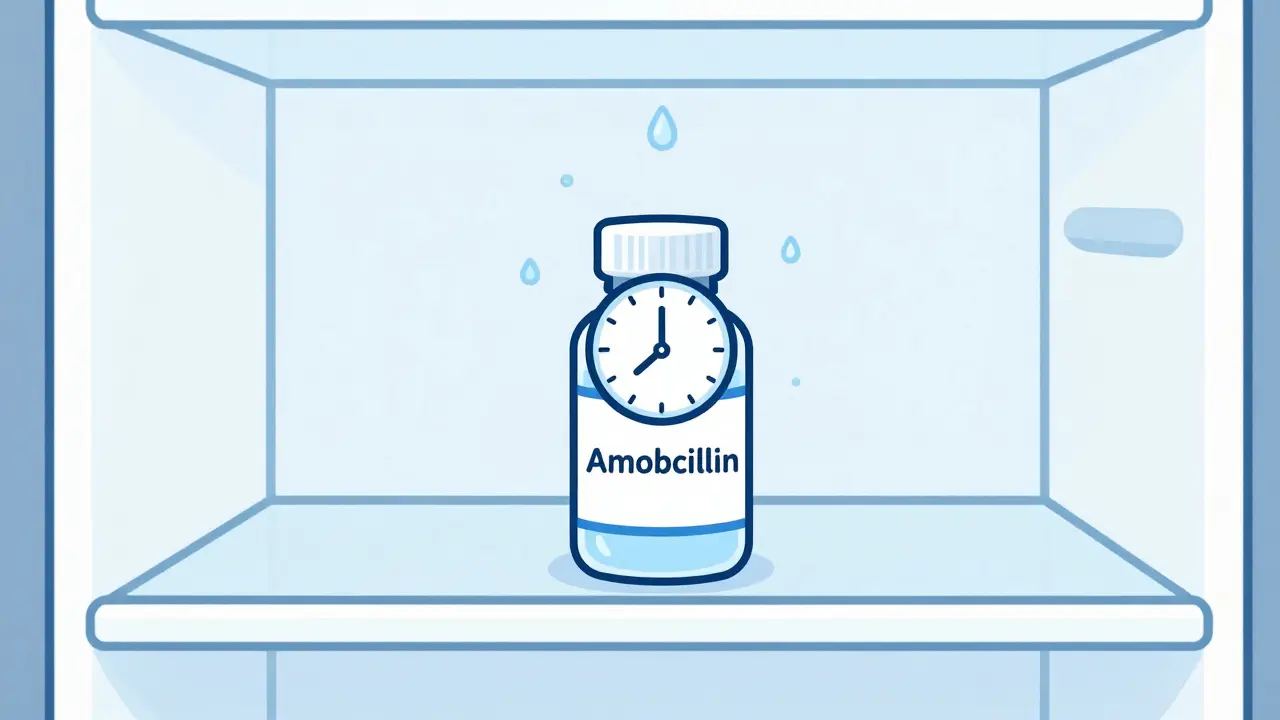
Why Your Liquid Antibiotic Doesn’t Last Like Pills Do
When you pick up a bottle of liquid amoxicillin for your child, it looks fresh, smells fine, and the label says to finish the whole bottle. But then you’re told: throw it out after 10 or 14 days, even if there’s half left. Why? It’s not a trick. It’s chemistry.
Liquid antibiotics aren’t like pills you can stash in a drawer for months. They’re made by mixing dry powder with water right before you get it from the pharmacy. That water triggers chemical reactions that slowly break down the medicine. Once that happens, the antibiotic loses strength. And if it’s not strong enough, the infection doesn’t clear - which means your kid might get sicker, or worse, the bacteria could become resistant.
The Science Behind the Clock
Most liquid antibiotics are beta-lactams - like amoxicillin, ampicillin, and penicillin V. These drugs have a fragile ring structure that falls apart in water. This is called hydrolysis. The moment you add water, the clock starts ticking.
Studies show that at room temperature (27-29°C), amoxicillin/clavulanate drops below 90% potency by day five. That’s the threshold regulators use to define “still effective.” Refrigeration slows this down. At 2-8°C, plain amoxicillin lasts up to 14 days. But add clavulanate - the part that fights resistant bacteria - and the clock ticks faster. It only lasts 10 days, even in the fridge.
Even the container matters. If you pour the liquid into a plastic oral syringe, clavulanate breaks down even quicker - sometimes under five days. The original bottle? It’s designed to protect the medicine. Switching containers? You’re speeding up the decay.
Freezing: A Hidden Trick
Most people don’t know this, but freezing can extend shelf life dramatically. Back in 1979, researchers found that amoxicillin kept at -20°C stayed above 90% potent for 60 days. Same with ampicillin and penicillin V. Even at -10°C, amoxicillin held 88% of its strength after two months.
So why don’t pharmacies freeze it? Because most families don’t have space, and thawing and refreezing can cause clumping or uneven mixing. Plus, once it’s thawed, the clock resets. You can’t freeze it, thaw it, and then expect another 14 days. The stability data doesn’t support that.
Still, if you’re on a long course and the medicine won’t be used for days, ask your pharmacist if freezing is an option. Some clinics do it - especially for kids on 14-day treatments.
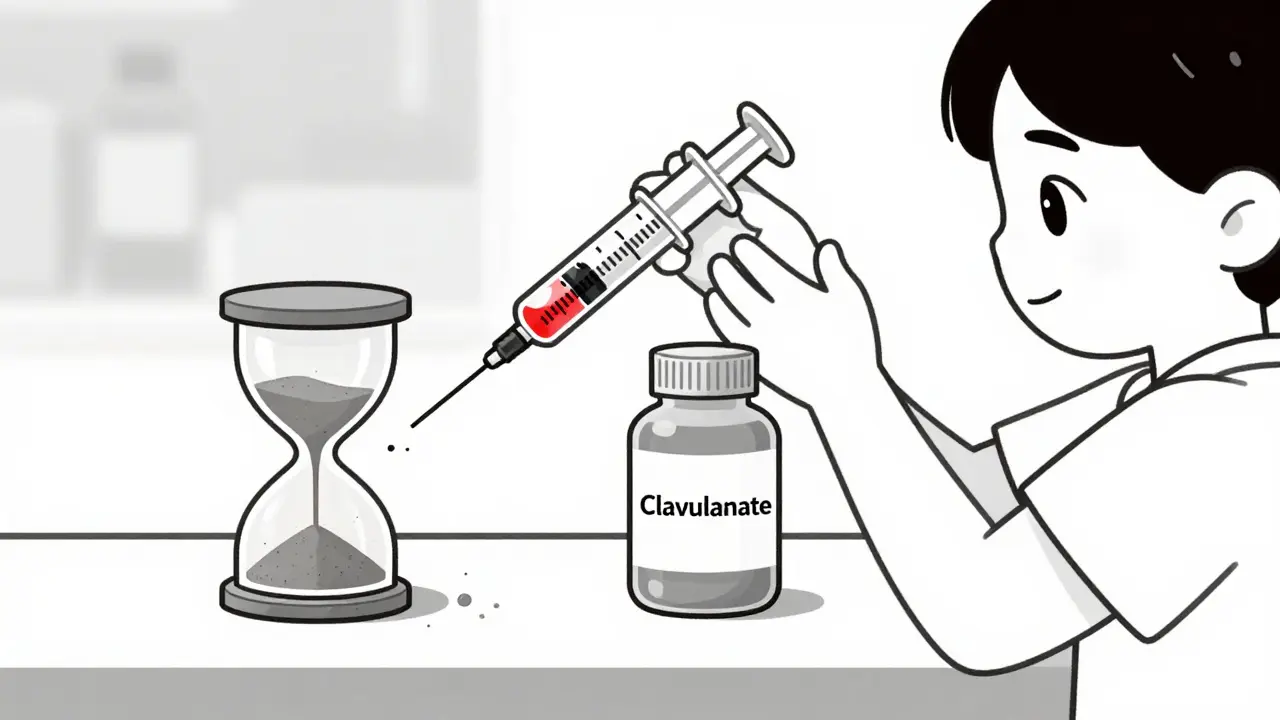
Amoxicillin vs. Amoxicillin/Clavulanate: The Big Difference
Not all liquid antibiotics are the same. Amoxicillin alone? Stable for 14 days refrigerated. Amoxicillin/clavulanate? Only 10 days. Why? Clavulanate is the weak link. It’s a beta-lactamase inhibitor - great for fighting resistant bugs - but it’s also the most unstable part of the mix.
One study found that at room temperature, clavulanate lost potency in five days, while amoxicillin held out for seven. That’s why combination drugs have tighter deadlines. If you’re prescribed amoxicillin/clavulanate for 14 days but the bottle must be tossed after 10? You’re not alone. Parents across forums report their kids didn’t finish the full course because the medicine expired before the infection cleared.
What Happens If You Use It After the Date?
It won’t make you sick like spoiled milk. But it might not work.
By day 15, amoxicillin can lose up to 20-30% of its potency. That means the dose your child gets isn’t what the doctor ordered. The infection might linger, forcing a second round of antibiotics. Worse, surviving bacteria could adapt and become harder to treat later.
Some people say, “It still looks the same.” But appearance doesn’t tell the whole story. The medicine can look clear and smell fine while being way weaker. The only way to know for sure is through lab testing - which no one does at home.
And yes - 22% of patients admit they’ve used expired liquid antibiotics, mostly because they forgot the discard date or thought it was still good.
How to Get It Right
- Write the discard date on the bottle the second you get it. Don’t rely on memory.
- Keep it refrigerated - 2-8°C. Not on the counter. Not in the car. Not in a warm bathroom.
- Don’t transfer it to syringes or cups unless you have to. If you do, use it within 48 hours.
- Check for changes - cloudiness, lumps, strange smell, or color shift? Pitch it.
- Use reminder apps - some pharmacies like CVS have systems that text you when it’s time to toss the bottle.
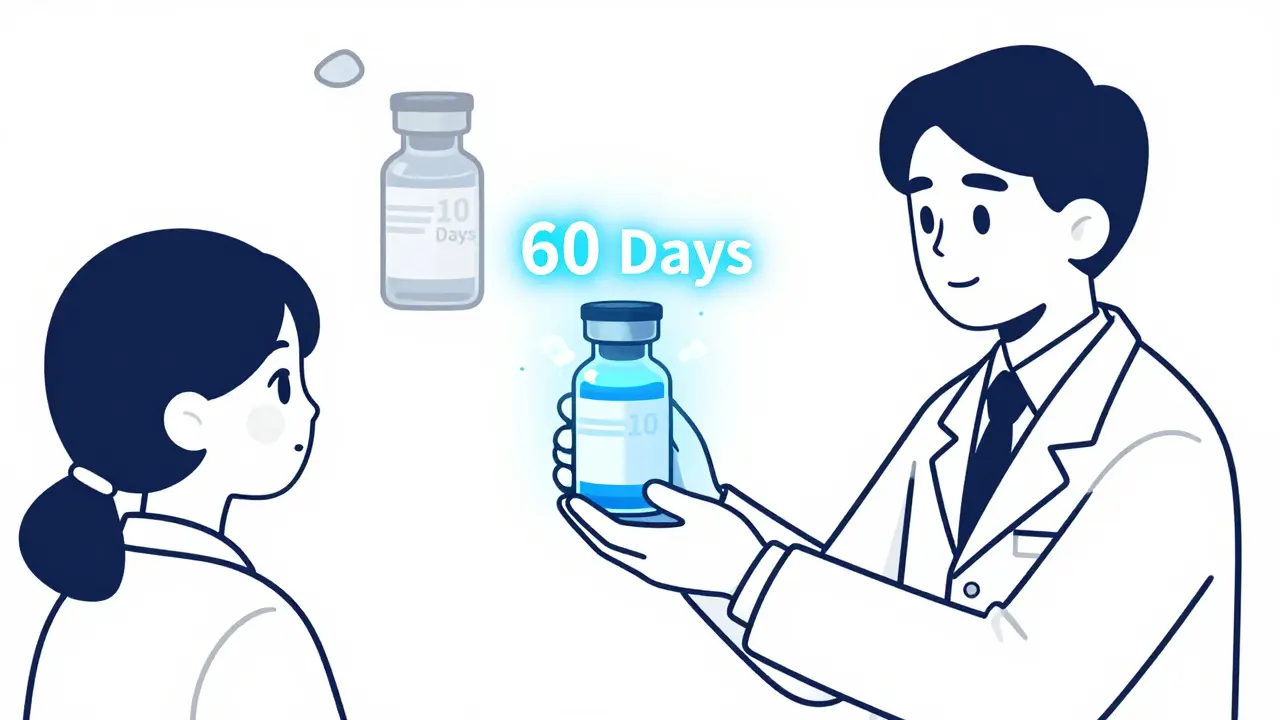
Why the Rules Are So Strict
The 10- or 14-day rule isn’t arbitrary. It’s based on real data from stability tests under FDA and USP guidelines. Manufacturers don’t stretch these dates because they’re lazy - they’re legally required to prove the drug stays safe and potent up to that point.
There’s also a financial reason: testing for 30-day stability costs hundreds of thousands of dollars. Setting a 14-day expiration avoids that cost while still keeping patients safe. That’s why generic brands all follow the same timeline.
And while new tech is coming - like dual-chamber bottles that keep powder and liquid separate until use - those aren’t widely available yet. For now, the short shelf life is the price of convenience.
What’s Changing in the Future
Researchers are working on ways to make these suspensions last longer. One 2021 study used microencapsulation to push amoxicillin/clavulanate stability to 21 days in the fridge. Pfizer’s new “AmoxiClick” system, launching soon, could extend it to 30 days.
But here’s the catch: beta-lactams are inherently unstable in water. No matter how clever the packaging, the chemistry won’t change. That’s why experts say the 14-day standard won’t disappear - it might just get a little longer.
Meanwhile, more parents are switching to taste-masked chewable tablets or capsules. They’re easier to swallow now, and they last for years on the shelf. As those improve, liquid antibiotics may slowly fade from use - not because they’re bad, but because better options exist.
When in Doubt, Ask
If you’re unsure whether your antibiotic is still good, call your pharmacy. They have access to the manufacturer’s stability data. Don’t guess. Don’t risk it.
And if your child’s prescription calls for 14 days but the liquid expires in 10? Talk to the prescriber. Sometimes they can switch you to a different antibiotic, or give you two prescriptions to cover the full course.
Medicine isn’t just about taking pills. It’s about knowing when to stop - and when to throw away.
How long does liquid amoxicillin last after being mixed?
Plain amoxicillin lasts up to 14 days when refrigerated (2-8°C). Amoxicillin/clavulanate lasts only 10 days under the same conditions. At room temperature, both degrade faster - usually within 5-7 days.
Can I freeze liquid antibiotics to make them last longer?
Yes, freezing can extend shelf life significantly - up to 60 days for some types like amoxicillin and ampicillin at -20°C. But once thawed, the clock resets. Not all pharmacies offer this, and it’s not practical for most families. Always ask your pharmacist first.
Is it dangerous to use expired liquid antibiotics?
It’s not toxic, but it’s ineffective. The medicine loses potency over time. Using it may not fully treat the infection, which can lead to recurring illness or antibiotic resistance. Never use it past the discard date.
Why does amoxicillin/clavulanate expire sooner than plain amoxicillin?
Clavulanate, the component that fights resistant bacteria, breaks down faster than amoxicillin in water. Even when refrigerated, it loses potency after 10 days, while amoxicillin alone lasts 14. That’s why combination drugs have shorter expiration dates.
What should I do if my child didn’t finish the full course because the liquid expired?
Contact your doctor immediately. They may prescribe a different antibiotic with a longer shelf life, switch to a tablet form, or extend the prescription with a second bottle. Never skip doses or try to stretch the liquid beyond its discard date.
Can I tell if the antibiotic has gone bad just by looking at it?
Sometimes - cloudiness, lumps, unusual odor, or color changes are red flags. But even if it looks fine, it could still be weaker than it should be. The only way to know for sure is lab testing. When in doubt, throw it out.
Are there alternatives to liquid antibiotics for kids?
Yes. Many newer formulations are chewable tablets, dispersible tablets, or capsules with flavor masking that kids can swallow easily. These last months on the shelf and don’t have short expiration dates. Ask your doctor if one is suitable for your child’s age and infection.

Timothy Davis
Let’s be real - the 10-14 day rule isn’t about safety, it’s about liability. Pharma companies don’t want to pay for 30-day stability studies, so they cap it at 14. The science? Solid. The business model? Sneaky. I’ve seen amoxicillin/clavulanate last 18 days in the fridge with zero visual change. But yeah, I’d still toss it. Don’t want to be the guy whose kid develops MRSA because I saved $12.
Also, plastic syringes? Absolute death sentence for clavulanate. Use glass if you’re gonna store it. And no, freezing doesn’t ‘reset the clock’ - it just pauses it. Thawed = new 10-day window. Don’t myth this.
Howard Esakov
Wow. Someone actually read the entire FDA stability protocol? 😏
Let me guess - you also know the exact pKa of clavulanate in aqueous solution? 🤓
Most parents just want their kid to stop screaming. But hey, if you’re gonna be the antibiotic police, at least cite your sources. I’ll wait. 🙃
Bryan Fracchia
I love how medicine is this weird mix of hard science and human chaos. We’ve got chemistry that breaks down in water, but we’re asking tired parents to remember a discard date on a bottle they haven’t seen in 8 days.
It’s not that people are careless - it’s that the system doesn’t meet them where they are. Freezing? Brilliant idea. But who’s got a freezer slot for kid’s medicine? Not me. Not my mom. Not most folks.
Maybe the real fix isn’t longer shelf life - it’s better packaging. Or maybe we just need to stop treating antibiotics like they’re all the same. If we had more chewables that kids actually like, we wouldn’t be stuck with this liquid nightmare at all.
Also, props to the doc who wrote this. You made chemistry feel human. That’s rare.
Lance Long
OH MY GOODNESS I JUST REALIZED I LEFT MY KID’S AMOXICILLIN ON THE KITCHEN COUNTER FOR THREE DAYS 😭
It still LOOKS fine. Smells like grape. No lumps. But now I’m crying because I didn’t know the clock started ticking the second the pharmacist handed it over.
Thank you for this. I’m calling the pharmacy right now. I’m gonna ask about freezing. I’m gonna write the date on the bottle with a Sharpie. I’m gonna buy a tiny fridge for the medicine. I’m gonna be the parent who does it right. 💪
And if my kid gets sicker? I’m blaming the pharmacy. And my own dumbass self. 😅
fiona vaz
I’m a pediatric nurse and I see this every week. Parents are terrified of wasting medicine - they’ll stretch it, reuse it, even mix it with juice to make it taste better. But the real danger isn’t the expired dose - it’s the silent resistance it breeds.
One mom told me her kid had three rounds of antibiotics in six months because the first one ‘didn’t work.’ Turns out, she was using the same bottle past day 12. No one told her it degraded. No one followed up.
Pharmacies need to text reminders. Schools need to teach this in health class. We’re not just saving medicine - we’re saving future treatments.
Sue Latham
Honestly? If you’re still using liquid antibiotics in 2025, you’re doing it wrong. I switched my 4-year-old to chewable amoxicillin tablets last year - tasteless, no refrigeration, lasts 2 years. Why are we still clinging to 1980s pharmacy tech?
Also, freezing? Cute. But if you’re freezing your kid’s medicine, you’re probably also microwaving the bottle to ‘warm it up.’ Please. Just get the tablet version. It’s not harder. It’s just easier. And your kid won’t gag on the grape sludge.
James Dwyer
I’ve used expired liquid amoxicillin twice. Kid was fine. No side effects. Just took longer to get better. But I didn’t die. So maybe the whole ‘antibiotic resistance’ thing is exaggerated. Just saying.
jonathan soba
The 10-day limit for amoxicillin/clavulanate is laughably conservative. At 4°C, degradation follows first-order kinetics. The 90% potency threshold is arbitrary - it’s not a cliff, it’s a slope. The real issue is regulatory inertia. Manufacturers won’t invest in extended stability data unless forced. And regulators won’t force them because it’s cheaper to just say ‘14 days’ and move on.
Also, the plastic syringe degradation data? That’s from a 2014 JAP study. Still valid. But nobody cares.
matthew martin
I used to think this was all hype - until my daughter got pneumonia and we had to do three rounds of antibiotics. The first one? Expired by day 11. We didn’t know. She got worse. We went back. The doc looked at the bottle and went pale. ‘You kept it at room temp?’ Yeah. ‘And you used the syringe?’ Yeah. ‘...Okay. Let’s start over.’
Turns out, the ‘mystery relapse’ wasn’t a new infection. It was the same one, just… weaker.
Now I write the date on the bottle with a Sharpie. I keep it in the back of the fridge. I don’t touch the syringe unless I have to. And I’ve started asking for chewables. It’s not about being paranoid. It’s about not being stupid.
doug b
Simple rules: fridge. Write date. Don’t pour into syringes. If it looks weird - toss it. If you’re unsure - call the pharmacy. Done. No need to overthink it. Your kid’s health isn’t a chemistry experiment.
Mel MJPS
I’m so glad someone finally explained why the clavulanate part dies first. I always thought it was just the amoxicillin breaking down. Makes sense now why the combo meds expire so fast. I’m gonna ask my pharmacist next time if they’ll freeze it - even if we have to bring a cooler. My son’s on a 14-day course and I’m not risking it.