
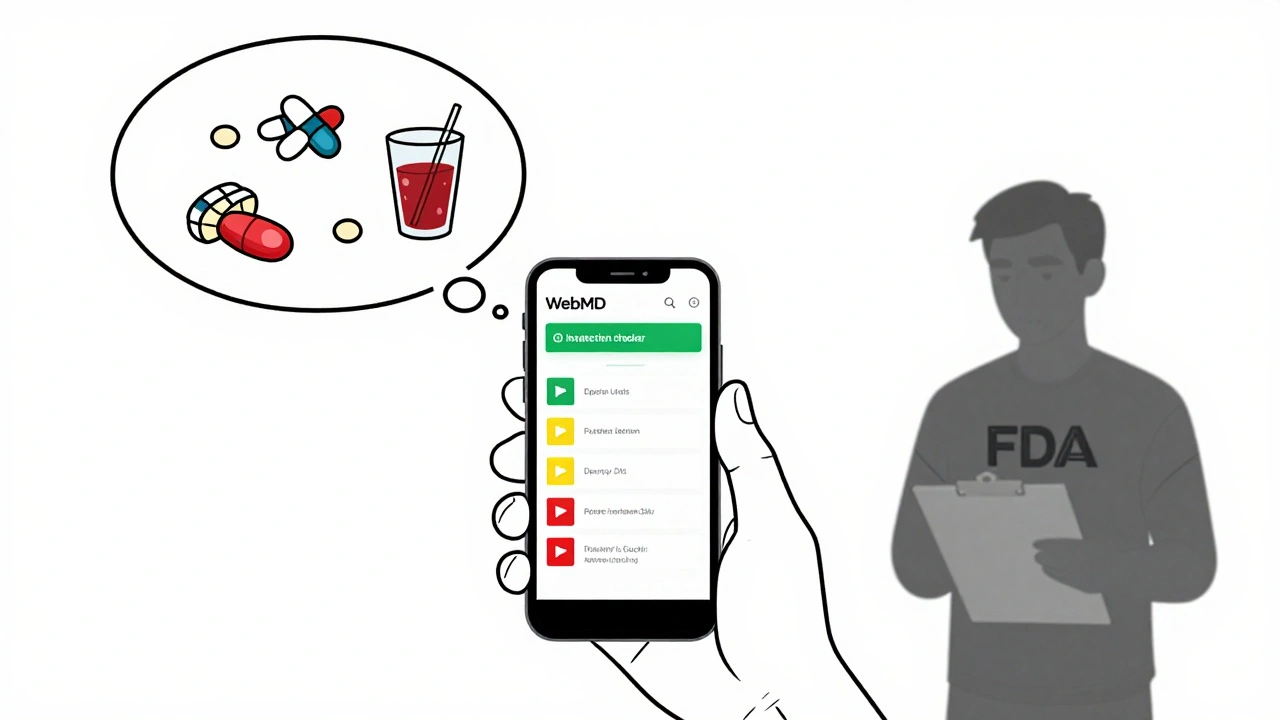
Every year in the U.S., over 1.3 million people end up in the emergency room because of bad reactions between medications, supplements, or even food. Nearly 40% of those cases involve drug interactions - combinations that seem harmless until they aren’t. You might think checking your pills on a website is enough. But not all tools are created equal. And some can give you a false sense of security.
What You’re Actually Using: WebMD vs. the FDA
Many people assume the FDA runs a public drug interaction checker. They don’t. The FDA doesn’t offer a tool you can type your meds into. Instead, they track problems after drugs hit the market - through reports of side effects, recalls, and safety alerts. If a new interaction causes harm, the FDA might issue a warning months later. But they won’t help you check your own mix of pills right now. What you’re probably using is WebMD’s Drug Interaction Checker. It’s free, fast, and easy. You type in your medications - even over-the-counter ones - and it spits out a list of possible conflicts. It flags things like “warfarin and cranberry juice” or “ibuprofen and high blood pressure meds.” The results are color-coded: green for safe, yellow for moderate risk, red for dangerous. It’s designed for people who aren’t doctors. And for most everyday uses, it works fine. But here’s the catch: WebMD doesn’t tell you why an interaction happens. It doesn’t explain how your liver breaks down the drugs, or whether your kidneys are struggling. It doesn’t mention if your genetic makeup makes you more vulnerable. And it often misses herbal supplements like St. John’s Wort or garlic pills - even though these can be just as risky as prescription drugs.Behind the Scenes: The Real Power Player - DrugBank
If WebMD is the friendly neighbor who gives you a quick heads-up, DrugBank is the pharmacist with a PhD who pulls out textbooks to explain what’s really going on. DrugBank started as a research project at the University of Alberta and now powers hospital systems across the U.S. Its free version lets you check up to five drugs at once. But unlike WebMD, it shows you the exact mechanism: “This combo inhibits CYP3A4 enzyme, slowing metabolism of simvastatin, increasing risk of muscle damage.” It cites real studies. It classifies interactions as minor, moderate, or major - and explains what each actually means in real life. A 2022 study in JMIR Medical Informatics gave DrugBank a 4.8 out of 5 for accuracy. WebMD scored lower, with one University of Florida study finding 17% of its serotonin syndrome warnings weren’t backed by solid research. DrugBank’s error rate? Just 3%. But here’s the problem: DrugBank’s free version is limited. It doesn’t include pharmacogenomic data - meaning it won’t tell you if your genes make you extra sensitive to certain drugs. That affects up to half of all patients. And if you’re on more than five medications, you’re out of luck unless you pay for the enterprise version - which costs $1,200 a month and is only meant for clinics and hospitals.Why “Moderate” Doesn’t Mean “Safe”
One of the biggest mistakes people make is thinking a yellow flag isn’t serious. It is. A 2021 study in the Annals of Internal Medicine found that “moderate” interactions caused 18% of preventable hospital admissions. That’s not a warning to ignore - it’s a red light to call your doctor. Take this example: You’re on lisinopril for blood pressure and take ibuprofen for a headache. WebMD says “moderate interaction.” You think, “I’ve taken this combo before.” But what you don’t know is that ibuprofen can blunt the effect of lisinopril - and over time, your blood pressure creeps up. Meanwhile, your kidneys are getting stressed. Two months later, you’re hospitalized with acute kidney injury. That’s not a fluke. That’s a preventable outcome. Same with NSAIDs and heart failure. WebMD might flag it, but if you’re over 65 and already have heart issues, that “moderate” label could be the difference between staying home and ending up in intensive care.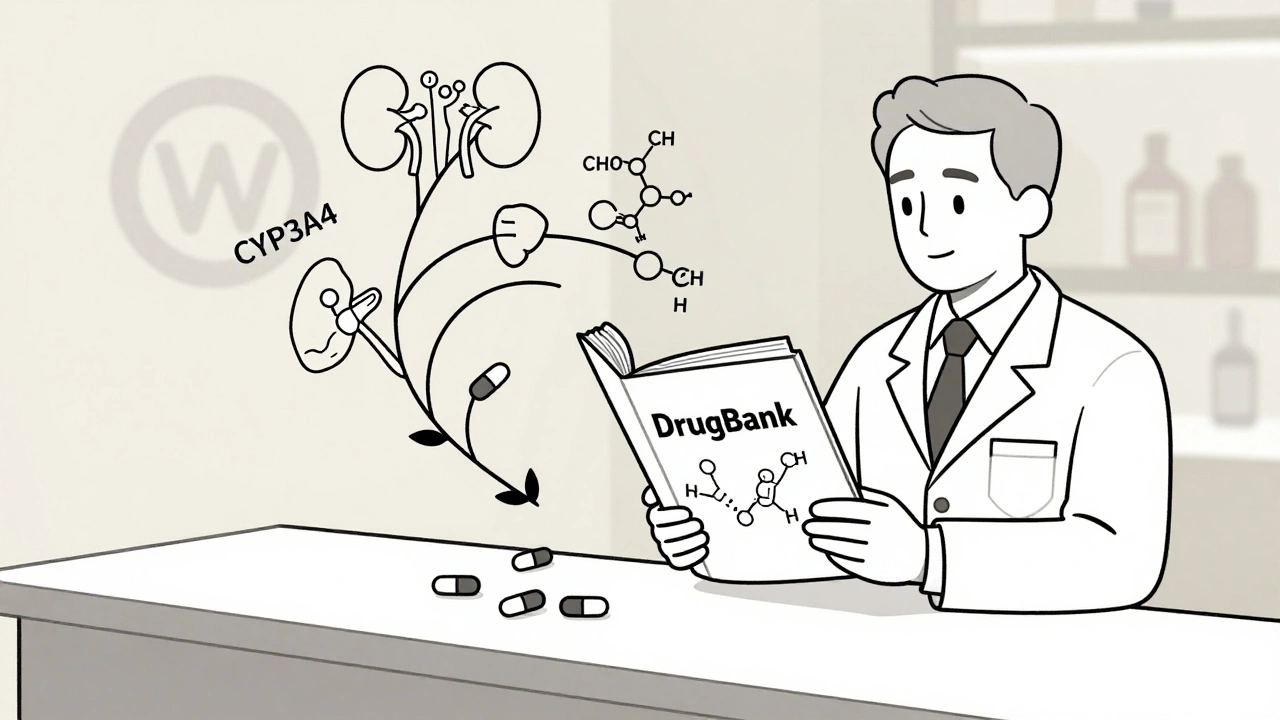
The Hidden Gaps: Food, Supplements, and New Drugs
Food-drug interactions are just as dangerous as drug-drug ones. Grapefruit juice stops your body from breaking down statins - leading to dangerous muscle damage. Dairy can block antibiotics like ciprofloxacin from working. WebMD’s checker now includes over 1,200 herbal supplements - but it still misses key ones, especially those sold as “natural” or “dietary.” And then there’s the lag. When a new drug hits the market, it can take 12 to 18 months for any checker to fully understand its interactions. In 2020, the FDA warned about fedratinib - a cancer drug - causing thiamine deficiency. Free checkers didn’t flag it until months later. Twelve patients developed serious neurological damage before the warning went out. Even big names like WebMD and DrugBank can’t keep up with every new drug. And if you’re taking something off-label - which happens in 21% of prescriptions, according to FDA data - the checker has even less data to work with.What the Experts Say
Dr. Richard H. Dana, Chief Pharmacist at Johns Hopkins, puts it bluntly: “WebMD is excellent for patient education - but dangerous if used for clinical decision-making.” He’s not saying don’t use it. He’s saying: use it as a starting point, not the final answer. If the checker flags something, go to your doctor. Don’t stop your meds. Don’t assume it’s wrong. Don’t ignore it. Dr. Linda A. Lee from the FDA says digital tools are crucial for catching obvious risks during polypharmacy - especially for older adults on five or more drugs. But she stresses: “No tool replaces a clinician’s judgment.” And here’s something most people don’t realize: DrugBank gets most of its funding from pharmaceutical companies. That’s not inherently bad - they need money to keep updating their database. But it does raise questions. Are they downplaying interactions that involve drugs made by their paying clients? A 2023 JAMA Internal Medicine investigation looked into this and found no direct evidence of bias - but the potential is there.
How to Use These Tools Without Getting Hurt
Here’s how to actually stay safe:- Always check both drug-drug and drug-food interactions. Forty percent of serious interactions involve food or drinks.
- Don’t trust the color codes alone. If it says “moderate,” ask your pharmacist: “What does this mean for me?”
- Write down every pill, supplement, and herbal tea you take - including dosage and frequency. Bring it to every appointment.
- For high-risk combinations (blood thinners, heart meds, antidepressants), cross-check with a second source. Use DrugBank’s free version even if you mostly use WebMD.
- If you’re over 65, have kidney or liver disease, or take five or more drugs - don’t rely on free tools alone. Ask your doctor for a medication review.
- Never use these tools to decide whether to start, stop, or change a prescription. That’s your doctor’s job.
What’s Coming Next
The FDA is pushing for “explainable AI” in all drug interaction tools by 2026. That means checkers will have to show you the evidence behind every warning - not just say “this is dangerous.” Some platforms are starting to integrate real-time FDA adverse event data. Others are testing blockchain systems so patients can control their own interaction history. But the biggest threat? AI hallucinations. Stanford researchers found that large language models - like the ones powering some new chatbots - invent drug interactions 22% of the time. If you ask an AI, “Is it safe to take X with Y?” and it says yes - even if it’s wrong - you might believe it. That’s why the FDA released draft guidance in September 2023 warning against using unverified AI tools for medical decisions.Bottom Line
WebMD’s checker is great for a quick check. It’s simple. It’s free. It catches the obvious stuff. But it’s not a substitute for professional advice. DrugBank is more accurate, more detailed, and more trustworthy - but it’s not built for the average person. It’s built for hospitals. The real safety net isn’t a website. It’s communication. Talk to your pharmacist. Ask your doctor. Keep a list. Don’t assume because a tool says it’s safe, it really is. Your health isn’t a Google search. It’s a conversation - and you’re the most important person in it.Can I trust the FDA’s drug interaction checker?
No, the FDA does not offer a public drug interaction checker. They monitor drug safety through reports of side effects and issue warnings after problems are identified. You can’t type your medications into an FDA tool to check for interactions. Instead, use third-party tools like WebMD or DrugBank - but always verify critical results with your doctor or pharmacist.
Is WebMD’s drug checker accurate enough?
WebMD’s checker is accurate for common, well-documented interactions and works well for general awareness. However, studies show it misses about 15% of high-risk interactions - especially those involving supplements, newer drugs, or complex combinations. It also lacks detailed explanations. Use it as a starting point, not a final answer. Always confirm serious flags with a healthcare provider.
What’s better than WebMD for checking drug interactions?
DrugBank’s free version is more accurate and detailed than WebMD, showing the biological mechanisms behind interactions and citing peer-reviewed studies. For clinical use, platforms like Medscape or Micromedex offer deeper data, but often require registration. For patients, combining WebMD’s simplicity with DrugBank’s depth gives the best balance - but neither replaces professional advice.
Why do some drug interactions get missed by these tools?
Tools lag behind new drugs - it can take 12 to 18 months for interactions to be added to databases. They also often ignore herbal supplements, over-the-counter products, and individual factors like kidney function, genetics, or age. Even the best tools can’t account for every unique patient profile. That’s why clinical judgment is still essential.
Should I stop my medication if a checker flags an interaction?
Never stop or change a medication based solely on a checker’s warning. Some flagged interactions are minor or only risky under specific conditions. Others may be unavoidable if the benefits outweigh the risks. Always contact your doctor or pharmacist first. They can help you weigh the actual danger and decide if an alternative is needed.
Are free drug interaction checkers safe to use?
Free tools like WebMD and DrugBank’s free tier are safe to use for general awareness - as long as you understand their limits. They’re not designed for clinical decision-making. Never rely on them for high-risk medications like blood thinners, antidepressants, or heart drugs without consulting a professional. The biggest risk isn’t the tool - it’s believing it’s foolproof.
Can AI replace drug interaction checkers in the future?
AI can help predict interactions faster and identify patterns humans miss. But current AI models, including large language models, hallucinate - inventing false interactions 22% of the time, according to Stanford research. The FDA is requiring all future certified tools to show how they reach their conclusions (explainable AI). Until then, AI should support - not replace - human judgment.

Elizabeth Crutchfield
i just typed in my meds on webmd and it said i was fine... then i got hospitalized. never again. i dont trust those color codes anymore.
Chad Handy
The fundamental flaw in relying on consumer-facing drug interaction checkers is that they operate on aggregated population-level data and fail to account for individual pharmacokinetic variability, which is influenced by epigenetic expression, gut microbiome composition, hepatic enzyme polymorphisms, and renal clearance rates-all of which are dynamically altered by age, comorbidities, and concurrent dietary intake, rendering generic alerts statistically meaningful but clinically insufficient.
michael booth
Good post. Really breaks down the reality of these tools. Always talk to your pharmacist. They know more than you think and they're paid to care. I've seen too many people ignore yellow flags and end up in the ER. Don't be one of them.
Martyn Stuart
I work in a community pharmacy, and I can tell you: the most dangerous patients aren't the ones who don't check anything-they're the ones who check WebMD, see 'moderate,' and then say, 'It's fine, I've done this for years.' The interaction might be moderate, but the cumulative effect on a 72-year-old with stage 2 CKD? That's not moderate. That's a waiting room.
Karl Barrett
DrugBank is the only tool that doesn't treat you like a child. It shows you the CYP450 pathways, the protein binding percentages, the half-life overlaps. WebMD is like a traffic light. DrugBank is the entire engineering manual behind the signal. But yeah, $1200/month? That's not a tool-it's a corporate firewall keeping real knowledge from the people who need it most.
Jake Deeds
Honestly, if you're using a free website to manage your meds, you're basically playing Russian roulette with your liver. I don't care if it's 'free' or 'easy'-if you're on more than three prescriptions, you owe it to yourself to pay for a proper consultation. Your life isn't a free trial.
val kendra
My grandma takes 8 pills a day. I made her a spreadsheet with all her meds, supplements, and even her tea. We cross-checked every combo with DrugBank and then took it to her pharmacist. She’s been fine for a year now. Just write it down. It takes 10 minutes.
Isabelle Bujold
I wish more people understood that 'moderate' doesn't mean 'harmless'-it means 'harmful if ignored over time.' I had a patient who took ibuprofen daily with lisinopril for five years. She thought it was fine because WebMD said 'yellow.' By the time she came to us, her GFR was down to 38. We had to start her on dialysis. That wasn't an accident. It was neglect dressed up as convenience.
George Graham
I'm from a small town where people don't have easy access to specialists. We use WebMD because it's all we've got. But I always tell folks: if it flags something, write it down, bring it to your next visit, and say 'I saw this-what do you think?' That’s how you stay safe without a hospital on every corner.
Joe Lam
You're all just wasting time. If you need a tool to tell you not to mix drugs, you shouldn't be taking them in the first place. Real adults know their bodies. You don't need a website to tell you grapefruit and statins don't mix-that's common sense.
Jenny Rogers
The fact that people treat medical advice like a Yelp review is terrifying. WebMD is not a medical authority. It's a website owned by a media conglomerate that monetizes anxiety. If you're using it to make decisions, you're not just ignorant-you're complicit in your own endangerment.
Dematteo Lasonya
I read this and immediately texted my mom. She’s 71, on five meds, and takes turmeric every morning 'for inflammation.' WebMD didn’t flag it. DrugBank did. She’s stopped it. No drama. Just a text. Sometimes the best tool is someone who cares enough to ask.