
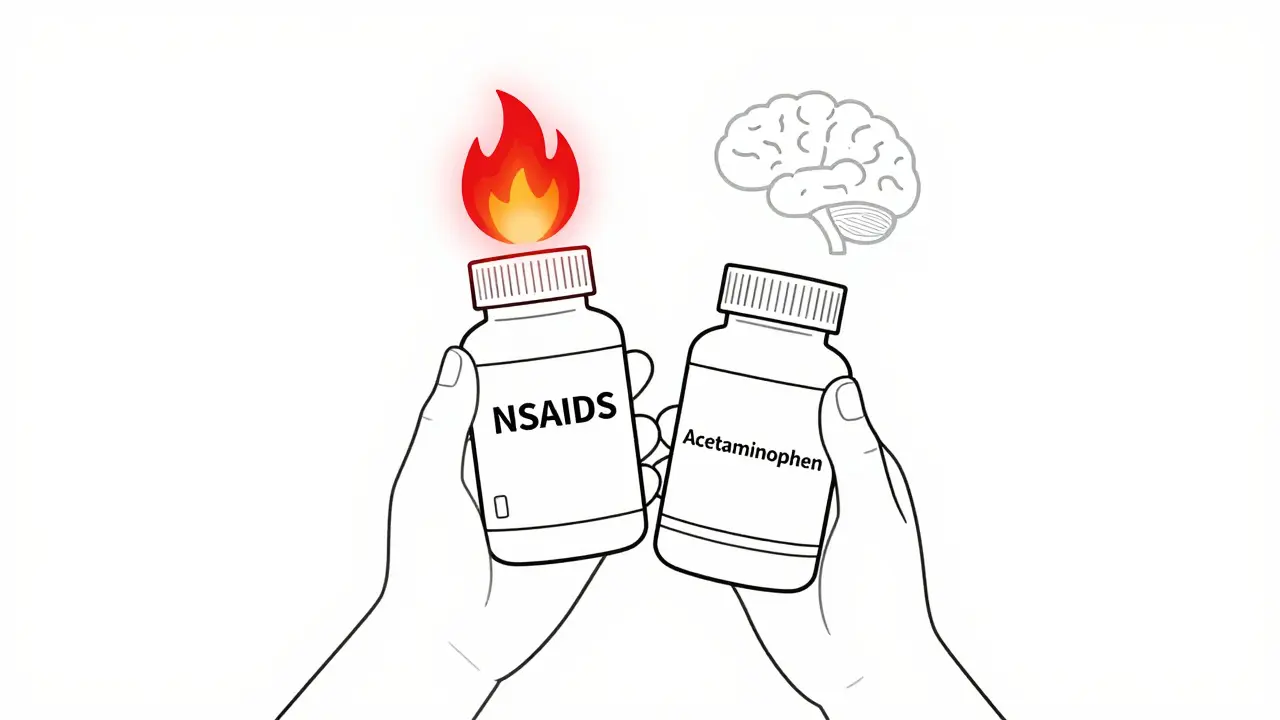
When you’ve got a throbbing headache, a sore back, or swollen knees, reaching for an over-the-counter pain reliever feels like second nature. But not all pain meds are the same. Two of the most common choices-NSAIDs and acetaminophen-work in completely different ways, and picking the wrong one could mean less relief or even hidden risks.
How They Work: The Science Behind the Bottle
NSAIDs, like ibuprofen (Advil, Motrin) and naproxen (Aleve), reduce pain by blocking enzymes called COX-1 and COX-2. These enzymes trigger inflammation, swelling, and pain signals in your body. That’s why NSAIDs work so well for injuries with swelling-like a sprained ankle, arthritis flare-ups, or menstrual cramps. They don’t just mask the pain; they calm the inflammation causing it. Acetaminophen (Tylenol) is different. Its exact mechanism isn’t fully understood, but it mainly affects pain signals in the brain and spinal cord. It doesn’t touch inflammation at all. That’s why it’s great for headaches, fevers, or general aches, but won’t help with a swollen joint or muscle tear. This difference matters. If your pain comes from inflammation, NSAIDs have the edge. If it’s just a dull ache without redness or swelling, acetaminophen often does the job-without the stomach upset.When to Choose NSAIDs
NSAIDs are your go-to when swelling is part of the problem. Think:- Arthritis pain in knees, hips, or hands
- Back or neck pain from strained muscles or inflamed discs
- Post-workout soreness after heavy lifting
- Menstrual cramps caused by uterine inflammation
- Sprains, strains, or tendonitis
When Acetaminophen Is the Better Pick
If you’re dealing with:- Headaches or migraines
- Fever from a cold or flu
- Toothache without visible swelling
- Mild muscle soreness from sitting too long
- Pain if you’re on blood thinners like warfarin
Dosing: What You Can Actually Take
It’s easy to overdo it. Here’s what’s safe for most healthy adults:| Medication | Single Dose | Max Daily Dose | Time Between Doses |
|---|---|---|---|
| Acetaminophen (Tylenol) | 325-650 mg | 4,000 mg | Every 4-6 hours |
| Ibuprofen (Advil) | 200-400 mg | 1,200 mg | Every 6-8 hours |
| Naproxen (Aleve) | 220 mg | 660 mg | Every 8-12 hours |
Combining Them: A Smart Strategy
You don’t have to choose one or the other. Many doctors now recommend using both together. A 2023 study from Harvard Health found that taking acetaminophen and an NSAID at the same time gives better pain relief than either alone-and lets you use lower doses of each. That means less risk of liver damage from acetaminophen and less stomach irritation from NSAIDs. Here’s a common schedule:- 8 AM: 500 mg acetaminophen
- 2 PM: 400 mg ibuprofen
- 8 PM: 500 mg acetaminophen
- 10 PM: 220 mg naproxen (if needed)
Who Should Avoid Each One
Don’t take NSAIDs if you:- Have a history of stomach ulcers or bleeding
- Have heart disease, high blood pressure, or kidney problems
- Take blood thinners like aspirin or warfarin
- Are pregnant in the third trimester
- Drink three or more alcoholic drinks a day
- Have liver disease (like hepatitis or cirrhosis)
- Take other meds that contain acetaminophen (check labels!)
- Have had a reaction to it before

Real-Life Scenarios
You twisted your ankle playing soccer. Swelling? Redness? Heat? Go with ibuprofen. It’ll reduce the inflammation and pain. Start with 400 mg every 8 hours. Skip acetaminophen-it won’t touch the swelling. You’ve had a migraine for 12 hours. No swelling, just pounding pain and sensitivity to light. Try 650 mg acetaminophen first. If it doesn’t help in an hour, you can try 400 mg ibuprofen. Many people find acetaminophen easier on the stomach during migraines. Your knees ache every morning from arthritis. NSAIDs work better here. But if your stomach gets upset, switch to acetaminophen and talk to your doctor about a joint-friendly NSAID like celecoxib, or try alternating doses. You’re on blood pressure meds and have a headache. Stick with acetaminophen. NSAIDs can raise blood pressure and interfere with your meds.The Bottom Line
There’s no single “best” pain reliever. It depends on what’s hurting you-and what’s going on in your body.- Swelling? Go NSAID.
- Just aching? Acetaminophen is safer.
- Uncertain? Start with acetaminophen. It’s gentler.
- Chronic pain? Talk to your doctor about combining both.
Can I take ibuprofen and Tylenol together?
Yes, you can safely take ibuprofen and acetaminophen together if you follow the correct doses. Many doctors recommend this combination because it gives stronger pain relief with lower doses of each drug, reducing side effects. For example, take 500 mg acetaminophen at 8 AM and 400 mg ibuprofen at 2 PM, then repeat at 8 PM. Never exceed the daily maximum for either.
Is acetaminophen safer than NSAIDs for long-term use?
For most people, yes-but only if you don’t go over 3,000 mg a day. Acetaminophen doesn’t irritate the stomach or raise blood pressure like NSAIDs do. But it can cause serious liver damage if taken too high, especially with alcohol or existing liver issues. NSAIDs carry higher risks for heart, kidney, and stomach problems over time. Neither is risk-free long-term. Always check with your doctor if you’re using either daily.
Why does my doctor say not to take NSAIDs if I have high blood pressure?
NSAIDs can cause your body to retain fluid and reduce kidney function, which raises blood pressure. They can also interfere with blood pressure medications like ACE inhibitors or diuretics. Even over-the-counter doses can make it harder to control hypertension. Acetaminophen doesn’t have this effect, so it’s usually the preferred pain reliever for people with high blood pressure.
Can I take NSAIDs if I’ve had a heart attack?
Generally, no. NSAIDs increase the risk of another heart attack or stroke, especially in the first year after an event. Even low doses can be dangerous. Acetaminophen is usually the safer choice, but always talk to your cardiologist before taking any pain reliever. They may recommend alternatives like physical therapy or prescription pain options with lower cardiovascular risk.
What happens if I accidentally take too much acetaminophen?
Taking more than 4,000 mg in 24 hours can cause liver damage, sometimes without symptoms at first. If you suspect an overdose-even if you feel fine-seek medical help immediately. Nausea, vomiting, and fatigue can appear 12-24 hours later. The antidote, N-acetylcysteine, works best if given within 8 hours. Don’t wait. Call poison control or go to the ER.
Are generic brands as good as name brands like Advil or Tylenol?
Yes. Generic ibuprofen and acetaminophen contain the same active ingredients as Advil and Tylenol. They’re regulated by the FDA and must meet the same standards for strength, purity, and effectiveness. The only differences are in inactive ingredients, packaging, and price. Generic versions are often 70-80% cheaper. Save your money-your pain relief won’t be any different.
What to Do Next
If you’re using one of these regularly, write down:- Which pain you’re treating
- How often you take it
- Any side effects you notice




John McGuirk
They’re hiding the truth about NSAIDs. You think it’s just stomach issues? Nah. The FDA and Big Pharma rigged the studies. They want you dependent on pills so you keep coming back. I stopped taking anything after I found out acetaminophen is linked to brain fog in 70% of users. They don’t tell you that. I’ve seen it. My cousin’s cat got weird after licking a spilled Tylenol bottle. Coincidence? I think not. 🤔
Darren Links
Look, I don’t care what some study says. In America, we don’t need fancy science to know what works. I’ve been popping Advil since I was 16 and I’m still standing. Acetaminophen? That’s what weaklings use when they can’t handle real pain. My grandpa fought in Korea and he took two aspirin and a shot of whiskey. That’s medicine. Not this overanalyzed nonsense.
Husain Atther
This is a well-structured and thoughtful overview. The distinction between inflammation-based and central pain is clinically sound. For many in developing nations, access to even basic analgesics remains a challenge, so understanding the risk-benefit balance is critical. I appreciate the emphasis on combination therapy-it reflects evolving clinical practice. A reminder to always consult a physician before long-term use is prudent and responsible.
Helen Leite
OMG I JUST REALIZED MY COLD MEDS HAVE ACETAMINOPHEN IN THEM 😱 I’VE BEEN TAKING TYLENOL TOO!!! I’M GONNA DIE FROM LIVER FAILURE!!! 🤕💀 I’M SO SCARED I CAN’T EVEN SIT DOWN!! HELP!! 🥺
Elizabeth Cannon
People are overcomplicating this. If your knee hurts after lifting, take ibuprofen. If your head hurts from stress, take Tylenol. If you’re on blood pressure meds? Stick to Tylenol. If you drink? Don’t mix. Simple. No need for charts, studies, or fancy words. Just use your brain. And stop reading internet posts like they’re medical degrees. You’re not a doctor. Don’t act like one.
Marlon Mentolaroc
Let me break this down for you like you’re five. NSAIDs = inflammation fighter. Acetaminophen = pain signal blocker. One’s for swollen joints, the other’s for headaches. Mixing them? Smart. Overdosing? Dumb. Labels exist for a reason. If you can’t read ‘4000 mg max,’ maybe don’t self-medicate. Also, generics are fine. You’re not paying for the brand logo, you’re paying for the chemical. Same molecule. Same effect. Save your cash.
Gina Beard
Pain is not a problem to be solved. It is a message. To silence it with chemicals is to ignore the soul’s whisper. The body knows. The body remembers. We have forgotten how to listen. A pill is not wisdom. It is escape.
Don Foster
Anyone who thinks combining acetaminophen and NSAIDs is revolutionary clearly never read a 1998 NEJM paper on synergistic analgesia. Also the FDA limit for acetaminophen has been 4000 mg since 1982. The 3000 mg recommendation is just a lazy guideline pushed by risk-averse hospitals. And generics? Of course they’re equal. The FDA doesn’t allow inferior products. If you don’t know that you’re not qualified to even read this article
siva lingam
Wow. 2000 words to say take ibuprofen for swelling and Tylenol for headaches. I could’ve just googled it. Also why is there a whole section on cats? Did someone’s cat die from acetaminophen? Asking for a friend.