
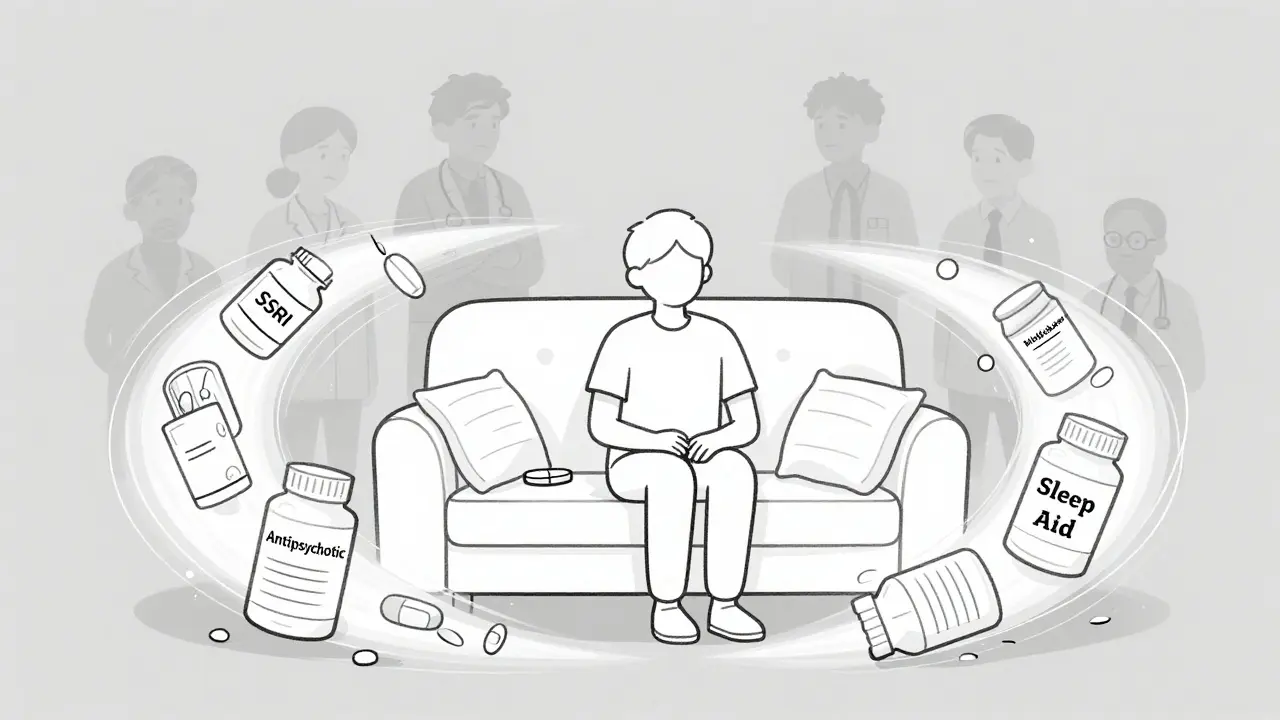
When someone is struggling with depression, schizophrenia, or bipolar disorder, doctors often turn to medication. But what happens when one drug isn’t enough? Many patients end up on two, three, or even four psychiatric medications at once. This isn’t rare-it’s becoming the norm. In the U.S., antipsychotic polypharmacy jumped from 3.3% to 13.7% among Medicaid patients with schizophrenia between 1999 and 2005. That’s a fourfold increase. And it’s not just happening in the U.S. Similar trends are visible in Australia, Europe, and Canada. But behind these numbers is a growing crisis: complex polypharmacy is putting patients at risk without clear proof it’s helping.
Why Are So Many People on So Many Drugs?
It starts with a simple idea: if one antidepressant doesn’t work, try another. If that still doesn’t help, add an antipsychotic. Then a mood stabilizer. Then a sleep aid. Then a beta-blocker for heart palpitations caused by the first drug. This isn’t a carefully planned strategy-it’s often a reaction to frustration. Clinicians aren’t being careless. They’re trying to fix what feels broken. But the evidence doesn’t back up most of these combinations.
There are a few cases where polypharmacy makes sense. For example, adding bupropion to citalopram can help someone who only partially responds to an SSRI. Using an antipsychotic with a mood stabilizer during a severe manic episode is supported by research. Short-term use of a benzodiazepine with an antidepressant for acute anxiety in major depression is also reasonable. But these are exceptions, not the rule.
What’s not supported? Taking two antipsychotics at the same time. Or combining three antidepressants. Or adding anticholinergics just to counteract side effects of another drug. These practices are common, but they’re not evidence-based. A 2006 study in an Early Psychosis Intervention Programme showed that when clinicians followed a structured treatment algorithm, antipsychotic polypharmacy dropped from 483 patients to just 68 over time. That’s not magic-it’s discipline.
The Hidden Cost: More Drugs, More Side Effects
Every medication you take adds risk. And when you’re on five or more drugs, the chance of dangerous interactions skyrockets. The CDC found that 28.7% of people with chronic illnesses are taking five or more medications. That group had significantly lower scores on health-related quality of life-worse physical function, more fatigue, more trouble moving around. Their mental health scores? Not much different. But that doesn’t mean they’re fine. It means the damage is invisible until it’s too late.
For older adults with schizophrenia, the problem is worse. Many are on antipsychotics, antidepressants, blood pressure meds, diabetes drugs, and painkillers all at once. Their livers and kidneys don’t process drugs like they used to. A small change in dosage can lead to confusion, falls, or even heart rhythm problems. A 2023 review in Frontiers in Pharmacology found that polypharmacy in this group is increasing rapidly-but we still don’t know if the benefits outweigh the risks.
And it’s not just physical side effects. Medications can make depression worse. Anticholinergics can cause memory fog. Benzodiazepines can lead to dependence. Weight gain from antipsychotics can trigger diabetes. And when patients feel worse, they often get more drugs-not less.
The ‘Kitchen Sink’ Approach
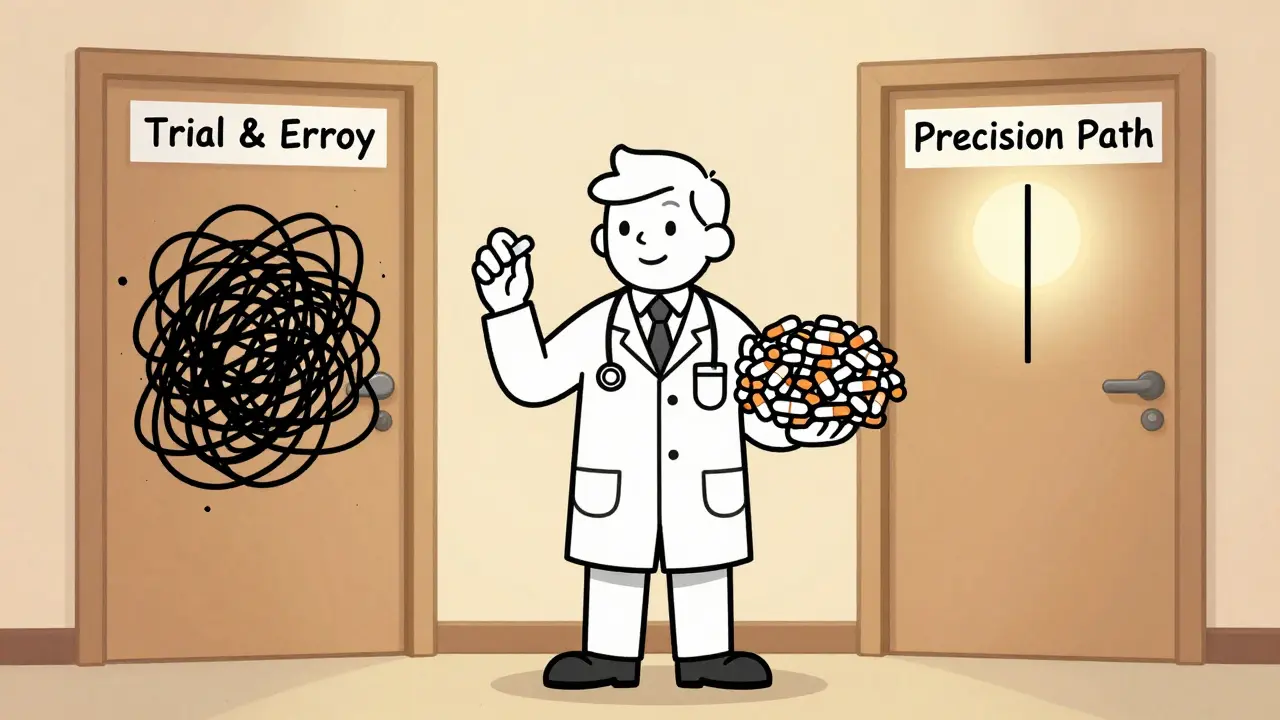
Psychiatrist Dr. Joseph Goldberg called this trend the ‘kitchen sink’ approach: throwing everything at the wall and seeing what sticks. It sounds aggressive. It feels like doing something. But it’s not treatment-it’s trial and error with someone’s brain as the lab.
One patient I know (not a real name, but a real case) was on six psychiatric drugs: an SSRI, an SNRI, an antipsychotic, a mood stabilizer, a sleep aid, and an anti-anxiety pill. She was exhausted. Her hands shook. She couldn’t remember her own phone number. Her doctor said, ‘It’s just how it is.’ She didn’t know she could ask for a review. She didn’t know she could ask to taper one drug at a time.
This isn’t isolated. In primary care settings, 37.2% of patients receiving mental health treatment had complex polypharmacy-often without a clear reason. And most patients don’t realize how many drugs they’re on. One study found that 60% of patients on five or more medications couldn’t name all of them.
What’s Being Done About It?
Change is slow, but it’s happening. Some clinics are now using treatment algorithms-step-by-step plans that guide doctors to try one drug at a time, wait for results, and only add more if necessary. The Early Psychosis Intervention Programme example proved it works. When structure replaces guesswork, polypharmacy drops.
Another promising tool is pharmacogenomic testing. This looks at your genes to see how your body breaks down certain drugs. A 2022 study in the Journal of Clinical Pharmacology found that using this testing reduced adverse drug reactions by 30-50% in psychiatric patients. It doesn’t guarantee success, but it cuts down the trial-and-error cycle. Imagine knowing before you start a drug whether it’ll make you nauseous, sleepy, or give you tremors. That’s not science fiction-it’s available now.
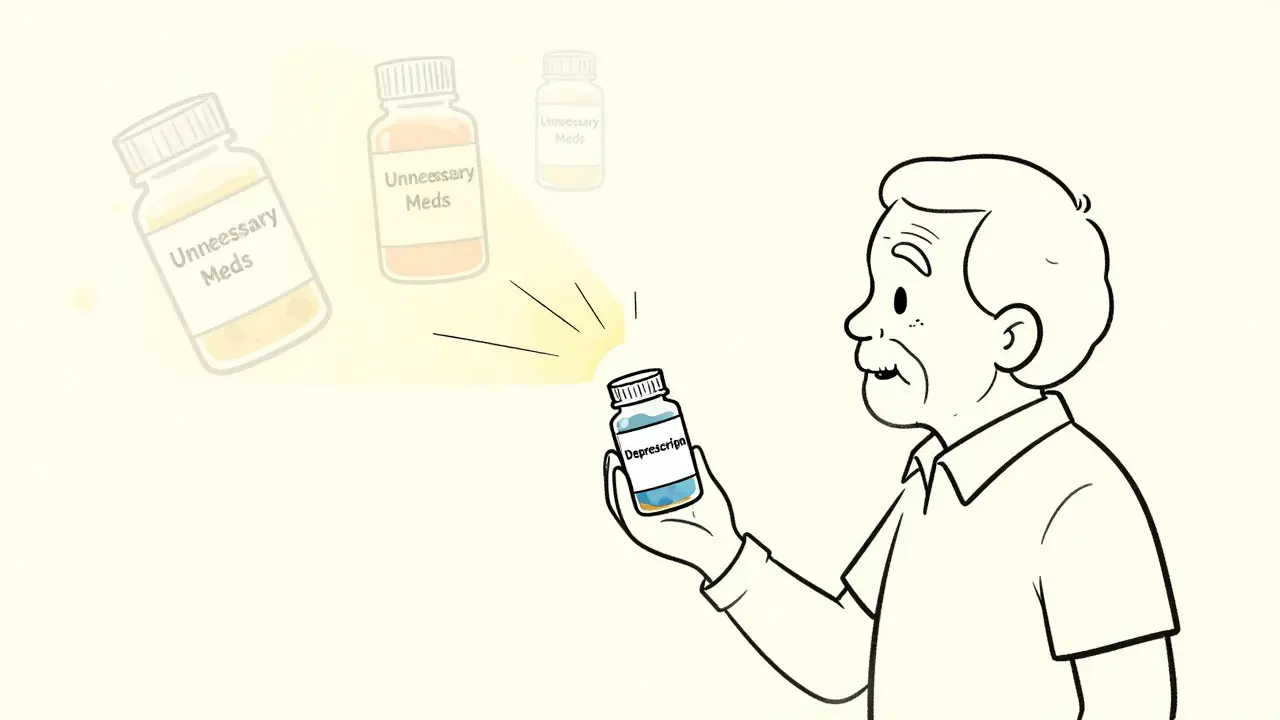
Deprescribing-gradually reducing or stopping unnecessary meds-is gaining traction. A 2024 study tracking patients over 18 months showed that when clinicians systematically reviewed medication regimens, the average number of psychotropic drugs dropped. Side effects decreased. Blood pressure, cholesterol, and blood sugar improved. Even depression and anxiety scores got better. Not because they added more drugs-but because they removed the ones that weren’t helping.
The Real Barrier: Fear and Lack of Protocols
So why isn’t this happening everywhere? Because fear is powerful. Patients are scared that taking away a drug will make them relapse. Clinicians are scared they’ll be blamed if something goes wrong. And there’s no standard protocol to follow. A 2023 survey found that 78% of institutions had no formal process for reviewing polypharmacy. That’s not negligence-it’s lack of support.
Most doctors aren’t trained in deprescribing. Medical school doesn’t teach you how to take a drug away. It teaches you how to add one. And when a patient says, ‘I think this one’s making me worse,’ the easiest answer is to keep going. But that’s not care. That’s inertia.
What You Can Do
If you or someone you care about is on multiple psychiatric medications, here’s what to ask:
- Is there a clear reason for each drug?
- Has anyone tried stopping or reducing one at a time?
- Are we monitoring for side effects every few months?
- Has pharmacogenomic testing been considered?
- Can we schedule a full med review in the next 3 months?
You don’t need to demand radical changes. Just ask for a plan. A slow, careful review-not a sudden stop-is safer. Many patients feel better once the clutter is cleared.
The Future Is Personalized, Not Piled
Polypharmacy isn’t going away. More people are living longer with multiple illnesses. But we don’t have to accept chaos as the norm. The future of mental health treatment isn’t more pills. It’s smarter ones. It’s knowing which drug works for you, not just what’s on the shelf. It’s using genetics, regular reviews, and clear protocols to cut the noise and focus on what actually helps.
Right now, we’re treating symptoms with a shotgun. The goal should be a scalpel. Precision. Purpose. Proof.
Is it safe to take multiple psychiatric medications at the same time?
Some combinations are safe and supported by research-like adding bupropion to an SSRI for partial depression response. But many others, especially taking two antipsychotics together or combining three antidepressants, have little to no evidence and carry higher risks of side effects, drug interactions, and long-term harm. Always ask why each medication is being prescribed and whether it’s been tested for your specific situation.
Can psychiatric polypharmacy make depression or anxiety worse?
Yes. Some medications can cause fatigue, brain fog, or emotional blunting. Others, like benzodiazepines, can lead to dependence and rebound anxiety. Weight gain from antipsychotics can trigger shame or low self-esteem, which worsens mood. And when drugs interact, they can lower serotonin or dopamine in unpredictable ways. A 2022 study found that patients on five or more medications reported worse physical quality of life-even if their mood scores didn’t change.
What is deprescribing, and is it safe?
Deprescribing is the planned, gradual reduction or stopping of medications that may no longer be needed or are causing harm. It’s not about quitting drugs suddenly-it’s about carefully removing ones that aren’t helping, under medical supervision. Studies show that when done right, deprescribing improves energy, reduces side effects, and even lowers depression and anxiety scores. It’s safest when done slowly, with regular check-ins and a clear plan.
Can pharmacogenomic testing help reduce the number of medications I’m on?
Yes. Pharmacogenomic testing looks at your genes to predict how your body processes certain drugs. It can show if you’re likely to have side effects, if a drug won’t work for you, or if you need a lower dose. A 2022 study found this testing reduced adverse reactions by 30-50% in psychiatric patients. It doesn’t eliminate the need for trial and error, but it cuts down the number of failed attempts-making it easier to find the right treatment without piling on more pills.
Why don’t more doctors review medication regimens regularly?
Most doctors weren’t trained to take drugs away-they were trained to add them. There’s also fear: fear of relapse, fear of blame, fear of patient pushback. Plus, there are no standardized protocols in most clinics. A 2023 survey found 78% of institutions had no formal process for reviewing polypharmacy. Without time, training, or support, it’s easier to keep prescribing than to pause and rethink.
Are older adults at higher risk from psychiatric polypharmacy?
Yes. As we age, our liver and kidneys process drugs more slowly. This means medications build up in the body, increasing side effects like confusion, dizziness, falls, and heart rhythm problems. Older adults with schizophrenia are especially vulnerable-they’re often on multiple psychiatric drugs plus medications for diabetes, high blood pressure, or arthritis. A 2023 review found that while polypharmacy in this group is rising, we still don’t know if the benefits outweigh the risks.


Gabriella Adams
So many people are on so many meds because the system is broken. Doctors are pressured to fix things fast, and patients are desperate. But we’re not fixing-we’re bandaging. I work in a clinic where we started using treatment algorithms. Within a year, polypharmacy dropped by 60%. It’s not magic. It’s just discipline. We stopped guessing and started listening.
And guess what? Patients felt better. Not because we added drugs, but because we took some away.
Vamsi Krishna
Bro this is why i always say mental health is just pharma’s new oil field. They don’t want you cured, they want you subscribed. Six meds? That’s a monthly subscription box with side effects. I’ve seen people on 8 drugs-antidepressant, antipsychotic, mood stabilizer, sleep pill, anti-anxiety, beta-blocker, anticholinergic, and a statin for weight gain from the antipsychotic. It’s not treatment. It’s a pyramid scheme with a stethoscope.
Brad Ralph
So we’re treating the brain like a broken Wi-Fi router-keep adding routers until the signal works?
¯\_(ツ)_/¯
Sophia Nelson
Everyone’s so focused on the drugs, but no one talks about how the system rewards prescribing. More meds = more billing codes. More visits. More revenue. The real problem isn’t the doctors-it’s the insurance companies that pay for more drugs but won’t cover therapy or long-term reviews.
Skilken Awe
Pharmacogenomic testing? Please. You think a DNA test will fix a system built on profit, not science? That’s like giving a broken car a new air freshener and calling it an upgrade. We need structural reform, not genetic glitter. And stop pretending this is about patient care-it’s about revenue cycles and liability avoidance.
Steve DESTIVELLE
It is not about the number of drugs it is about the intention behind the prescription if the intention is to heal then even one drug is enough if the intention is to control then even a hundred drugs are too few because the soul does not heal with chemistry it heals with presence and patience and the system has forgotten that
Joanne Tan
omg yes!! i was on 5 meds and felt like a zombie. my dr was like 'it's fine' but i knew something was off. i asked to taper one by one and after 3 months i felt like myself again. no one tells you you can ask for this. we need to normalize asking 'why is this here?'
Reggie McIntyre
This is why I love deprescribing. It’s like spring cleaning for your brain. You don’t need every candle, every blanket, every spice rack in the kitchen to be happy. Sometimes less is more. And sometimes, the thing making you feel worse… is the thing you were told would fix you. Mind blown.
Carla McKinney
Let’s be honest: most of these patients don’t have a diagnosis-they have a convenience. Antidepressant? Check. Antipsychotic? Check. Benzodiazepine? Check. Mood stabilizer? Check. Sleep aid? Check. That’s not treatment. That’s a shopping list from a pharmaceutical rep’s PowerPoint. And clinicians are too tired to push back. So they just click ‘add to regimen’.
Jack Havard
Deprescribing? That’s just the first step toward government-controlled mental health. Next they’ll say you can’t take meds unless you’ve had 12 sessions of ‘emotional alignment’. They’re not trying to help you-they’re trying to control you. And pharmacogenomic testing? That’s just genetic profiling with a white coat.
Annie Joyce
My sister was on 4 psychiatric drugs and her hands shook so bad she couldn’t hold a coffee cup. We asked for a review. They took away the anticholinergic first. Within 2 weeks, her tremors were gone. She didn’t even know it was the culprit. That’s wild. We need to stop treating symptoms and start treating people.
Kristin Jarecki
While the data is compelling, we must acknowledge that clinical judgment still plays a vital role. Not all polypharmacy is inappropriate. Some patients have complex, refractory conditions that require multimodal intervention. The goal is not to eliminate combination therapy, but to ensure it is intentional, monitored, and evidence-informed. Protocol-driven care, not blanket reduction, is the ethical imperative.
Jonathan Noe
Let’s not forget the patients who actually benefit from polypharmacy. My cousin has schizoaffective disorder. One antipsychotic? No. Two? Still not enough. Add a mood stabilizer? Now she can hold a job. Add a sleep med? Now she sleeps 6 hours. She’s not a statistic. She’s thriving. Don’t throw out the baby with the bathwater.
Jim Johnson
you know what saved me? asking for a med review. i was on 5 pills and felt like i was underwater. my dr was like 'you’re stable' but stable isn’t the same as alive. we cut one, then another. now i’m on one. i sleep. i laugh. i remember my own birthday. it’s not magic. it’s just not being afraid to ask ‘what if we took this away?’
christian jon
EVERYTHING YOU’RE SAYING IS A LIE!!
THEY’RE NOT DOING THIS BECAUSE THEY’RE LAZY-THEY’RE DOING IT BECAUSE THE ILLUMINATI CONTROL THE PHARMA COMPANIES AND THEY’RE PLANTING CHEMICALS IN THE WATER SUPPLY TO MAKE PEOPLE DEPRESSED SO THEY’LL BUY MORE PILLS!!
AND DON’T EVEN GET ME STARTED ON THE 5G TOWERS THAT AMPLIFY THE SIDE EFFECTS!!
MY NEIGHBOR’S CAT GOT DEPRESSED AFTER WE MOVED AND NOW SHE’S ON FLUOXETINE-IT’S ALL CONNECTED!!
THEY WANT YOU TO THINK YOU CAN ‘DEPRESCRIBE’-BUT THAT’S JUST A TRICK TO MAKE YOU FEEL SAFE WHILE THEY PUT MORE DRUGS IN YOUR FOOD!!