
Living with diabetes doesn’t mean you’re destined for kidney failure, nerve pain, or vision loss. While these complications are common, they’re not inevitable. The truth is, diabetic complications like kidney disease, neuropathy, and eye damage are largely preventable - if you know what to do and stick with it. The science is clear: it’s not just about lowering your blood sugar. It’s about managing your whole body - your blood pressure, your cholesterol, your feet, your eyes, and your daily habits. And the good news? Rates of these complications have dropped significantly over the last 20 years. People with diabetes are living longer, healthier lives than ever before.
Why These Three Complications Matter
Diabetes doesn’t just affect your blood sugar. Over time, high glucose levels damage blood vessels and nerves throughout your body. The three biggest threats are:
- Diabetic kidney disease (nephropathy): Your kidneys filter waste from your blood. When damaged, they leak protein into your urine and eventually lose function. This can lead to dialysis or transplant.
- Neuropathy: Nerve damage, especially in your feet and hands, causes numbness, tingling, burning, or pain. It’s silent at first - you might not feel a blister or cut until it’s infected.
- Diabetic retinopathy: High blood sugar weakens the tiny blood vessels in your retina. Without treatment, this can lead to vision loss or blindness.
These aren’t distant risks. About 1 in 3 adults with diabetes will develop kidney disease. Nearly half will have some form of nerve damage. And without regular eye checks, diabetic retinopathy can sneak up on you - often without symptoms until it’s advanced.
The ABCs of Prevention
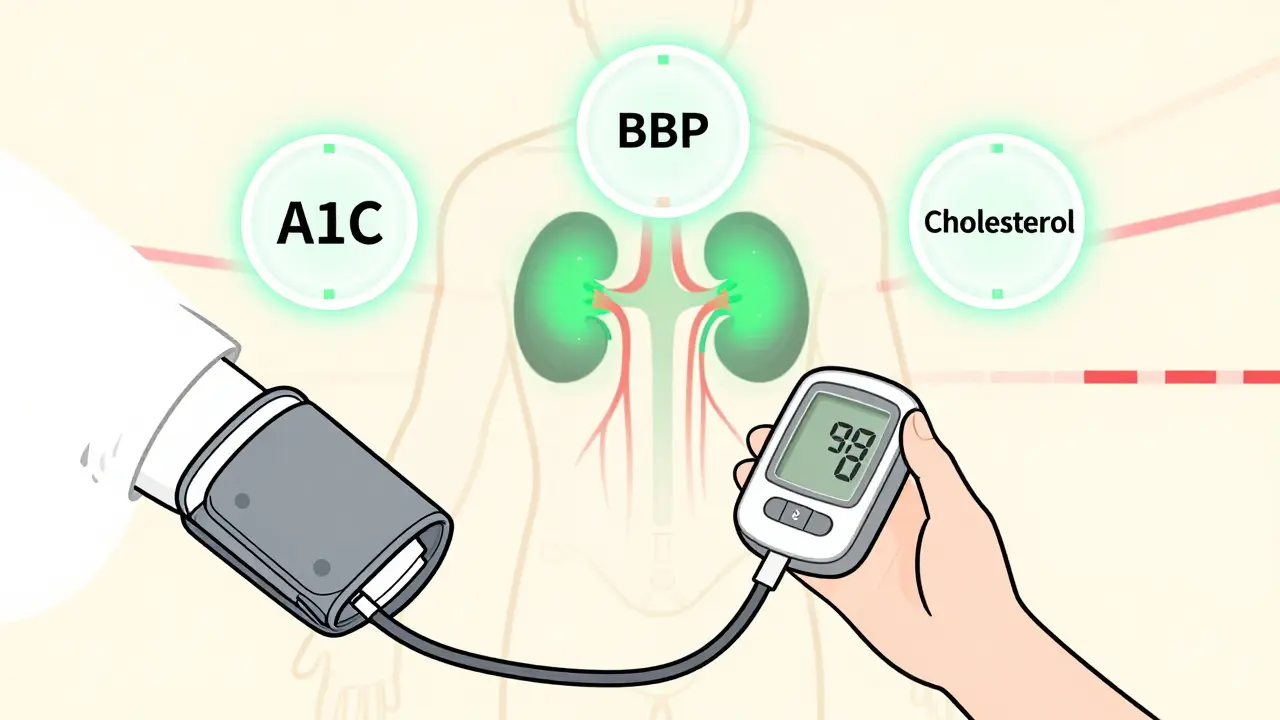
The CDC calls it the ABCs - three key numbers you need to know and control:
- A = A1C (average blood sugar over 3 months). Target: below 7% for most people. Some may aim for 6.5% or higher based on age or other health issues.
- B = Blood pressure. Target: below 140/90 mm Hg. For kidney protection, many doctors aim for 130/80 or lower.
- C = Cholesterol. Focus on LDL (bad cholesterol) under 100 mg/dL. HDL (good cholesterol) should be above 40 for men and 50 for women.
These aren’t just numbers on a chart. They’re your frontline defense. A 2024 study in PubMed showed that people who hit all three targets cut their risk of kidney disease and heart problems in half. And here’s the kicker: you don’t need to be perfect. Even small improvements - like dropping your A1C from 9% to 8% - make a real difference.
Medicines That Do More Than Lower Sugar
Forget the idea that diabetes meds only fix blood sugar. Newer drugs are changing the game.
SGLT2 inhibitors (like empagliflozin, dapagliflozin) and GLP-1 receptor agonists (like semaglutide, liraglutide) were originally designed to lower glucose. But research now shows they do something even more powerful: protect your heart, kidneys, and blood vessels.
Clinical trials found that these drugs reduce the risk of kidney disease progression by 30-40%. They also cut heart attacks and strokes by 14-26%. That’s not a side effect - it’s the point. If you have type 2 diabetes and kidney or heart risks, these aren’t optional. They’re essential tools.
Ask your doctor: Is one of these right for me? Even if your sugar is under control, these medicines might still be worth considering.
Foot Care: Your Daily Lifesaver
Neuropathy doesn’t just cause pain. It makes you vulnerable to foot injuries you can’t feel. And that’s deadly.
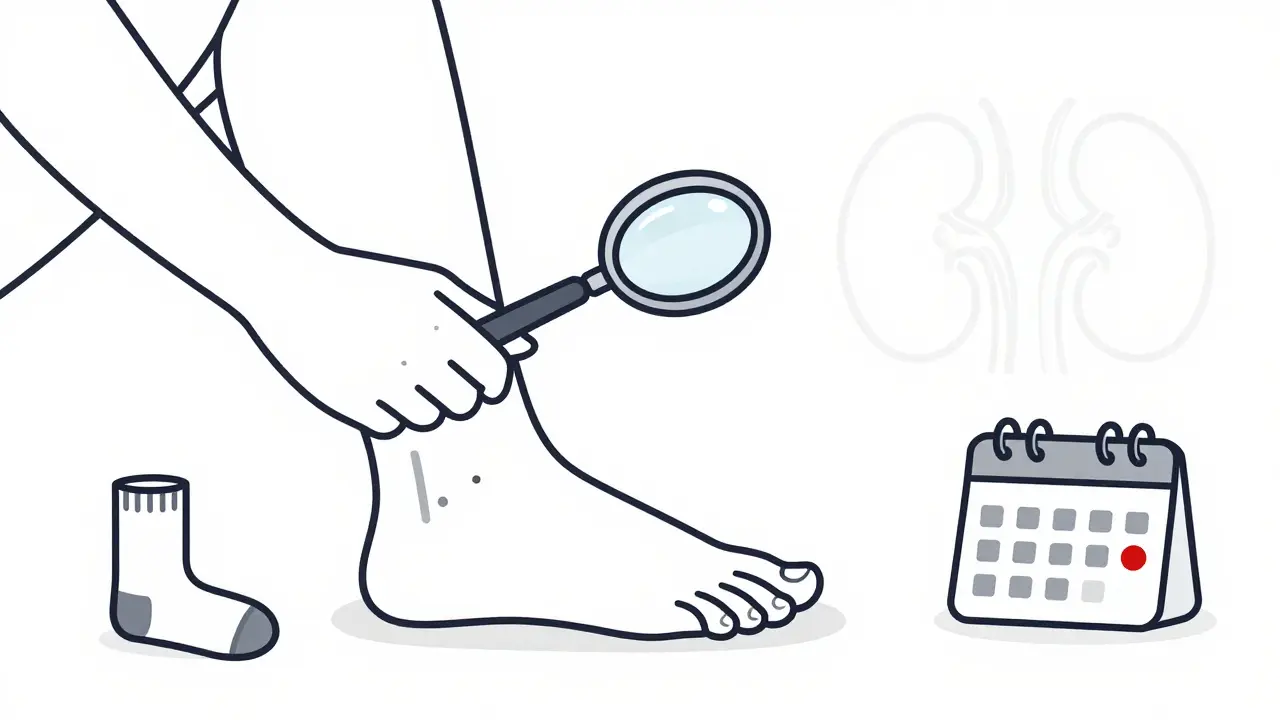
Every day, check your feet. Look for:
- Cuts, blisters, or sores
- Redness, swelling, or warmth
- Calluses or cracked skin
- Changes in color or temperature
Wash them daily with warm (not hot) water. Dry thoroughly - especially between toes. Use moisturizer on your feet, but not between toes (that invites fungus). Wear clean, well-fitting socks and shoes. Never go barefoot - not even indoors.
Why? Because 15% of people with diabetes will develop a foot ulcer in their lifetime. And if an ulcer doesn’t heal within a few days? See a podiatrist immediately. Delaying care can mean amputation.
Eye Exams: The One Appointment You Can’t Skip
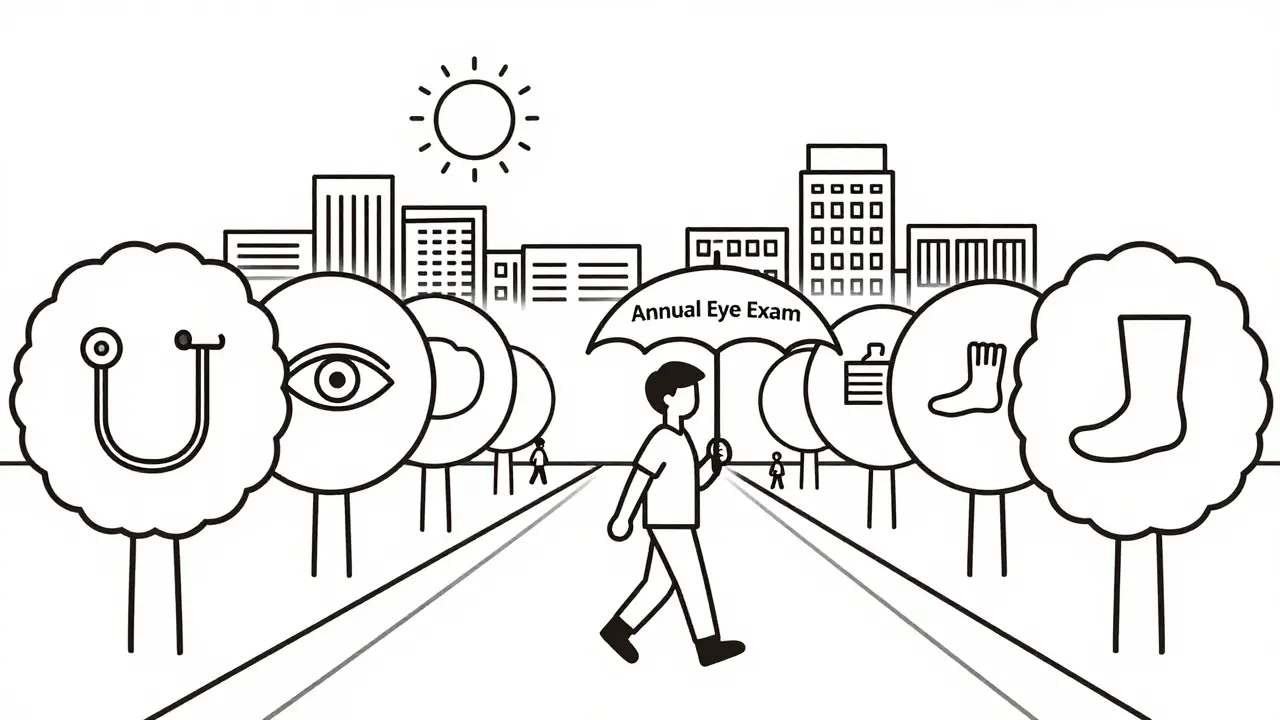
Diabetic retinopathy often has no symptoms until vision is already damaged. That’s why an annual dilated eye exam is non-negotiable.
During this exam, your eye doctor puts drops in your eyes to widen your pupils. Then they look at the back of your eye - the retina - to check for leaking blood vessels, swelling, or abnormal growths.
Here’s the powerful part: if caught early and treated, this exam can reduce your risk of blindness by 95%. That’s not a guess. That’s what the American Diabetes Association confirms. And it’s true whether you have type 1 or type 2 diabetes.
Don’t wait for blurry vision. Don’t skip it because you “see fine.” Go every year. Even if your sugar is perfect.
Move More, Eat Better, Lose Weight
You’ve heard it before - but it’s still true. Exercise and diet aren’t just for weight loss. They directly protect your organs.
Do at least 150 minutes of moderate activity each week. That’s 30 minutes, 5 days a week. Walk, swim, bike, dance - whatever gets your heart pumping. Studies show this lowers blood pressure, improves insulin sensitivity, and reduces inflammation in blood vessels.
For diet: focus on whole foods. Vegetables, lean proteins, beans, whole grains, nuts. Cut back on processed carbs, sugary drinks, and fried foods. You don’t need a fancy diet. Just eat real food.
Weight loss? Aim for 5-10% of your body weight. That’s 10-20 pounds for someone who weighs 200. That small change can cut your A1C by 0.5-1%. It lowers blood pressure. It reduces fat around your liver and kidneys. And it makes your meds work better.
Stop Smoking - It’s Not Optional
If you smoke, you’re doubling your risk of kidney disease, heart attack, stroke, and nerve damage. Smoking narrows your blood vessels. It makes it harder for oxygen to reach your tissues. It speeds up damage in your kidneys and eyes.
Quitting isn’t easy. But it’s the single most powerful thing you can do to protect your body. Talk to your doctor about nicotine replacement, counseling, or prescription aids. There’s no shame in needing help. Your future self will thank you.
Monitoring: What Tests You Need and When
Prevention isn’t guesswork. It’s tracking.
- A1C: Every 3-6 months
- Blood pressure: At every doctor visit (or monitor at home)
- Cholesterol: At least once a year
- Urine test (UACR): Once a year to check for kidney damage
- eGFR: Once a year to measure kidney function
- Dilated eye exam: Once a year
- Foot exam: At every diabetes checkup
- Dental checkup: Twice a year - gum disease worsens blood sugar control
Keep a log. Bring it to appointments. Ask your doctor: What did my last test show? What should I be watching for?
What If You’ve Already Got Damage?
Even if you’ve started to develop complications, it’s not too late. Slowing or stopping progression is still possible.
Early kidney damage? Tight blood pressure control and SGLT2 inhibitors can halt decline. Mild neuropathy? Better sugar control and foot care can prevent ulcers. Early retinopathy? Laser treatment or injections can preserve vision.
Progress isn’t always about reversal. Sometimes it’s about stopping the train before it crashes. And you’re still in control of that.
Final Thought: You’re Not Alone
Diabetes is hard. Managing all this feels overwhelming. But you’re not alone. Thousands of people with diabetes are doing this - and thriving. The decline in complications over the last 20 years proves it’s possible.
Start small. Pick one thing: check your feet every night. Schedule that eye exam. Walk 20 minutes today. Build from there. Consistency beats perfection every time.
Your body is resilient. With the right actions, you can protect your kidneys, your nerves, your eyes - and your future.
Maddi Barnes
Okay, but can we talk about how the CDC just slapped some letters together and called it a strategy? 🤦♀️ A1C, BP, cholesterol-sure, fine. But what about sleep? Stress? Gut health? Nobody talks about how chronic inflammation from bad sleep ruins everything, even if your numbers look pretty on paper. I’ve been low-carb for 7 years, walk 10k steps daily, and still got microalbuminuria at 42. So yeah, the ABCs help… but they’re not magic. Also, 🥲 I cry every time I see my foot care log. It’s like a diary of near-misses.
Courtney Hain
Let me guess-pharma companies paid the CDC to push this ‘ABC’ nonsense so they could sell you SGLT2 inhibitors for $800/month. These drugs were developed by Big Pharma to replace insulin, which they can’t patent. You know what actually prevents complications? Fasting. Intermittent fasting. Ketosis. The body heals itself when you stop flooding it with glucose. And no, I don’t have a medical degree. But I read a study on PubMed once. Also, why is everyone ignoring the glyphosate in our food? It mimics insulin resistance. The government knows. They just don’t care.
Greg Scott
This post was actually really helpful. I’ve been lazy about foot checks, but now I’m doing it every night before bed. Small wins, you know?
Davis teo
I just got my A1C down to 6.8 after 14 years of 8.5+. I did it by quitting sugar, walking 45 mins every day, and crying in the shower sometimes. But honestly? The biggest change was telling my family to stop bringing me cake on birthdays. They thought I was being ‘mean.’ Now they bring fruit. I’m not mad. I’m just… vibing. 🍑❤️
James Roberts
Wow. This is one of the most balanced, science-backed, non-dramatic diabetes posts I’ve seen in years. Seriously. Kudos. And yes, SGLT2 inhibitors are game-changers-my nephrologist called them ‘the insulin of the 2020s.’ Also, foot care isn’t optional. I lost a toe once. Not because of infection. Because I didn’t check. I thought it was ‘just a blister.’ It wasn’t. Don’t be me. 🙏
Danielle Gerrish
I’m 32, type 1 since I was 8, and I’ve had retinopathy since 22. I had laser surgery. Twice. I’ve had ulcers. I’ve been on dialysis for 8 months. I’m on the transplant list. I’m not trying to be dramatic. I’m just saying: this isn’t a ‘lifestyle tweak’ for me. This is survival. And yes, I still eat pizza. But I check my feet. Every. Single. Night. And I cry. And I keep going. If you’re reading this and you’re scared? You’re not alone. I’m here. I’m still here.
madison winter
I read the whole thing. It’s fine. I guess.
Jeremy Williams
The clinical data supporting SGLT2 inhibitors and GLP-1 agonists in renal protection is, in fact, robust. The EMPA-REG OUTCOME and CANVAS trials demonstrated statistically significant reductions in composite renal endpoints. Furthermore, the DAPA-CKD trial showed a 30% reduction in progression to end-stage kidney disease. These are not anecdotal observations; they are reproducible, peer-reviewed outcomes. One must, however, consider cost, access, and individual comorbidities before initiating therapy. A thoughtful, patient-centered approach remains paramount.
Benjamin Fox
America invented insulin. America invented the A1C test. America invented SGLT2 inhibitors. And now some guy in a lab coat tells you to walk more? LOL. We got the best healthcare system in the world. You want to live? Get a good job. Get insurance. Stop whining. 🇺🇸💪
Jonathan Rutter
You think this is hard? Try being a diabetic parent. I’ve got two kids with type 1. One’s 5. The other’s 9. I’ve woken up at 3 a.m. three nights a week for 12 years to check their glucose. I’ve cried because I couldn’t afford the pump. I’ve been yelled at by ER nurses for ‘not managing better.’ And now you want me to believe that if I just walk 30 minutes, my kidneys will be fine? Wake up. The system is rigged. The insulin prices are a crime. And your ‘ABCs’? They’re a Band-Aid on a hemorrhage.
Jana Eiffel
The notion that diabetic complications are ‘preventable’ presumes a Cartesian duality between body and will-a dangerous fiction. The body is not a machine to be optimized, but a complex, emergent system shaped by genetics, environment, trauma, and social determinants. To reduce mortality to behavioral compliance is not science-it is neoliberal ideology dressed in medical language. One cannot ‘control’ what one has not been given the means to control.
aine power
SGLT2 inhibitors. Done. Next.
Tommy Chapman
I’m not gonna lie-I used to think this was all hype. But after my uncle lost his leg? Nah. I started walking. I stopped soda. I got my eyes checked. And yeah, I’m still here. No fancy supplements. No detoxes. Just… showing up. That’s all it takes. You don’t need to be perfect. Just present. 🤝