
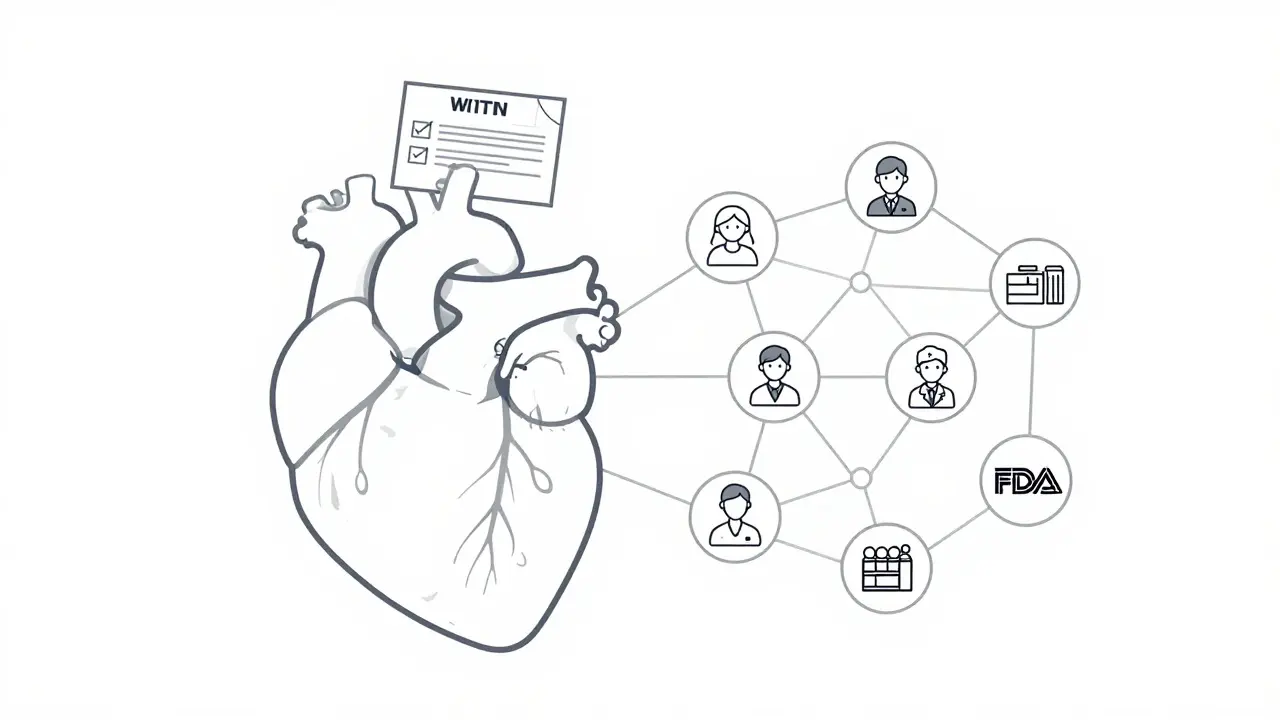
The U.S. Food and Drug Administration doesn’t just approve drugs and medical devices - it keeps watching them after they’re on the market. That’s where MedWatch comes in. It’s the FDA’s main system for collecting reports about harmful side effects, product failures, and other safety problems tied to medicines, vaccines, medical devices, and even cosmetics. Since 1993, it’s been the backbone of post-market safety monitoring in the United States. If something goes wrong after a product is sold, MedWatch is how that problem gets flagged - and sometimes, how it gets fixed.
How MedWatch Works: Two Sides of the Same Coin
MedWatch isn’t just a reporting tool. It’s also a safety alert system. On one side, it collects reports. On the other, it shares critical updates. The goal? Spot patterns early. One person reporting a bad reaction might not mean much. But if 50 people report the same issue with the same drug within a few weeks? That’s a signal. And the FDA acts.
There are two ways reports get into the system. The first is voluntary. Anyone - patients, doctors, nurses, pharmacists, or even family members - can file a report using Form FDA 3500. This form asks for basic info: what product was used, what happened, when it happened, and the outcome. You don’t need to prove the product caused the problem. You just need to describe what you saw.
The second way is mandatory. Manufacturers, importers, and hospitals that use medical devices must report certain events by law. If a device causes a death or serious injury, the company has 30 days to report it. If it’s life-threatening, they have just five workdays. These reports use Form FDA 3500B and go into a separate database called MAUDE, which tracks device-specific issues.
Every year, MedWatch gets about 1.2 million reports. Around 78% are about drugs. Medical devices make up 15%. Biologics like vaccines and blood products account for the rest. And here’s something surprising: nearly half of those reports come from patients and caregivers, not doctors. That’s because MedWatch lets regular people report - something most other countries’ systems don’t do.
What Happens After You Submit a Report?
Once a report lands in the system, it goes into the FDA Adverse Event Reporting System, or FAERS. That’s a database with over 28 million entries. But it’s not just a digital filing cabinet. FAERS uses advanced algorithms to find hidden patterns. Tools like the Proportional Reporting Ratio (PRR) and Bayesian Confidence Propagation Neural Network (BCPNN) scan for unusual spikes in certain side effects tied to specific products.
Every year, FDA analysts review about 5,000 potential safety signals. Some turn out to be noise - a coincidence. Others lead to real action. In 2021, reports of rare blood clots linked to certain textured breast implants came in fast through MedWatch. Within 45 days, the FDA issued a recall. That’s how quickly the system can move when the data points to danger.
But not every report leads to a recall. Many result in label updates. For example, a 2019 report from an oncologist about unexpected immune reactions to the cancer drug Keytruda led to a safety update added to the drug’s prescribing information. That change helped doctors monitor patients better.
According to former FDA Commissioner Dr. Janet Woodcock, MedWatch reports contributed to 37% of all FDA safety communications between 2015 and 2020. That’s not small. It’s the difference between catching a problem before it hurts hundreds - or thousands - of people.
Who Should Report, and What Makes a Good Report?
You don’t need to be a doctor to report. If you or someone you know had a bad reaction to a medication, experienced a device malfunction, or noticed an unusual side effect - file a report. Even if you’re not sure it was the product’s fault. The FDA says: when in doubt, report.
A good report has details. Not just: “I felt sick.” But: “I took Xarelto on March 12. On March 15, I started bleeding from my gums. I had no history of bleeding disorders. I was also taking aspirin daily. The bleeding stopped after I stopped the drug.” That kind of info helps analysts connect the dots.
The FDA lists six key elements for a useful report:
- Patient’s age and sex
- Name of the product (include NDC code for drugs or model number for devices)
- Exact description of the adverse event
- When the reaction started after taking the product
- Any actions taken (did you stop the drug? Go to the ER?)
- Outcome (did the person recover? Die? Have lasting damage?)
Missing any of these? The report might get tossed. A 2020 ProPublica investigation found that 17% of submissions were too vague to analyze. That’s a waste - and a missed chance to protect others.
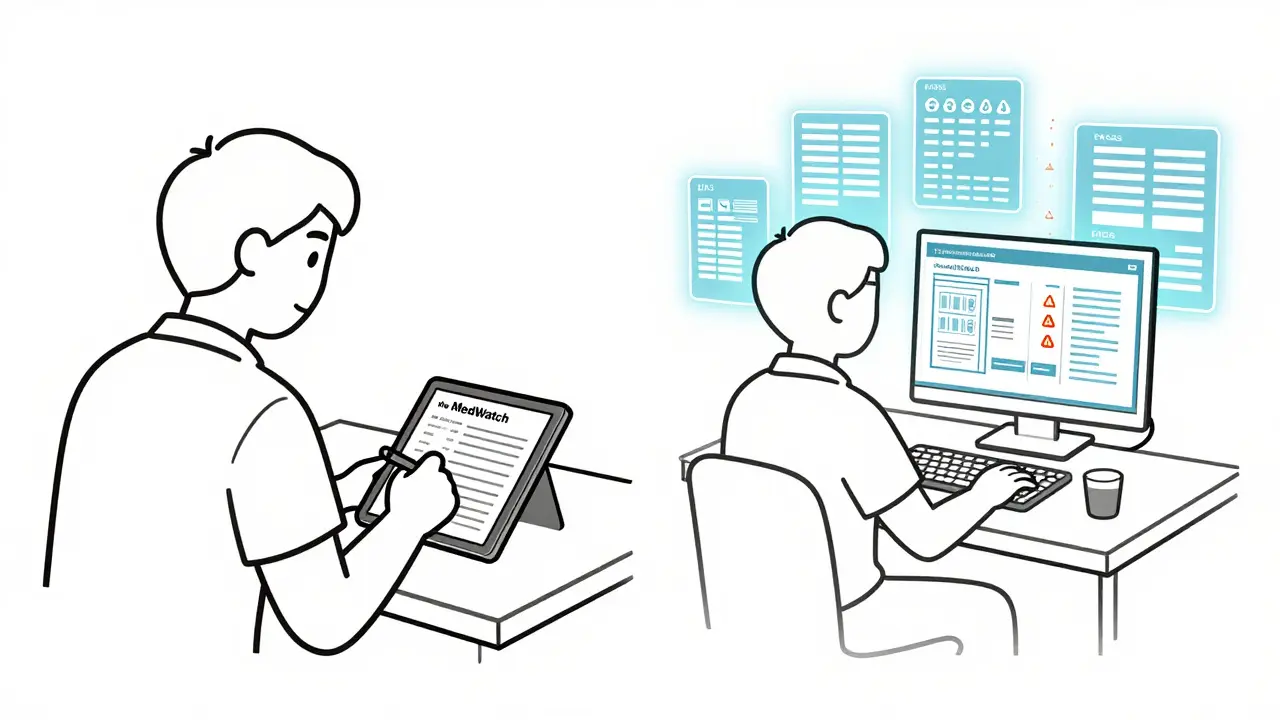
Healthcare providers face another hurdle: time. On average, filling out a report takes 15 to 20 minutes. That’s a lot when you’re already swamped. But for providers using Epic or other modern electronic health record systems, integration has cut that time to 8-12 minutes. The FDA is pushing more systems to build MedWatch reporting directly into their platforms.
The Big Problem: Underreporting
MedWatch is powerful - but it’s also broken in one major way: almost no one reports.
Studies estimate that only 1% to 10% of actual adverse events make it into the system. That means for every 100 people who have a bad reaction, only one or two file a report. Why? Patients don’t know how. Doctors are too busy. Some think it won’t matter. Others don’t realize they’re supposed to report.
The Government Accountability Office called this “a serious limitation.” Without enough data, the FDA can’t see the full picture. A drug might seem safe because few reports came in - but that could just mean no one reported.
Dr. Joel Lexchin, a professor at York University and critic of pharmaceutical oversight, puts it bluntly: “The system is only as effective as the reporting rate.” And the rate is still too low.
Even the FDA admits it. In its 2023 budget, the agency said it only has 120 full-time staff to analyze over a million reports. That’s about 8,300 reports per analyst per year. No wonder signals get missed.
What’s New? Digital Upgrades Are Coming
The FDA knows MedWatch needs modernization. In September 2023, they launched MedWatch Direct - a new API system that lets electronic health records and pharmacy software send reports automatically. Think of it like a silent alarm: when a patient has a reaction, the system flags it and sends a pre-filled report to the FDA. No manual entry needed.
By Q2 2024, the FDA plans to roll out AI tools that scan clinical notes for signs of adverse events. If a doctor writes, “Patient developed rash after starting new medication,” the AI could extract that and turn it into a report. Early tests show this could boost reporting by 25%.
Longer-term, the FDA is testing blockchain to verify report authenticity and reduce fraud. They’re also building smarter signal detection tools that could analyze data in hours instead of weeks.
But tech alone won’t fix the core problem. If patients still don’t know how to report - or think it’s pointless - the system won’t work. The FDA is working on public awareness campaigns and simpler reporting tools for non-medical users.
Why MedWatch Matters More Than You Think
MedWatch isn’t flashy. You won’t see headlines about it. But it’s one of the quietest heroes in public health. Every time a dangerous drug gets a black box warning, a faulty device gets recalled, or a vaccine label gets updated - MedWatch was likely part of the reason.
It’s not perfect. It’s underfunded. It’s underused. But it’s the only system that lets you - yes, you - help protect others. You don’t need to be a scientist. You don’t need to know medical jargon. Just tell the truth about what happened.
And if you’re a healthcare worker? Reporting isn’t optional. It’s part of your duty. One report might not change the world. But 10,000 reports? That’s how safety improves.
How to Report to MedWatch
Reporting is free and easy. Here’s how:
- Go to www.fda.gov/medwatch
- Click “Report a Problem”
- Choose whether you’re a consumer or a professional
- Fill out the online form (or download Form FDA 3500)
- Submit via web, fax (1-800-FDA-0178), mail, or phone (1-800-FDA-1088)
Need help? The FDA offers a 24/7 hotline with an average wait time of 47 seconds. They also have free webinars and downloadable guides. The 127-page “MedWatch Voluntary Reporting Guidelines” is your cheat sheet - and it’s all free.
What MedWatch Can’t Do
MedWatch doesn’t prove causation. It doesn’t replace clinical trials. It doesn’t guarantee immediate action. And it can’t fix systemic problems like drug pricing or access.
It’s a detection tool - not a solution engine. It spots the warning signs. Then the FDA decides what to do. Sometimes that’s a warning label. Sometimes it’s a recall. Sometimes it’s nothing - because the signal fades. But without MedWatch, you’d never know.
Who can report to MedWatch?
Anyone can report to MedWatch - patients, family members, healthcare providers, pharmacists, and even manufacturers. You don’t need to be a medical professional. If you suspect a medicine, device, or cosmetic caused a problem, you can and should report it.
Is MedWatch the same as MAUDE?
No. MedWatch is the overall program for reporting safety issues with all FDA-regulated products. MAUDE (Manufacturer and User Facility Device Experience) is a specific database within MedWatch that collects reports only for medical devices. So all device reports go into MAUDE, but MedWatch also handles drugs, vaccines, and cosmetics.
Do I need to prove the product caused the problem to report?
No. You don’t need to prove causation. The FDA asks you to report any serious adverse event, product use error, or quality issue - even if you’re unsure whether the product caused it. The agency’s analysts will investigate whether there’s a link.
How long does it take for the FDA to act on a MedWatch report?
There’s no fixed timeline. Some reports lead to quick action - like the 2021 breast implant recall, which happened within 45 days of a signal being detected. Others take months or years, especially if the issue is rare or complex. The FDA analyzes patterns, not single reports, so it often takes multiple similar reports before action is taken.
Can I report a problem with an over-the-counter medicine or supplement?
Yes. MedWatch accepts reports on all FDA-regulated products, including over-the-counter drugs, dietary supplements, cosmetics, and even tobacco products. If you had a bad reaction to something you bought at the drugstore, you can report it.
Are MedWatch reports anonymous?
Yes, you can report anonymously. The FDA does not require your name or contact info. But if you want to be contacted for follow-up questions, you can leave your details. Most healthcare providers include their info so they can be reached if more data is needed.
What if I made a mistake on my report?
You can submit a corrected report. Just include the original report number if you have it, and note that this is an update. The FDA’s system tracks versions, so they’ll see the correction. Don’t worry about getting it perfect the first time - better to report something incomplete than nothing at all.
Can I report a problem with a product bought outside the U.S.?
Yes. MedWatch accepts international reports if the product is FDA-regulated and available in the U.S. market. For example, if you bought a U.S.-approved drug while traveling and had a reaction, you can report it. But if the product was never approved by the FDA, it won’t be tracked through MedWatch.


Alexandra Enns
Let’s be real-this whole MedWatch system is a joke. The FDA has 120 analysts for a MILLION reports? That’s like putting one cop on duty for a city of 8 million people. And don’t even get me started on how they still use FORMS. In 2024? We’re talking about AI, blockchain, and real-time alerts-and they’re still begging people to fax in their symptoms. This isn’t public health-it’s bureaucratic performance art.
Marie-Pier D.
Thank you for writing this!! 🙏 I reported my mom’s reaction to her new blood pressure med last year-no idea if it mattered, but I felt like I had to try. You’re right: even if you’re not a doctor, your story counts. I cried when I hit submit. Not because I was scared-but because I finally felt like I wasn’t alone in this mess. 💙
venkatesh karumanchi
Interesting. In India, we don’t have anything like this. If a drug makes you sick, you just stop taking it. No one reports. No one cares. Maybe that’s why so many people here get hurt by cheap generics. We need systems like this-even if they’re flawed. Better than nothing.
Kevin Waters
One thing people don’t realize: MedWatch isn’t meant to prove causation-it’s meant to find signals. Think of it like a smoke detector. You don’t wait for the house to burn down before you check the alarm. Same here. The fact that 50% of reports come from patients? That’s a win. We just need more of them.
Kat Peterson
OMG I just read this and I’m literally shaking. 😭 Like… I took that one antidepressant for 3 days and my tongue swelled up? I thought it was allergies. I didn’t report it because I thought ‘it was probably just me.’ Now I feel like a terrible human. I’m submitting it RIGHT NOW. #MedWatchNow
Izzy Hadala
It is worth noting that the Proportional Reporting Ratio (PRR) and Bayesian Confidence Propagation Neural Network (BCPNN) methodologies employed by FAERS are statistically robust for signal detection, though they remain susceptible to reporting bias and confounding factors. The absence of a standardized control population introduces inherent limitations in causal inference. Further longitudinal integration with EHRs may mitigate these concerns.
Elizabeth Cannon
why do docs make this so hard?? i filled out the form and it asked for the NDC code like i’m some kind of pharmacist 😤 i just know the pill was blue and said ‘Lipitor’ on it. i had to google it. if you’re trying to get more people to report, maybe make the form less like a med school final??
Shelby Marcel
so i reported my dads heart palpitations after his new chemo drug… and then i got an email saying ‘your report has been received’ and that was it. no follow up. no ‘thank you’. i felt like i just yelled into a void. is this even doing anything??
blackbelt security
My company uses Epic. We’ve got a one-click MedWatch button built right into the patient chart. Takes 90 seconds. No excuse anymore. If you’re a provider and you’re not reporting, you’re part of the problem.
Patrick Gornik
MedWatch is a postmodern monument to institutional failure-a digital altar where the faithful deposit their suffering, hoping the gods of bureaucracy will notice. But the gods are asleep. They’re sipping lattes while algorithms crunch data that no one reads. We’ve turned collective trauma into a KPI. The system doesn’t protect us-it pacifies us. It makes us feel like we’ve done our part… while the real power remains untouched. The real question isn’t how to improve reporting-it’s whether we’ve become too numb to care anymore.
Tommy Sandri
While the U.S. MedWatch system represents a significant advancement in pharmacovigilance, it is instructive to compare it with the European EudraVigilance system, which mandates structured electronic reporting from all marketing authorization holders. The absence of such a universal mandate in the U.S. contributes to the disparity in reporting rates and analytical depth.
Juan Reibelo
As a nurse who’s filed over 20 reports… I’ll say this: if you’re waiting for a perfect report, you’re never going to submit one. I’ve sent in half-baked, typo-filled, tear-stained forms. And guess what? They still got used. The FDA doesn’t need perfection-they need truth. So just… tell your story. Even if it’s messy.
Luke Davidson
My sister had a seizure after a new migraine med. We didn’t know what to do. We called the 1-800 number and the lady on the other end cried with us. She said, ‘Thank you for calling. This is why we do this.’ I didn’t know reports could feel like human connection. I’m telling everyone.
Karen Conlin
Here’s the thing: MedWatch is the only system where a 72-year-old grandma in Ohio can help stop a dangerous drug from killing someone in Texas. No degrees needed. No lab coat. Just honesty. That’s powerful. And if you think your report won’t matter? You’re wrong. One report starts a chain. Chains become waves. Waves become change. So go. Report. Now.